


Sriram Sanka

Databases | Cloud | Infrastructure | Security |

Archive for the ‘Compute’ Category

Serverless Application Repository Deep Dive: Architecture, Security, Cost & Operations

Posted by Sriram Sanka on August 18, 2026

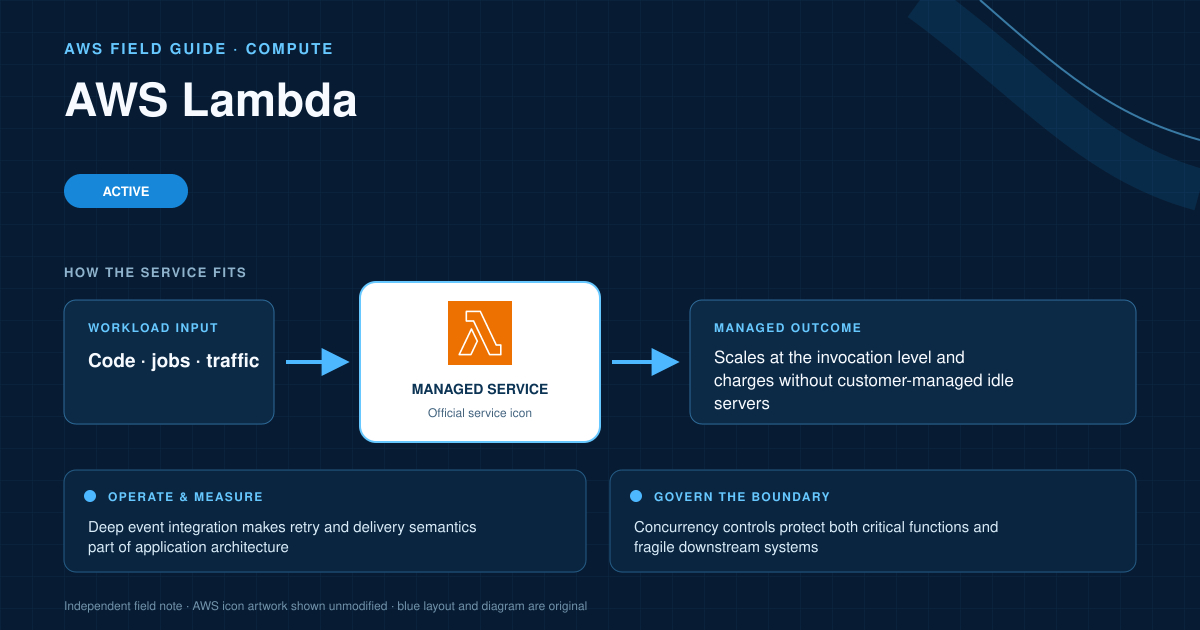
AWS Serverless Application Repository architecture diagram
AWS Serverless Application Repository architecture and operating-boundary overview.

The AWS Serverless Application Repository is a catalog and distribution channel for applications defined with AWS SAM. Publishers can version and share reusable serverless patterns publicly, privately, or across an organization; consumers can inspect and deploy those templates as CloudFormation-managed resources.

Distributes versioned AWS SAM applications through public or private policies
Consumer deployment produces ordinary CloudFormation-managed resources in their account
Trust, permissions, upgrades, and publisher ownership determine whether reuse is safe
Field note 01

The short version

The AWS Serverless Application Repository is a catalog and distribution channel for applications defined with AWS SAM. Publishers can version and share reusable serverless patterns publicly, privately, or across an organization; consumers can inspect and deploy those templates as CloudFormation-managed resources.

The repository is most valuable as a governed product catalog, not as a one-click shortcut around architecture review. Reuse can compress months of repeated work, but a deployed application still introduces code, IAM permissions, data flows, update obligations, and CloudFormation ownership into the consumer account. Trust, provenance, version policy, and maintainership matter as much as the template’s functionality.

The practical decision is not whether Serverless Application Repository is powerful. It is whether its operating model fits the system and the team. It is best suited to internal platform components, standardized event processors, organization-wide serverless patterns, reference implementations, public developer tools, and reusable AWS SAM applications with clear parameters, permissions, documentation, and lifecycle ownership. It is usually a poor fit for opaque third-party packages, rapidly changing internal code better delivered through a normal monorepo, applications whose consumers require heavy forks, or any component that lacks an accountable publisher and a safe update and retirement process. That boundary should be written into the architecture decision so later growth does not turn an intentional choice into accidental lock-in.

Field note 02

Build the right mental model

A repository application is a versioned AWS SAM template plus metadata such as name, description, labels, source URL, license, readme, author, and semantic version. The template declares Lambda functions and other AWS resources that CloudFormation will create. An application policy determines whether it is private, shared with specified accounts or an AWS Organization, or public. Consumers review the declared capabilities and parameters, then create a CloudFormation change set and stack. The catalog distributes a deployment definition; it does not host a runtime of its own.

Publishers package referenced artifacts, validate the SAM template, publish immutable application versions, and set sharing policy. Public applications require additional metadata and source visibility. Consumers browse by name, publisher, category, or event source, examine the template and readme, supply parameters, acknowledge required capabilities, and deploy. Updating is a new deployment of a newer version against the existing stack name. Because resources are CloudFormation-managed, out-of-band changes create drift and can complicate update or deletion.

Separate the control plane from the data plane in both design and incident response. The control plane creates configuration and desired state; the data plane carries production work. A deployment API succeeding does not prove that traffic, jobs, or events are healthy. Conversely, a transient control-plane problem should not automatically stop already-running work. Document which APIs are needed during steady state, which are needed only for change, and which dependencies sit on the critical request path.

Make ownership boundaries visible. Identity, network reachability, encryption keys, artifacts, telemetry, quotas, and billing dimensions frequently belong to different teams. A service can be technically managed while the surrounding system remains unmanaged. Name an owner for the application, the platform configuration, the data, the recovery procedure, and the cost model. That simple map prevents the most common failure mode in cloud programs: assuming an abstraction transferred a responsibility that it only moved.

Field note 03

Where it earns its keep

The strongest Serverless Application Repository architectures begin with a workload whose constraints align with the service. The following patterns are starting points, not product marketing categories. Each still needs an explicit data model, failure model, and ownership model.

Do not choose a cloud service from the deployment demo alone. A demo proves that the happy path exists; an architecture decision must explain day-two change, degraded dependencies, recovery, security evidence, and cost under real load. For Serverless Application Repository, those questions reveal whether the service removes undifferentiated work or merely postpones it.

  • Internal golden patterns: Approved APIs, processors, alarms, and event integrations can be published once with organizational security and observability defaults.
  • Developer ecosystem tools: Public publishers can distribute complete serverless utilities with source, documentation, parameters, and automated deployment.
  • Cross-account platform components: Private sharing can make versioned capabilities available to many accounts while preserving consumer-owned runtime resources.
Field note 04

Architecture moves that age well

A useful reference architecture is a set of constraints with reasons, not a diagram crowded with service icons. Start with the moves below, assign an owner to each, and encode the ones that can be enforced. Exceptions should include an expiration date and a test that proves why the normal path does not work.

Start capacity work with a workload model rather than a product limit table. Capture arrival rate, concurrency, duration, payload size, state size, latency objective, recovery objective, and acceptable interruption. Measure percentiles and saturation, not just averages. Then test the model with production-like traffic and failure injection. Service quotas are guardrails and ceilings; they are not a substitute for understanding how a dependency behaves as demand approaches its own boundary.

  • Publish change sets, permission explanations, cost drivers, and lifecycle policy with every application.
  • Use organization-aware sharing and a controlled publisher account for internal platform products.
  • Test install, upgrade, rollback, and deletion in clean accounts across supported regions.
  • Track deployed versions so security notices and deprecations can reach actual consumers.
Field note 05

Scaling and performance

The repository does not scale application traffic; the resources in the SAM template do. A reusable component must expose the correct concurrency, memory, timeout, batching, retention, encryption, and data-store parameters without overwhelming consumers. Defaults should be safe at both small and meaningful scale. Publishers need tests that deploy into clean accounts and regions, exercise quota and failure behavior, and verify deletion. Artifact availability and regional support should be explicit. A template that deploys is only the first stage of a scalable product.

Start capacity work with a workload model rather than a product limit table. Capture arrival rate, concurrency, duration, payload size, state size, latency objective, recovery objective, and acceptable interruption. Measure percentiles and saturation, not just averages. Then test the model with production-like traffic and failure injection. Service quotas are guardrails and ceilings; they are not a substitute for understanding how a dependency behaves as demand approaches its own boundary.

Performance tuning must preserve correctness. Optimize the slowest meaningful business path, verify the change against a representative distribution, and watch for work displaced into queues, retries, caches, or operators. With Serverless Application Repository, a lower service-level latency can still create a worse system if downstream saturation, recovery backlog, or cost per completed transaction rises. Keep load-test artifacts and capacity assumptions versioned beside the architecture.

Field note 06

Security and governance

Review every resource, IAM statement, layer, image, artifact location, network path, and parameter before deployment. Repository publication blocks certain overly broad IAM patterns, but that is a floor rather than a complete review. Prefer publisher accounts with controlled CI/CD, signed commits or artifacts where available, dependency scanning, and immutable storage. Share internal applications through organization-aware policies. Consumers should create and inspect change sets, constrain deployment roles, apply organization guardrails, and monitor the resulting resources like any other production stack.

Use least privilege as an engineering process, not a one-time IAM document. Begin with separate human, deployment, and runtime identities. Observe required actions, narrow resources and conditions, and add explicit organization guardrails for high-impact operations. Encrypt data in transit and at rest, but also design key ownership, rotation, deletion protection, and break-glass access. Centralize audit records in an account and storage boundary that a compromised workload cannot rewrite.

Threat-model Serverless Application Repository across four surfaces: the management API, the workload’s runtime identity, the network and event inputs that reach it, and the software or configuration artifact that is deployed. Add the data stores and observability pipeline as separate trust boundaries. Preventive controls reduce the reachable state space; detective controls shorten time to evidence; recovery controls make destructive events survivable. A mature design has all three and tests them independently.

Governance should make the secure path faster. Provide approved modules, narrowly scoped roles, standard encryption and logging defaults, ownership tags, and automated evidence. Block dangerous configurations at the organization or pipeline boundary when the intent is unambiguous. Leave application teams enough room to tune the workload without letting every team invent identity, ingress, logging, and incident access from scratch.

Field note 07

Reliability and recovery

A published application needs release notes, backward-compatible parameter evolution, tested upgrades, rollback guidance, and an end-of-support policy. CloudFormation can roll back failed infrastructure changes, but it cannot automatically reverse data migrations or external side effects. Design updates so old and new versions can coexist during transition. Test fresh install, upgrade from supported versions, failed update, stack import or drift where relevant, and clean removal. Preserve source and artifacts for every supported version so a recovery is not dependent on a mutable latest package.

Define failure in business terms before selecting a recovery mechanism. Availability, durability, recovery time, and recovery point are different objectives. Multi-zone placement improves some infrastructure failures but does not repair corrupt deployments or deleted data. Backups address some data events but do not guarantee a runnable application. Use layered controls: health-based replacement, redundancy, deployment rollback, data protection, quota monitoring, and a rehearsed regional or organizational recovery path where the business requires one.

Write failure-mode tests for Serverless Application Repository before the first serious incident. Include unavailable capacity, throttled control APIs, expired credentials, bad configuration, dependency timeout, partial deployment, telemetry loss, and operator error. Test what happens to in-flight work, how the system detects the condition, who is paged, and how replay or rollback avoids duplicate effects. Recovery time measured in a game day is more credible than recovery time copied from a diagram.

Keep the recovery path simpler than the primary path. If restoration depends on the same identity, network, artifact repository, region, or specialist that the incident removed, it is not independent. Store runbooks where responders can reach them, pre-authorize narrowly scoped emergency actions, and verify backups by restoring into an isolated environment. Record the achieved recovery point and time so business owners can compare evidence with policy.

Field note 08

Cost and capacity economics

Publishing and discovery are only a small part of economics; deployed resources create the meaningful bill. Document a representative low, typical, and high workload cost, including logs, transfer, NAT, storage, queues, APIs, and provisioned capacity. Consumers should see which parameters drive spend. Internal catalogs can reduce engineering duplication and security review cost, but only if shared components remain supported. An abandoned common module creates organization-wide upgrade labor that can outweigh its original reuse benefit.

Evaluate unit economics at the level customers consume: cost per request, job, simulation, tenant, build, or environment. Tagging helps allocation, but architecture determines most spend. Include idle baseline, burst premium, storage growth, log retention, data transfer, support, licenses, and operator time. Rate discounts should follow rightsizing and workload-shape work. A commitment applied to the wrong baseline converts an optimization opportunity into a contract.

Create a cost model for Serverless Application Repository with a low, expected, and stress scenario. Tie every variable to a measurable workload characteristic and identify which team can influence it. Alarm on anomalous unit cost as well as total spend; total spend naturally rises with successful products, while unit cost exposes architectural drift. Review unused capacity and retained artifacts on a schedule, and give every long-lived resource an owner and lifecycle policy.

Optimization should preserve reliability margins. Removing all idle capacity, shortening every retention period, or consolidating every boundary may lower a spreadsheet while increasing incident probability and recovery time. Price the resilience requirement explicitly. Then apply the least risky lever first: eliminate waste, rightsize, improve utilization, reduce unnecessary transfer, select the correct purchasing model, and only then make longer commitments.

Field note 09

Operating it in production

Run internal applications as products with owners, support channels, changelogs, vulnerability response, compatibility matrices, and usage inventory. Automate packaging, validation, multi-account deployment tests, policy checks, and publication. Tag created resources and expose outputs that make integration clear. Notify consumers of security and lifecycle changes; do not rely on them discovering a new catalog version. Keep telemetry useful but avoid centralizing customer data into the publisher account unless the contract and privacy model require it.

Treat configuration as versioned product code. Changes should pass static checks, policy checks, integration tests, and an environment that resembles production. Promote the same artifact; do not rebuild it differently at every stage. Prefer gradual exposure, observable health gates, and automated rollback for reversible changes. For irreversible data or identity changes, use expansion-and-contraction patterns and explicit checkpoints. Record who changed what, why, and which measured signal declared the change safe.

Build one operational view that links Serverless Application Repository health to customer outcomes. Infrastructure metrics explain resources, application metrics explain behavior, traces explain selected paths, and logs provide detailed evidence. None is sufficient alone. Define symptom-based alerts around availability, latency, backlog, freshness, correctness, and saturation; route them to an accountable team; and attach the first diagnostic action. Remove alerts that never change a decision.

Run a monthly service review until the platform is boring. Examine incidents, near misses, failed changes, quota headroom, runtime or image lifecycle, cost per unit, access exceptions, recovery evidence, and support announcements. Convert repeated manual actions into automation only after the team understands the decision being automated. Good operations reduce surprise without hiding state from the people accountable for it.

Field note 10

Failure patterns to avoid

Most expensive mistakes are reasonable shortcuts that survived beyond their original context. Treat these risks as design-review prompts. Ask which control detects each condition, how quickly the team can recover, and whether the workload can be moved or reshaped before the risk becomes a constraint.

A risk register is useful only when it changes action. Give each item an owner, leading indicator, mitigation, and review date. If a risk is accepted, record the business reason. If it is mitigated, test the mitigation. If it is transferred to a managed service, verify the exact responsibility that moved instead of assuming the service name moved all of it.

  • One-click deployment encourages consumers to skip template and IAM review.
  • Mutable external artifacts can change what a supposedly versioned application deploys.
  • Breaking parameter or data changes make CloudFormation rollback insufficient.
  • Unowned internal applications turn reuse into a distributed maintenance liability.
Field note 11

Alternatives and the decision

A source repository shares code; the Serverless Application Repository shares a deployable, versioned SAM product. CloudFormation registries and Service Catalog serve broader infrastructure resource and governed product needs. Container registries distribute images without the surrounding application graph. Lambda layers share dependencies but can create runtime coupling. SAR is the right layer when the reusable unit is a serverless application and CloudFormation ownership is acceptable to both publisher and consumer.

Use the repository to make good architecture repeatable, not to make review optional. Begin with a small set of high-value patterns that have real maintainers and clear consumers. Publish conservative defaults, transparent permissions, source, tests, costs, update notes, and deprecation dates. A catalog with five trusted applications is more valuable than a marketplace of fifty unowned templates. Reuse becomes leverage only when lifecycle responsibility scales with adoption.

Use a short proof of architecture when uncertainty is material. Test the hardest requirement, the most important failure mode, and the expected cost driver—not another hello-world deployment. Compare Serverless Application Repository with the strongest alternative using the same workload and evidence. Record the decision, rejected options, assumptions, migration trigger, and date for review. Architecture remains healthy when a future team can understand both why the choice was correct and which changed fact would make it wrong.

Field note 12

A pragmatic 90-day adoption plan

Days 1–15: define the workload and responsibility map. Capture traffic or job shape, data sensitivity, availability and recovery objectives, latency, unit economics, dependencies, regional constraints, and team ownership. Build a thin threat model and request quota changes early. Select one representative path for the proof, not the easiest path. Establish a clean account, identity, network, artifact, encryption, and logging baseline before application convenience creates permanent exceptions.

Days 16–35: implement a production-shaped walking skeleton on Serverless Application Repository. Provision it from code, deploy an immutable artifact, integrate one real dependency, emit structured telemetry, and prove that a new team member can reproduce the environment. Exercise duplicate work, bad input, dependency timeout, and lost capacity. Measure cold and warm behavior where relevant, saturation, recovery backlog, and cost per successful business unit.

Days 36–60: harden delivery and recovery. Add policy checks, staged promotion, rollback or replacement, least-privilege runtime identity, secret rotation, data protection, retention, and symptom-based alerts. Restore from backup or recreate from artifacts in an isolated environment. Run a game day that includes an operator mistake and a compromised credential. Convert the findings into platform defaults and owned backlog items rather than a slide deck.

Days 61–90: place controlled production load on the service, review evidence with security, finance, and operations, and compare observed behavior with the original decision. Publish a paved-road module, dashboard, runbook, and exception process. Set capacity and cost review thresholds. Finally, write the exit criteria: the scale, feature, compliance need, economics, or organizational change that would trigger a move away from Serverless Application Repository. A reversible decision is easier to make well.

Posted in Compute | Tagged: , , , , , , , , , , , , | Leave a Comment »

AWS Elastic Beanstalk Deep Dive: Architecture, Security, Cost & Operations

Posted by Sriram Sanka on August 18, 2026

AWS Elastic Beanstalk architecture diagram
AWS Elastic Beanstalk architecture and operating-boundary overview.

Elastic Beanstalk turns an application source bundle or container into a managed web or worker environment, provisioning EC2, load balancing, health reporting, Auto Scaling, and supporting resources in the customer’s account. It offers a PaaS-like workflow without making the underlying infrastructure invisible.

Deploys supported application platforms while provisioning familiar AWS resources
Web and worker environments cover synchronous applications and SQS-backed processing
Platform lifecycle and deployment policy are central production design decisions
Field note 01

The short version

Elastic Beanstalk turns an application source bundle or container into a managed web or worker environment, provisioning EC2, load balancing, health reporting, Auto Scaling, and supporting resources in the customer’s account. It offers a PaaS-like workflow without making the underlying infrastructure invisible.

Beanstalk fits teams that want a conventional application runtime and a guided environment lifecycle while retaining access to the AWS resources underneath. Its opinionated platform branches reduce assembly work, but production teams must still manage platform upgrades, environment configuration, database lifecycle, deployment safety, and the cost and security of the resources it creates.

The practical decision is not whether Elastic Beanstalk is powerful. It is whether its operating model fits the system and the team. It is best suited to traditional web applications and background workers in supported Go, Java, .NET, Node.js, PHP, Python, Ruby, or Docker platforms, especially when the team prefers source-oriented deployments and needs more infrastructure visibility than a fully abstracted web service. It is usually a poor fit for large microservice estates, applications that need Kubernetes APIs, event functions, unusual host topologies, independent scaling of many components, or teams that already have a mature ECS, EKS, or internal platform delivery model. That boundary should be written into the architecture decision so later growth does not turn an intentional choice into accidental lock-in.

Field note 02

Build the right mental model

A Beanstalk application is a logical container for application versions and environments. An environment runs a selected platform branch and version as either a web-server tier or worker tier. A load-balanced web environment typically creates a CloudFormation stack containing an Auto Scaling group, EC2 instances, load balancer, security groups, monitoring, and related configuration. A worker environment consumes messages from SQS through a daemon and forwards them to the application. Beanstalk coordinates these resources but they remain visible, billable, and subject to account policy.

Developers upload a version, provide environment settings, and choose a deployment policy. Beanstalk stages the bundle, updates instances, evaluates health, and exposes events and status. Configuration can live in saved settings, environment variables, option settings, and .ebextensions or platform hooks. Managed platform updates can apply supported operating-system and runtime patches within configured maintenance windows. Blue/green deployment uses two environments and a URL swap; rolling and immutable policies trade capacity, speed, and risk differently. RDS databases are safest when managed outside the environment lifecycle.

Separate the control plane from the data plane in both design and incident response. The control plane creates configuration and desired state; the data plane carries production work. A deployment API succeeding does not prove that traffic, jobs, or events are healthy. Conversely, a transient control-plane problem should not automatically stop already-running work. Document which APIs are needed during steady state, which are needed only for change, and which dependencies sit on the critical request path.

Make ownership boundaries visible. Identity, network reachability, encryption keys, artifacts, telemetry, quotas, and billing dimensions frequently belong to different teams. A service can be technically managed while the surrounding system remains unmanaged. Name an owner for the application, the platform configuration, the data, the recovery procedure, and the cost model. That simple map prevents the most common failure mode in cloud programs: assuming an abstraction transferred a responsibility that it only moved.

Field note 03

Where it earns its keep

The strongest Elastic Beanstalk architectures begin with a workload whose constraints align with the service. The following patterns are starting points, not product marketing categories. Each still needs an explicit data model, failure model, and ownership model.

Do not choose a cloud service from the deployment demo alone. A demo proves that the happy path exists; an architecture decision must explain day-two change, degraded dependencies, recovery, security evidence, and cost under real load. For Elastic Beanstalk, those questions reveal whether the service removes undifferentiated work or merely postpones it.

  • Conventional web applications: Django, Rails, Spring, Express, ASP.NET, PHP, and Go services can use familiar runtime and reverse-proxy patterns.
  • Queue-backed workers: SQS-integrated worker environments support asynchronous and long-running application tasks outside the request path.
  • Migration landing zones: Existing applications can reach a managed, autoscaled environment before a team decides whether deeper container or serverless modernization is valuable.
Field note 04

Architecture moves that age well

A useful reference architecture is a set of constraints with reasons, not a diagram crowded with service icons. Start with the moves below, assign an owner to each, and encode the ones that can be enforced. Exceptions should include an expiration date and a test that proves why the normal path does not work.

Start capacity work with a workload model rather than a product limit table. Capture arrival rate, concurrency, duration, payload size, state size, latency objective, recovery objective, and acceptable interruption. Measure percentiles and saturation, not just averages. Then test the model with production-like traffic and failure injection. Service quotas are guardrails and ceilings; they are not a substitute for understanding how a dependency behaves as demand approaches its own boundary.

  • Externalize databases and durable state so an environment can be replaced or deleted safely.
  • Prefer blue/green or immutable change for critical systems and keep schema changes backward compatible.
  • Version environment settings and platform hooks alongside the application artifact.
  • Treat supported platform updates as a tested release train, not background maintenance.
Field note 05

Scaling and performance

Auto Scaling settings determine minimum and maximum instances and the metrics that change capacity. The application must be horizontally safe: sessions, uploads, locks, and job state should not live only on one instance. Load-balancer health, enhanced Beanstalk health, application readiness, and deployment health gates should agree. Platform hooks and bootstrap must finish predictably because every replacement instance repeats them. For workers, queue depth, message age, visibility timeout, and application concurrency form the scaling loop. Test deployments at maximum scale, not only on one development instance.

Start capacity work with a workload model rather than a product limit table. Capture arrival rate, concurrency, duration, payload size, state size, latency objective, recovery objective, and acceptable interruption. Measure percentiles and saturation, not just averages. Then test the model with production-like traffic and failure injection. Service quotas are guardrails and ceilings; they are not a substitute for understanding how a dependency behaves as demand approaches its own boundary.

Performance tuning must preserve correctness. Optimize the slowest meaningful business path, verify the change against a representative distribution, and watch for work displaced into queues, retries, caches, or operators. With Elastic Beanstalk, a lower service-level latency can still create a worse system if downstream saturation, recovery backlog, or cost per completed transaction rises. Keep load-test artifacts and capacity assumptions versioned beside the architecture.

Field note 06

Security and governance

Use distinct service and EC2 instance roles, narrow both, and keep application secrets out of committed configuration. Run instances in private subnets with controlled egress where feasible, terminate TLS with managed certificates, encrypt volumes and logs, and require IMDSv2 through launch configuration. Review every extension and platform hook because it executes with instance-level privilege. Standardize supported platform branches and retire deprecated versions. CloudFormation visibility helps governance only when security teams monitor the generated resources and prevent unsafe configuration drift.

Use least privilege as an engineering process, not a one-time IAM document. Begin with separate human, deployment, and runtime identities. Observe required actions, narrow resources and conditions, and add explicit organization guardrails for high-impact operations. Encrypt data in transit and at rest, but also design key ownership, rotation, deletion protection, and break-glass access. Centralize audit records in an account and storage boundary that a compromised workload cannot rewrite.

Threat-model Elastic Beanstalk across four surfaces: the management API, the workload’s runtime identity, the network and event inputs that reach it, and the software or configuration artifact that is deployed. Add the data stores and observability pipeline as separate trust boundaries. Preventive controls reduce the reachable state space; detective controls shorten time to evidence; recovery controls make destructive events survivable. A mature design has all three and tests them independently.

Governance should make the secure path faster. Provide approved modules, narrowly scoped roles, standard encryption and logging defaults, ownership tags, and automated evidence. Block dangerous configurations at the organization or pipeline boundary when the intent is unambiguous. Leave application teams enough room to tune the workload without letting every team invent identity, ingress, logging, and incident access from scratch.

Field note 07

Reliability and recovery

Treat an environment as replaceable. Blue/green deployment offers the clearest rollback boundary when schema and external dependencies remain compatible. Immutable deployments create a fresh instance set and reduce in-place mutation risk but temporarily increase capacity. Rolling policies trade some exposure and capacity. Keep databases, durable files, queues, DNS, and secrets independent from environment deletion. Configure health checks against real readiness, test instance replacement, and preserve enough old application versions for rollback without retaining artifacts indefinitely.

Define failure in business terms before selecting a recovery mechanism. Availability, durability, recovery time, and recovery point are different objectives. Multi-zone placement improves some infrastructure failures but does not repair corrupt deployments or deleted data. Backups address some data events but do not guarantee a runnable application. Use layered controls: health-based replacement, redundancy, deployment rollback, data protection, quota monitoring, and a rehearsed regional or organizational recovery path where the business requires one.

Write failure-mode tests for Elastic Beanstalk before the first serious incident. Include unavailable capacity, throttled control APIs, expired credentials, bad configuration, dependency timeout, partial deployment, telemetry loss, and operator error. Test what happens to in-flight work, how the system detects the condition, who is paged, and how replay or rollback avoids duplicate effects. Recovery time measured in a game day is more credible than recovery time copied from a diagram.

Keep the recovery path simpler than the primary path. If restoration depends on the same identity, network, artifact repository, region, or specialist that the incident removed, it is not independent. Store runbooks where responders can reach them, pre-authorize narrowly scoped emergency actions, and verify backups by restoring into an isolated environment. Record the achieved recovery point and time so business owners can compare evidence with policy.

Field note 08

Cost and capacity economics

There is no magic PaaS bundle: EC2, load balancers, EBS, NAT, data transfer, logs, databases, and other generated resources determine cost. Development environments often carry a full load-balancer and instance baseline even when idle. Use single-instance environments only where their reliability tradeoff is explicit. Right-size instance families, scale nonproduction down, review log and application-version retention, and calculate the temporary capacity required by immutable or rolling-with-additional-batch deployments. Platform convenience should be compared with its resource floor.

Evaluate unit economics at the level customers consume: cost per request, job, simulation, tenant, build, or environment. Tagging helps allocation, but architecture determines most spend. Include idle baseline, burst premium, storage growth, log retention, data transfer, support, licenses, and operator time. Rate discounts should follow rightsizing and workload-shape work. A commitment applied to the wrong baseline converts an optimization opportunity into a contract.

Create a cost model for Elastic Beanstalk with a low, expected, and stress scenario. Tie every variable to a measurable workload characteristic and identify which team can influence it. Alarm on anomalous unit cost as well as total spend; total spend naturally rises with successful products, while unit cost exposes architectural drift. Review unused capacity and retained artifacts on a schedule, and give every long-lived resource an owner and lifecycle policy.

Optimization should preserve reliability margins. Removing all idle capacity, shortening every retention period, or consolidating every boundary may lower a spreadsheet while increasing incident probability and recovery time. Price the resilience requirement explicitly. Then apply the least risky lever first: eliminate waste, rightsize, improve utilization, reduce unnecessary transfer, select the correct purchasing model, and only then make longer commitments.

Field note 09

Operating it in production

Pin an approved platform branch, schedule updates, and test new platform versions in a clone before production. Keep environment configuration in source control and minimize console-only changes. Use EB CLI or CI/CD for consistent version promotion, and record which artifact reached each environment. Centralize application and proxy logs, add custom metrics, and investigate health causes rather than treating the color indicator as diagnosis. Document how to recreate an environment from configuration, then prove it by building a parallel environment.

Treat configuration as versioned product code. Changes should pass static checks, policy checks, integration tests, and an environment that resembles production. Promote the same artifact; do not rebuild it differently at every stage. Prefer gradual exposure, observable health gates, and automated rollback for reversible changes. For irreversible data or identity changes, use expansion-and-contraction patterns and explicit checkpoints. Record who changed what, why, and which measured signal declared the change safe.

Build one operational view that links Elastic Beanstalk health to customer outcomes. Infrastructure metrics explain resources, application metrics explain behavior, traces explain selected paths, and logs provide detailed evidence. None is sufficient alone. Define symptom-based alerts around availability, latency, backlog, freshness, correctness, and saturation; route them to an accountable team; and attach the first diagnostic action. Remove alerts that never change a decision.

Run a monthly service review until the platform is boring. Examine incidents, near misses, failed changes, quota headroom, runtime or image lifecycle, cost per unit, access exceptions, recovery evidence, and support announcements. Convert repeated manual actions into automation only after the team understands the decision being automated. Good operations reduce surprise without hiding state from the people accountable for it.

Field note 10

Failure patterns to avoid

Most expensive mistakes are reasonable shortcuts that survived beyond their original context. Treat these risks as design-review prompts. Ask which control detects each condition, how quickly the team can recover, and whether the workload can be moved or reshaped before the risk becomes a constraint.

A risk register is useful only when it changes action. Give each item an owner, leading indicator, mitigation, and review date. If a risk is accepted, record the business reason. If it is mitigated, test the mitigation. If it is transferred to a managed service, verify the exact responsibility that moved instead of assuming the service name moved all of it.

  • Attaching a database to the environment lifecycle can turn cleanup into data loss.
  • Deep .ebextensions customization creates a private platform that is difficult to upgrade.
  • Green health can hide application correctness or downstream degradation.
  • Idle nonproduction environments retain a load-balanced infrastructure cost floor.
Field note 11

Alternatives and the decision

Lightsail is simpler and more bundled for small sites. Lambda fits bounded events. ECS and EKS offer stronger container orchestration and service composition at the price of a larger platform surface. App Runner offered a simpler managed web-service path but is closed to new customers as of the current lifecycle notice. Elastic Beanstalk occupies a pragmatic middle: conventional applications, EC2-backed control, and a guided deployment model without choosing every infrastructure component manually.

Beanstalk remains useful when its application-environment model matches the software. Keep customizations shallow, platforms current, state external, and environments reproducible. If every release depends on deep platform hooks, custom AMIs, and manual resource edits, the abstraction is no longer reducing work; move to a platform you operate explicitly. If the standard branch runs the application cleanly, Beanstalk can provide a durable paved road with surprisingly little ceremony.

Use a short proof of architecture when uncertainty is material. Test the hardest requirement, the most important failure mode, and the expected cost driver—not another hello-world deployment. Compare Elastic Beanstalk with the strongest alternative using the same workload and evidence. Record the decision, rejected options, assumptions, migration trigger, and date for review. Architecture remains healthy when a future team can understand both why the choice was correct and which changed fact would make it wrong.

Field note 12

A pragmatic 90-day adoption plan

Days 1–15: define the workload and responsibility map. Capture traffic or job shape, data sensitivity, availability and recovery objectives, latency, unit economics, dependencies, regional constraints, and team ownership. Build a thin threat model and request quota changes early. Select one representative path for the proof, not the easiest path. Establish a clean account, identity, network, artifact, encryption, and logging baseline before application convenience creates permanent exceptions.

Days 16–35: implement a production-shaped walking skeleton on Elastic Beanstalk. Provision it from code, deploy an immutable artifact, integrate one real dependency, emit structured telemetry, and prove that a new team member can reproduce the environment. Exercise duplicate work, bad input, dependency timeout, and lost capacity. Measure cold and warm behavior where relevant, saturation, recovery backlog, and cost per successful business unit.

Days 36–60: harden delivery and recovery. Add policy checks, staged promotion, rollback or replacement, least-privilege runtime identity, secret rotation, data protection, retention, and symptom-based alerts. Restore from backup or recreate from artifacts in an isolated environment. Run a game day that includes an operator mistake and a compromised credential. Convert the findings into platform defaults and owned backlog items rather than a slide deck.

Days 61–90: place controlled production load on the service, review evidence with security, finance, and operations, and compare observed behavior with the original decision. Publish a paved-road module, dashboard, runbook, and exception process. Set capacity and cost review thresholds. Finally, write the exit criteria: the scale, feature, compliance need, economics, or organizational change that would trigger a move away from Elastic Beanstalk. A reversible decision is easier to make well.

Posted in Compute | Tagged: , , , , | Leave a Comment »

EC2 Image Builder Deep Dive: Architecture, Security, Cost & Operations

Posted by Sriram Sanka on August 18, 2026

EC2 Image Builder architecture diagram
EC2 Image Builder architecture and operating-boundary overview.

EC2 Image Builder automates the creation, hardening, testing, scanning, versioning, and distribution of Amazon Machine Images and container images. It turns an often-manual golden-image process into a repeatable supply chain with recipes, components, workflows, infrastructure, and distribution policy.

Automates repeatable AMI and container image build, test, scan, and distribution workflows
Versioned recipes and components create auditable supply-chain inputs
Fleet adoption and safe retirement are as important as successful image creation
Field note 01

The short version

EC2 Image Builder automates the creation, hardening, testing, scanning, versioning, and distribution of Amazon Machine Images and container images. It turns an often-manual golden-image process into a repeatable supply chain with recipes, components, workflows, infrastructure, and distribution policy.

Image Builder earns its place when many workloads depend on a trusted base image and patch cadence. The pipeline is not merely a convenience for baking packages; it is a security boundary that converts mutable upstream operating systems and dependencies into reviewed, immutable artifacts. Success requires provenance, deterministic components, meaningful tests, staged distribution, adoption visibility, and a plan to retire vulnerable descendants.

The practical decision is not whether EC2 Image Builder is powerful. It is whether its operating model fits the system and the team. It is best suited to enterprise golden AMIs, regulated operating-system baselines, recurring patch rebuilds, marketplace-derived images, standardized agents and hardening, cross-account and cross-region AMI distribution, container base images, and fleets that replace hosts from versioned artifacts. It is usually a poor fit for one-off developer machines, application configuration that belongs in a container or deployment layer, mutable production patching with no replacement process, and teams that cannot track which workloads consume which image versions. That boundary should be written into the architecture decision so later growth does not turn an intentional choice into accidental lock-in.

Field note 02

Build the right mental model

A recipe selects a versioned parent image and ordered build and test components. Components are documents, commonly YAML, executed by the AWS Task Orchestrator and Executor on temporary build or test instances. Infrastructure configuration determines the instance profile, network, logs, key pair, instance types, and settings used during builds. A pipeline supplies schedule and execution behavior. Workflows can customize build, test, and distribution stages. Distribution configuration copies, shares, or publishes resulting AMIs or container images to target regions, accounts, organizations, repositories, or launch templates.

At execution time, Image Builder launches temporary compute in the customer account, applies build components to the parent, creates an artifact, launches test infrastructure, runs validation, and distributes the approved result. Systems Manager Agent and inventory are important to the instance workflow. Semantic versions identify recipes, components, and images. Pipelines can run on a schedule or when dependencies change. Inspector scanning can add vulnerability findings. Logs and workflow outputs provide evidence, while lifecycle policies remove old images and snapshots according to organizational retention requirements.

Separate the control plane from the data plane in both design and incident response. The control plane creates configuration and desired state; the data plane carries production work. A deployment API succeeding does not prove that traffic, jobs, or events are healthy. Conversely, a transient control-plane problem should not automatically stop already-running work. Document which APIs are needed during steady state, which are needed only for change, and which dependencies sit on the critical request path.

Make ownership boundaries visible. Identity, network reachability, encryption keys, artifacts, telemetry, quotas, and billing dimensions frequently belong to different teams. A service can be technically managed while the surrounding system remains unmanaged. Name an owner for the application, the platform configuration, the data, the recovery procedure, and the cost model. That simple map prevents the most common failure mode in cloud programs: assuming an abstraction transferred a responsibility that it only moved.

Field note 03

Where it earns its keep

The strongest EC2 Image Builder architectures begin with a workload whose constraints align with the service. The following patterns are starting points, not product marketing categories. Each still needs an explicit data model, failure model, and ownership model.

Do not choose a cloud service from the deployment demo alone. A demo proves that the happy path exists; an architecture decision must explain day-two change, degraded dependencies, recovery, security evidence, and cost under real load. For EC2 Image Builder, those questions reveal whether the service removes undifferentiated work or merely postpones it.

  • Enterprise golden AMIs: Standard operating systems can ship required agents, security baselines, evidence, and controlled patch cadence to many accounts.
  • Immutable fleet patching: Regular rebuilds let Auto Scaling groups and replacement workflows move hosts to patched artifacts instead of mutating them in place.
  • Trusted container bases: Platform teams can publish scanned base images and shared runtime layers to controlled ECR repositories for application teams.
Field note 04

Architecture moves that age well

A useful reference architecture is a set of constraints with reasons, not a diagram crowded with service icons. Start with the moves below, assign an owner to each, and encode the ones that can be enforced. Exceptions should include an expiration date and a test that proves why the normal path does not work.

Start capacity work with a workload model rather than a product limit table. Capture arrival rate, concurrency, duration, payload size, state size, latency objective, recovery objective, and acceptable interruption. Measure percentiles and saturation, not just averages. Then test the model with production-like traffic and failure injection. Service quotas are guardrails and ceilings; they are not a substitute for understanding how a dependency behaves as demand approaches its own boundary.

  • Isolate the build account and treat every component script as privileged supply-chain code.
  • Stage images through launch and health tests that use real fleet templates and policies.
  • Publish approved image references through automation and measure adoption across accounts.
  • Apply lifecycle rules only after verifying no launch template or running fleet still needs the artifact.
Field note 05

Scaling and performance

Image pipelines scale organizationally more than transactionally. Separate slow, widely shared operating-system baselines from fast application delivery so a small code change does not rebuild an entire enterprise image. Use component reuse carefully: one flawed central component can affect every downstream recipe. Schedule builds to absorb patch latency and regional distribution time before maintenance deadlines. Parallel pipelines require quota, subnet, instance, EBS, KMS, ECR, and API capacity. Keep tests focused enough to finish reliably but strong enough to catch boot, agent, network, security, and application regressions.

Start capacity work with a workload model rather than a product limit table. Capture arrival rate, concurrency, duration, payload size, state size, latency objective, recovery objective, and acceptable interruption. Measure percentiles and saturation, not just averages. Then test the model with production-like traffic and failure injection. Service quotas are guardrails and ceilings; they are not a substitute for understanding how a dependency behaves as demand approaches its own boundary.

Performance tuning must preserve correctness. Optimize the slowest meaningful business path, verify the change against a representative distribution, and watch for work displaced into queues, retries, caches, or operators. With EC2 Image Builder, a lower service-level latency can still create a worse system if downstream saturation, recovery backlog, or cost per completed transaction rises. Keep load-test artifacts and capacity assumptions versioned beside the architecture.

Field note 06

Security and governance

The build account and pipeline roles are high-value supply-chain targets. Isolate them, restrict who can edit components or recipes, require reviewed source changes, log every execution, and minimize instance and distribution permissions. Pin parent identities and repositories according to policy, scan packages and artifacts, block public AMIs, encrypt snapshots and logs with controlled keys, and distribute through organization-aware policy. Do not place long-lived secrets inside images. Treat component scripts as privileged code and prohibit unverified downloads during builds wherever a controlled artifact source is possible.

Use least privilege as an engineering process, not a one-time IAM document. Begin with separate human, deployment, and runtime identities. Observe required actions, narrow resources and conditions, and add explicit organization guardrails for high-impact operations. Encrypt data in transit and at rest, but also design key ownership, rotation, deletion protection, and break-glass access. Centralize audit records in an account and storage boundary that a compromised workload cannot rewrite.

Threat-model EC2 Image Builder across four surfaces: the management API, the workload’s runtime identity, the network and event inputs that reach it, and the software or configuration artifact that is deployed. Add the data stores and observability pipeline as separate trust boundaries. Preventive controls reduce the reachable state space; detective controls shorten time to evidence; recovery controls make destructive events survivable. A mature design has all three and tests them independently.

Governance should make the secure path faster. Provide approved modules, narrowly scoped roles, standard encryption and logging defaults, ownership tags, and automated evidence. Block dangerous configurations at the organization or pipeline boundary when the intent is unambiguous. Leave application teams enough room to tune the workload without letting every team invent identity, ingress, logging, and incident access from scratch.

Field note 07

Reliability and recovery

A successful build is not proof that an image can serve production. Test boot, cloud-init or user data, SSM registration, network policy, volume encryption, required agents, application startup, health checks, and clean shutdown. Launch the image through the same templates and guardrails used by real fleets. Stage distribution into a canary account or environment, then promote. Preserve the last known-good version and its source inputs. Test rollback of launch templates and replacement fleets, and ensure lifecycle deletion cannot remove an artifact still referenced by a production resource.

Define failure in business terms before selecting a recovery mechanism. Availability, durability, recovery time, and recovery point are different objectives. Multi-zone placement improves some infrastructure failures but does not repair corrupt deployments or deleted data. Backups address some data events but do not guarantee a runnable application. Use layered controls: health-based replacement, redundancy, deployment rollback, data protection, quota monitoring, and a rehearsed regional or organizational recovery path where the business requires one.

Write failure-mode tests for EC2 Image Builder before the first serious incident. Include unavailable capacity, throttled control APIs, expired credentials, bad configuration, dependency timeout, partial deployment, telemetry loss, and operator error. Test what happens to in-flight work, how the system detects the condition, who is paged, and how replay or rollback avoids duplicate effects. Recovery time measured in a game day is more credible than recovery time copied from a diagram.

Keep the recovery path simpler than the primary path. If restoration depends on the same identity, network, artifact repository, region, or specialist that the incident removed, it is not independent. Store runbooks where responders can reach them, pre-authorize narrowly scoped emergency actions, and verify backups by restoring into an isolated environment. Record the achieved recovery point and time so business owners can compare evidence with policy.

Field note 08

Cost and capacity economics

Image Builder has no reason to encourage waste, but build and test instances, EBS volumes and snapshots, copied AMIs, ECR storage, scanning, logs, inter-region transfer, and failed retries all contribute. Image sprawl is usually the largest long-lived cost and governance problem. Define retention by support window, not by an arbitrary count, and protect still-referenced images. Use modest build instance types unless compilation or validation needs more. Calculate the larger savings from reduced patch labor, incident exposure, and faster fleet replacement alongside direct pipeline spend.

Evaluate unit economics at the level customers consume: cost per request, job, simulation, tenant, build, or environment. Tagging helps allocation, but architecture determines most spend. Include idle baseline, burst premium, storage growth, log retention, data transfer, support, licenses, and operator time. Rate discounts should follow rightsizing and workload-shape work. A commitment applied to the wrong baseline converts an optimization opportunity into a contract.

Create a cost model for EC2 Image Builder with a low, expected, and stress scenario. Tie every variable to a measurable workload characteristic and identify which team can influence it. Alarm on anomalous unit cost as well as total spend; total spend naturally rises with successful products, while unit cost exposes architectural drift. Review unused capacity and retained artifacts on a schedule, and give every long-lived resource an owner and lifecycle policy.

Optimization should preserve reliability margins. Removing all idle capacity, shortening every retention period, or consolidating every boundary may lower a spreadsheet while increasing incident probability and recovery time. Price the resilience requirement explicitly. Then apply the least risky lever first: eliminate waste, rightsize, improve utilization, reduce unnecessary transfer, select the correct purchasing model, and only then make longer commitments.

Field note 09

Operating it in production

Run image engineering as a release train. Track upstream advisories, build triggers, component ownership, test evidence, scan exceptions, distribution, adoption, and retirement. Publish image IDs through a discoverable parameter or catalog instead of copying them into tickets. Give consuming teams a deadline and rollout dashboard when a security rebuild occurs. Generate an SBOM where the organizational toolchain supports it. Monitor pipeline failure, build duration, stale parent versions, critical findings, distribution lag, and fleet adoption—not simply the count of images produced.

Treat configuration as versioned product code. Changes should pass static checks, policy checks, integration tests, and an environment that resembles production. Promote the same artifact; do not rebuild it differently at every stage. Prefer gradual exposure, observable health gates, and automated rollback for reversible changes. For irreversible data or identity changes, use expansion-and-contraction patterns and explicit checkpoints. Record who changed what, why, and which measured signal declared the change safe.

Build one operational view that links EC2 Image Builder health to customer outcomes. Infrastructure metrics explain resources, application metrics explain behavior, traces explain selected paths, and logs provide detailed evidence. None is sufficient alone. Define symptom-based alerts around availability, latency, backlog, freshness, correctness, and saturation; route them to an accountable team; and attach the first diagnostic action. Remove alerts that never change a decision.

Run a monthly service review until the platform is boring. Examine incidents, near misses, failed changes, quota headroom, runtime or image lifecycle, cost per unit, access exceptions, recovery evidence, and support announcements. Convert repeated manual actions into automation only after the team understands the decision being automated. Good operations reduce surprise without hiding state from the people accountable for it.

Field note 10

Failure patterns to avoid

Most expensive mistakes are reasonable shortcuts that survived beyond their original context. Treat these risks as design-review prompts. Ask which control detects each condition, how quickly the team can recover, and whether the workload can be moved or reshaped before the risk becomes a constraint.

A risk register is useful only when it changes action. Give each item an owner, leading indicator, mitigation, and review date. If a risk is accepted, record the business reason. If it is mitigated, test the mitigation. If it is transferred to a managed service, verify the exact responsibility that moved instead of assuming the service name moved all of it.

  • Unpinned downloads make a versioned recipe produce different bytes on different days.
  • A shared component compromise propagates into every dependent image pipeline.
  • Passing package tests while failing production launch configuration creates false confidence.
  • Image and snapshot retention grows silently when retirement is disconnected from usage inventory.
Field note 11

Alternatives and the decision

Packer is a portable image authoring tool that can run inside many CI systems; Image Builder provides a managed AWS pipeline and distribution integration. Systems Manager Patch Manager updates running instances, while Image Builder supports immutable replacement. Container build systems handle application images and may offer faster developer loops. AMI factory frameworks can add organization-specific controls. Image Builder is strongest when AWS-native lifecycle, testing, scanning, and multi-account distribution outweigh the need for cross-cloud portability.

Use EC2 Image Builder to establish a chain of custody from approved parent to deployed fleet. Keep recipes small, components reviewed, builds isolated, tests production-shaped, and distribution staged. The project is incomplete until consumers automatically discover and adopt new images and old artifacts retire safely. A golden image that nobody upgrades to is only gold in the catalog; the operating system exposed in production remains the real product.

Use a short proof of architecture when uncertainty is material. Test the hardest requirement, the most important failure mode, and the expected cost driver—not another hello-world deployment. Compare EC2 Image Builder with the strongest alternative using the same workload and evidence. Record the decision, rejected options, assumptions, migration trigger, and date for review. Architecture remains healthy when a future team can understand both why the choice was correct and which changed fact would make it wrong.

Field note 12

A pragmatic 90-day adoption plan

Days 1–15: define the workload and responsibility map. Capture traffic or job shape, data sensitivity, availability and recovery objectives, latency, unit economics, dependencies, regional constraints, and team ownership. Build a thin threat model and request quota changes early. Select one representative path for the proof, not the easiest path. Establish a clean account, identity, network, artifact, encryption, and logging baseline before application convenience creates permanent exceptions.

Days 16–35: implement a production-shaped walking skeleton on EC2 Image Builder. Provision it from code, deploy an immutable artifact, integrate one real dependency, emit structured telemetry, and prove that a new team member can reproduce the environment. Exercise duplicate work, bad input, dependency timeout, and lost capacity. Measure cold and warm behavior where relevant, saturation, recovery backlog, and cost per successful business unit.

Days 36–60: harden delivery and recovery. Add policy checks, staged promotion, rollback or replacement, least-privilege runtime identity, secret rotation, data protection, retention, and symptom-based alerts. Restore from backup or recreate from artifacts in an isolated environment. Run a game day that includes an operator mistake and a compromised credential. Convert the findings into platform defaults and owned backlog items rather than a slide deck.

Days 61–90: place controlled production load on the service, review evidence with security, finance, and operations, and compare observed behavior with the original decision. Publish a paved-road module, dashboard, runbook, and exception process. Set capacity and cost review thresholds. Finally, write the exit criteria: the scale, feature, compliance need, economics, or organizational change that would trigger a move away from EC2 Image Builder. A reversible decision is easier to make well.

Posted in Compute | Tagged: , , , , , , , , , , , | Leave a Comment »

AWS SimSpace Weaver Deep Dive: Architecture, Security, Cost & Operations

Posted by Sriram Sanka on August 18, 2026

AWS SimSpace Weaver architecture diagram
AWS SimSpace Weaver architecture and operating-boundary overview.

SimSpace Weaver was a managed service for distributing large spatial simulations across compute instances while coordinating simulation time and entity data. AWS ended support on 20 May 2026; the console and service resources are no longer accessible, so this field note is a migration and architectural retrospective rather than an adoption guide.

AWS ended support and access to SimSpace Weaver on 20 May 2026
The service coordinated spatial partitions, entity data, and simulation time across workers
Migration must replace the coordination model—not merely move containers to another scheduler
Field note 01

The short version

SimSpace Weaver was a managed service for distributing large spatial simulations across compute instances while coordinating simulation time and entity data. AWS ended support on 20 May 2026; the console and service resources are no longer accessible, so this field note is a migration and architectural retrospective rather than an adoption guide.

The only responsible 2026 design decision is not to adopt SimSpace Weaver. Existing simulation concepts and code should be preserved as portable domain assets, while orchestration, partitioning, synchronization, persistence, and visualization move to supported infrastructure. The retirement is also a useful lesson: specialized managed services reduce difficult engineering quickly, but architecture must retain an exit path for proprietary coordination layers.

The practical decision is not whether SimSpace Weaver is powerful. It is whether its operating model fits the system and the team. It is best suited to historical analysis, migration planning, recovery of archived simulation code and data, and understanding the distributed spatial-simulation capabilities that a replacement architecture must reproduce. It is usually a poor fit for all new production adoption, any plan that assumes console or service-resource access after 20 May 2026, and any migration that waits for an unavailable managed control plane to export or transform state. That boundary should be written into the architecture decision so later growth does not turn an intentional choice into accidental lock-in.

Field note 02

Build the right mental model

SimSpace Weaver accepted a simulation schema that defined spatial domains, partitions, placement constraints, and application roles. Simulation applications ran distributed across managed compute while the service coordinated a shared simulation clock, entity ownership, and cross-partition data replication. Spatial apps updated entities in assigned areas; custom apps performed nonspatial work; service apps commonly handled clients or visualization. The app SDK integrated C++, Python, Unreal Engine, and Unity-oriented workflows. Local development supported iteration before deployment to the managed simulation.

A simulation packaged application binaries, schema, and supporting artifacts in S3, then started resources through service APIs and SDK scripts. The system mapped spatial partitions to worker applications and transferred authority as entities moved. A deterministic tick advanced simulation time while applications read nearby entities and submitted updates. Snapshots preserved selected simulation state for restart or analysis. This coordination layer was the service’s primary value and is also the largest migration gap: generic containers can run the code, but they do not automatically provide spatial partition ownership, replicated views, or synchronized ticks.

Separate the control plane from the data plane in both design and incident response. The control plane creates configuration and desired state; the data plane carries production work. A deployment API succeeding does not prove that traffic, jobs, or events are healthy. Conversely, a transient control-plane problem should not automatically stop already-running work. Document which APIs are needed during steady state, which are needed only for change, and which dependencies sit on the critical request path.

Make ownership boundaries visible. Identity, network reachability, encryption keys, artifacts, telemetry, quotas, and billing dimensions frequently belong to different teams. A service can be technically managed while the surrounding system remains unmanaged. Name an owner for the application, the platform configuration, the data, the recovery procedure, and the cost model. That simple map prevents the most common failure mode in cloud programs: assuming an abstraction transferred a responsibility that it only moved.

Field note 03

Where it earns its keep

The strongest SimSpace Weaver architectures begin with a workload whose constraints align with the service. The following patterns are starting points, not product marketing categories. Each still needs an explicit data model, failure model, and ownership model.

Do not choose a cloud service from the deployment demo alone. A demo proves that the happy path exists; an architecture decision must explain day-two change, degraded dependencies, recovery, security evidence, and cost under real load. For SimSpace Weaver, those questions reveal whether the service removes undifferentiated work or merely postpones it.

  • Migration reference scenarios: Known simulations with archived outputs provide the evidence needed to validate a successor’s timing, state, and client behavior.
  • Independent scenario campaigns: Where cross-scenario interaction is unnecessary, simulations can often become Batch or HPC jobs with simpler failure and cost models.
  • Custom distributed worlds: Truly interactive spatial worlds require an owned partition, replication, synchronization, gateway, and checkpoint architecture on supported compute.
Field note 04

Architecture moves that age well

A useful reference architecture is a set of constraints with reasons, not a diagram crowded with service icons. Start with the moves below, assign an owner to each, and encode the ones that can be enforced. Exceptions should include an expiration date and a test that proves why the normal path does not work.

Start capacity work with a workload model rather than a product limit table. Capture arrival rate, concurrency, duration, payload size, state size, latency objective, recovery objective, and acceptable interruption. Measure percentiles and saturation, not just averages. Then test the model with production-like traffic and failure injection. Service quotas are guardrails and ceilings; they are not a substitute for understanding how a dependency behaves as demand approaches its own boundary.

  • Archive source, schemas, snapshots, SDK assumptions, and reference outputs in formats the organization controls.
  • Specify authority, tick, partition, replication, and recovery semantics before selecting replacement compute.
  • Benchmark the replacement with spatial hotspots, boundary movement, worker failure, and client fan-out.
  • Reshape independent scenarios into separate jobs where doing so removes unnecessary shared-world coordination.
Field note 05

Scaling and performance

The original scale model distributed a spatial world across workers rather than simply cloning stateless request handlers. Replacement design begins by measuring entity count, update frequency, interaction radius, partition skew, tick duration, cross-boundary movement, client fan-out, and snapshot size. Static grids can overload when crowds cluster; dynamic partitioning adds coordination complexity. Parallel simulation must keep the slowest required participant from stalling the clock. Before choosing infrastructure, prototype the synchronization and data-distribution algorithm under the worst spatial concentration, not only a uniform synthetic map.

Start capacity work with a workload model rather than a product limit table. Capture arrival rate, concurrency, duration, payload size, state size, latency objective, recovery objective, and acceptable interruption. Measure percentiles and saturation, not just averages. Then test the model with production-like traffic and failure injection. Service quotas are guardrails and ceilings; they are not a substitute for understanding how a dependency behaves as demand approaches its own boundary.

Performance tuning must preserve correctness. Optimize the slowest meaningful business path, verify the change against a representative distribution, and watch for work displaced into queues, retries, caches, or operators. With SimSpace Weaver, a lower service-level latency can still create a worse system if downstream saturation, recovery backlog, or cost per completed transaction rises. Keep load-test artifacts and capacity assumptions versioned beside the architecture.

Field note 06

Security and governance

With the managed service retired, protect retained artifacts and data first. Inventory S3 packages, snapshots, schemas, SDK distributions, IAM policies, logs, client certificates, and source repositories. Remove unused service roles and credentials after evidence retention, restrict archives, and scan binaries before reuse. A replacement should isolate simulation workers, expose client gateways separately, authenticate control operations, encrypt persistent state, validate user-generated scenarios, and centralize audit. Do not copy broad historical IAM into a new platform merely to accelerate migration.

Use least privilege as an engineering process, not a one-time IAM document. Begin with separate human, deployment, and runtime identities. Observe required actions, narrow resources and conditions, and add explicit organization guardrails for high-impact operations. Encrypt data in transit and at rest, but also design key ownership, rotation, deletion protection, and break-glass access. Centralize audit records in an account and storage boundary that a compromised workload cannot rewrite.

Threat-model SimSpace Weaver across four surfaces: the management API, the workload’s runtime identity, the network and event inputs that reach it, and the software or configuration artifact that is deployed. Add the data stores and observability pipeline as separate trust boundaries. Preventive controls reduce the reachable state space; detective controls shorten time to evidence; recovery controls make destructive events survivable. A mature design has all three and tests them independently.

Governance should make the secure path faster. Provide approved modules, narrowly scoped roles, standard encryption and logging defaults, ownership tags, and automated evidence. Block dangerous configurations at the organization or pipeline boundary when the intent is unambiguous. Leave application teams enough room to tune the workload without letting every team invent identity, ingress, logging, and incident access from scratch.

Field note 07

Reliability and recovery

A replacement must define authoritative state, clock ownership, worker membership, partition reassignment, and checkpoint recovery explicitly. Decide whether the simulation can pause on a failed worker, replay from a durable event log, restore the most recent snapshot, or tolerate approximate progress. Validate deterministic replay if claimed; floating-point, ordering, random seeds, and external inputs can undermine it. Separate interactive visualization availability from simulation correctness. Store portable snapshots with versioned schema and conversion tools so future engine changes do not repeat the service-exit risk.

Define failure in business terms before selecting a recovery mechanism. Availability, durability, recovery time, and recovery point are different objectives. Multi-zone placement improves some infrastructure failures but does not repair corrupt deployments or deleted data. Backups address some data events but do not guarantee a runnable application. Use layered controls: health-based replacement, redundancy, deployment rollback, data protection, quota monitoring, and a rehearsed regional or organizational recovery path where the business requires one.

Write failure-mode tests for SimSpace Weaver before the first serious incident. Include unavailable capacity, throttled control APIs, expired credentials, bad configuration, dependency timeout, partial deployment, telemetry loss, and operator error. Test what happens to in-flight work, how the system detects the condition, who is paged, and how replay or rollback avoids duplicate effects. Recovery time measured in a game day is more credible than recovery time copied from a diagram.

Keep the recovery path simpler than the primary path. If restoration depends on the same identity, network, artifact repository, region, or specialist that the incident removed, it is not independent. Store runbooks where responders can reach them, pre-authorize narrowly scoped emergency actions, and verify backups by restoring into an isolated environment. Record the achieved recovery point and time so business owners can compare evidence with policy.

Field note 08

Cost and capacity economics

Retirement changes the comparison from managed-service price to the total cost of rebuilding or selecting a simulation platform. Include scheduler and coordination engineering, worker compute, high-throughput networking, storage, checkpoints, client streaming, observability, licenses, testing, and specialists. EC2 or containers may look cheaper per hour while shifting distributed-state engineering back to the team. Managed third-party engines may reduce that burden but introduce another lifecycle dependency. Model cost per simulated entity-hour or completed scenario and include migration validation.

Evaluate unit economics at the level customers consume: cost per request, job, simulation, tenant, build, or environment. Tagging helps allocation, but architecture determines most spend. Include idle baseline, burst premium, storage growth, log retention, data transfer, support, licenses, and operator time. Rate discounts should follow rightsizing and workload-shape work. A commitment applied to the wrong baseline converts an optimization opportunity into a contract.

Create a cost model for SimSpace Weaver with a low, expected, and stress scenario. Tie every variable to a measurable workload characteristic and identify which team can influence it. Alarm on anomalous unit cost as well as total spend; total spend naturally rises with successful products, while unit cost exposes architectural drift. Review unused capacity and retained artifacts on a schedule, and give every long-lived resource an owner and lifecycle policy.

Optimization should preserve reliability margins. Removing all idle capacity, shortening every retention period, or consolidating every boundary may lower a spreadsheet while increasing incident probability and recovery time. Price the resilience requirement explicitly. Then apply the least risky lever first: eliminate waste, rightsize, improve utilization, reduce unnecessary transfer, select the correct purchasing model, and only then make longer commitments.

Field note 09

Operating it in production

If migration did not finish before retirement, begin from assets that remain under organizational control: source, schema, S3 packages, snapshots, logs, infrastructure definitions, and documentation. Classify simulations by business value and reproducibility. Recreate one reference scenario locally, then on candidate infrastructure, and compare state, timing, client behavior, and outputs. Build conversion tools before manual procedures multiply. Preserve the final SimSpace version and SDK assumptions in an immutable archive, but remove dead deployment automation from active pipelines to prevent false recovery expectations.

Treat configuration as versioned product code. Changes should pass static checks, policy checks, integration tests, and an environment that resembles production. Promote the same artifact; do not rebuild it differently at every stage. Prefer gradual exposure, observable health gates, and automated rollback for reversible changes. For irreversible data or identity changes, use expansion-and-contraction patterns and explicit checkpoints. Record who changed what, why, and which measured signal declared the change safe.

Build one operational view that links SimSpace Weaver health to customer outcomes. Infrastructure metrics explain resources, application metrics explain behavior, traces explain selected paths, and logs provide detailed evidence. None is sufficient alone. Define symptom-based alerts around availability, latency, backlog, freshness, correctness, and saturation; route them to an accountable team; and attach the first diagnostic action. Remove alerts that never change a decision.

Run a monthly service review until the platform is boring. Examine incidents, near misses, failed changes, quota headroom, runtime or image lifecycle, cost per unit, access exceptions, recovery evidence, and support announcements. Convert repeated manual actions into automation only after the team understands the decision being automated. Good operations reduce surprise without hiding state from the people accountable for it.

Field note 10

Failure patterns to avoid

Most expensive mistakes are reasonable shortcuts that survived beyond their original context. Treat these risks as design-review prompts. Ask which control detects each condition, how quickly the team can recover, and whether the workload can be moved or reshaped before the risk becomes a constraint.

A risk register is useful only when it changes action. Give each item an owner, leading indicator, mitigation, and review date. If a risk is accepted, record the business reason. If it is mitigated, test the mitigation. If it is transferred to a managed service, verify the exact responsibility that moved instead of assuming the service name moved all of it.

  • The console and service resources are no longer a recoverable source of truth.
  • Moving worker binaries without replacing entity authority and clock coordination produces incorrect simulations.
  • Archived snapshots may be unusable without the exact schema and conversion tooling.
  • A rushed rewrite can preserve proprietary coupling while losing managed-service behavior.
Field note 11

Alternatives and the decision

A replacement may combine ECS or EKS for orchestration, EC2 for specialized networking and instance control, AWS Parallel Computing Service for Slurm-oriented HPC, game server platforms, simulation engines, message or data grids, and custom partition coordination. No generic AWS compute service is a drop-in replacement for Weaver’s spatial data fabric. Evaluate whether the problem still needs a live distributed world or can become independent scenario shards, parameter sweeps, or offline analytics; changing the workload shape can remove much of the coordination burden.

SimSpace Weaver is retired. Treat every remaining reference as technical debt or historical documentation, not a deployable dependency. Preserve domain logic and scenario data, define the coordination semantics the service once supplied, and select a supported platform through a representative simulation benchmark. Future specialized-service adoption should include exportable state, portable artifacts, a periodically tested fallback, and enough architecture documentation to reconstruct the hidden managed layer.

Use a short proof of architecture when uncertainty is material. Test the hardest requirement, the most important failure mode, and the expected cost driver—not another hello-world deployment. Compare SimSpace Weaver with the strongest alternative using the same workload and evidence. Record the decision, rejected options, assumptions, migration trigger, and date for review. Architecture remains healthy when a future team can understand both why the choice was correct and which changed fact would make it wrong.

Field note 12

A pragmatic 90-day adoption plan

Days 1–15: define the workload and responsibility map. Capture traffic or job shape, data sensitivity, availability and recovery objectives, latency, unit economics, dependencies, regional constraints, and team ownership. Build a thin threat model and request quota changes early. Select one representative path for the proof, not the easiest path. Establish a clean account, identity, network, artifact, encryption, and logging baseline before application convenience creates permanent exceptions.

Days 16–35: implement a production-shaped walking skeleton on SimSpace Weaver. Provision it from code, deploy an immutable artifact, integrate one real dependency, emit structured telemetry, and prove that a new team member can reproduce the environment. Exercise duplicate work, bad input, dependency timeout, and lost capacity. Measure cold and warm behavior where relevant, saturation, recovery backlog, and cost per successful business unit.

Days 36–60: harden delivery and recovery. Add policy checks, staged promotion, rollback or replacement, least-privilege runtime identity, secret rotation, data protection, retention, and symptom-based alerts. Restore from backup or recreate from artifacts in an isolated environment. Run a game day that includes an operator mistake and a compromised credential. Convert the findings into platform defaults and owned backlog items rather than a slide deck.

Days 61–90: place controlled production load on the service, review evidence with security, finance, and operations, and compare observed behavior with the original decision. Publish a paved-road module, dashboard, runbook, and exception process. Set capacity and cost review thresholds. Finally, write the exit criteria: the scale, feature, compliance need, economics, or organizational change that would trigger a move away from SimSpace Weaver. A reversible decision is easier to make well.

Posted in Compute | Tagged: , , , , , , , , , , , | Leave a Comment »

AWS Parallel Computing Service Deep Dive: Architecture, Security, Cost & Operations

Posted by Sriram Sanka on August 18, 2026

AWS Parallel Computing Service architecture diagram
AWS Parallel Computing Service architecture and operating-boundary overview.

AWS Parallel Computing Service provides a managed Slurm control plane for building and scaling high-performance computing clusters on AWS. It integrates customer-owned compute node groups, storage, networking, identity, and observability with a familiar scheduler used by scientists and engineers.

Managed Slurm control plane with customer-owned elastic compute node groups
Integrates AWS compute, EFA networking, shared filesystems, identity, and monitoring
HPC success depends on job topology, data path, checkpointing, and scheduler policy
Field note 01

The short version

AWS Parallel Computing Service provides a managed Slurm control plane for building and scaling high-performance computing clusters on AWS. It integrates customer-owned compute node groups, storage, networking, identity, and observability with a familiar scheduler used by scientists and engineers.

PCS is compelling when the organization wants Slurm semantics and ecosystem compatibility without operating the cluster controller itself. The service removes a delicate control-plane responsibility, but cluster architecture remains a full-system exercise: node images, queues, partitions, topology, EFA, shared storage, login access, software distribution, quotas, licenses, accounting, and cost-aware capacity policy still belong to the customer.

The practical decision is not whether AWS PCS is powerful. It is whether its operating model fits the system and the team. It is best suited to scientific and engineering simulation, computational fluid dynamics, weather, electronic design automation, molecular modeling, tightly coupled MPI, research computing, AI or analytics pipelines already organized around Slurm, and institutions that need durable HPC clusters with elastic AWS nodes. It is usually a poor fit for simple independent batch jobs with no Slurm dependency, general web services, small event handlers, teams that have no HPC operational skills, and workloads whose software licenses, data gravity, or interconnect assumptions have not been validated on AWS. That boundary should be written into the architecture decision so later growth does not turn an intentional choice into accidental lock-in.

Field note 02

Build the right mental model

A PCS cluster has a Slurm controller operated in an AWS service account and networked to resources in the customer account. Compute node groups describe EC2 capacity and launch templates; queues associate scheduler partitions with one or more node groups. Nodes connect to shared storage such as EFS, FSx for Lustre, other FSx file systems, File Cache, or self-managed NFS. Login nodes and visualization hosts are customer-designed. IAM controls AWS APIs, while Slurm users, accounts, partitions, and quality-of-service policy govern cluster work.

Users submit jobs with familiar Slurm commands. The scheduler evaluates requested CPUs, memory, GPUs, nodes, features, topology, time, partition, priority, dependencies, and policy. PCS and customer configurations provision suitable EC2 nodes and integrate them into the cluster. Slurm accounting and CloudWatch metrics provide different operational views. Launch templates configure AMIs, security, placement, storage mounts, and bootstrap. Elastic Fabric Adapter and cluster placement can support low-latency communication for eligible instances. The managed controller reduces undifferentiated administration but does not validate scientific software or job correctness.

Separate the control plane from the data plane in both design and incident response. The control plane creates configuration and desired state; the data plane carries production work. A deployment API succeeding does not prove that traffic, jobs, or events are healthy. Conversely, a transient control-plane problem should not automatically stop already-running work. Document which APIs are needed during steady state, which are needed only for change, and which dependencies sit on the critical request path.

Make ownership boundaries visible. Identity, network reachability, encryption keys, artifacts, telemetry, quotas, and billing dimensions frequently belong to different teams. A service can be technically managed while the surrounding system remains unmanaged. Name an owner for the application, the platform configuration, the data, the recovery procedure, and the cost model. That simple map prevents the most common failure mode in cloud programs: assuming an abstraction transferred a responsibility that it only moved.

Field note 03

Where it earns its keep

The strongest AWS PCS architectures begin with a workload whose constraints align with the service. The following patterns are starting points, not product marketing categories. Each still needs an explicit data model, failure model, and ownership model.

Do not choose a cloud service from the deployment demo alone. A demo proves that the happy path exists; an architecture decision must explain day-two change, degraded dependencies, recovery, security evidence, and cost under real load. For AWS PCS, those questions reveal whether the service removes undifferentiated work or merely postpones it.

  • Tightly coupled simulation: MPI applications can use placement, EFA-capable instances, and parallel storage within familiar Slurm job workflows.
  • Research computing platform: Institutions can offer shared queues, modules, accounts, priorities, and elastic node groups without self-managing the controller.
  • Heterogeneous engineering pipelines: Preprocessing, CPU simulation, GPU stages, and postprocessing can share dependencies and accounting across specialized partitions.
Field note 04

Architecture moves that age well

A useful reference architecture is a set of constraints with reasons, not a diagram crowded with service icons. Start with the moves below, assign an owner to each, and encode the ones that can be enforced. Exceptions should include an expiration date and a test that proves why the normal path does not work.

Start capacity work with a workload model rather than a product limit table. Capture arrival rate, concurrency, duration, payload size, state size, latency objective, recovery objective, and acceptable interruption. Measure percentiles and saturation, not just averages. Then test the model with production-like traffic and failure injection. Service quotas are guardrails and ceilings; they are not a substitute for understanding how a dependency behaves as demand approaches its own boundary.

  • Classify workloads as throughput, tightly coupled, accelerated, or memory-heavy before defining node groups.
  • Benchmark the complete data path and interconnect with real scientific inputs and output patterns.
  • Build immutable node images and publish supported modules, libraries, drivers, and compiler toolchains.
  • Align Slurm fair share, queue policy, licenses, interruption handling, and purchasing model.
Field note 05

Scaling and performance

HPC scale depends on job shape. Independent high-throughput jobs favor diverse elastic nodes; tightly coupled MPI jobs require enough simultaneous homogeneous capacity, correct placement, EFA, and a storage path that can feed them. Model queue wait, node launch time, scheduler backfill, walltime accuracy, filesystem bandwidth and metadata, checkpoint size, license availability, and placement success. Separate queues and node groups by meaningful hardware or policy. Reserve or block scarce accelerator capacity for deadlines, and use Spot only for workloads whose checkpoint and requeue behavior is proven.

Start capacity work with a workload model rather than a product limit table. Capture arrival rate, concurrency, duration, payload size, state size, latency objective, recovery objective, and acceptable interruption. Measure percentiles and saturation, not just averages. Then test the model with production-like traffic and failure injection. Service quotas are guardrails and ceilings; they are not a substitute for understanding how a dependency behaves as demand approaches its own boundary.

Performance tuning must preserve correctness. Optimize the slowest meaningful business path, verify the change against a representative distribution, and watch for work displaced into queues, retries, caches, or operators. With AWS PCS, a lower service-level latency can still create a worse system if downstream saturation, recovery backlog, or cost per completed transaction rises. Keep load-test artifacts and capacity assumptions versioned beside the architecture.

Field note 06

Security and governance

Isolate cluster subnets, restrict login paths, federate users where supported by the operating model, and separate AWS IAM from Slurm authorization. Harden and patch node images, control SSH keys and sudo, protect shared home and project storage, encrypt data, and restrict EFA and security-group communication to required cluster members. Scientific software and license servers are supply-chain and network dependencies. Centralize audit and accounting, but handle research data classifications explicitly. The managed controller is not permission to make compute nodes broadly reachable.

Use least privilege as an engineering process, not a one-time IAM document. Begin with separate human, deployment, and runtime identities. Observe required actions, narrow resources and conditions, and add explicit organization guardrails for high-impact operations. Encrypt data in transit and at rest, but also design key ownership, rotation, deletion protection, and break-glass access. Centralize audit records in an account and storage boundary that a compromised workload cannot rewrite.

Threat-model AWS PCS across four surfaces: the management API, the workload’s runtime identity, the network and event inputs that reach it, and the software or configuration artifact that is deployed. Add the data stores and observability pipeline as separate trust boundaries. Preventive controls reduce the reachable state space; detective controls shorten time to evidence; recovery controls make destructive events survivable. A mature design has all three and tests them independently.

Governance should make the secure path faster. Provide approved modules, narrowly scoped roles, standard encryption and logging defaults, ownership tags, and automated evidence. Block dangerous configurations at the organization or pipeline boundary when the intent is unambiguous. Leave application teams enough room to tune the workload without letting every team invent identity, ingress, logging, and incident access from scratch.

Field note 07

Reliability and recovery

The controller is managed, while job and data resilience remain workload responsibilities. Use durable shared storage, versioned inputs, checkpointing, requeue policy, and reproducible environments. A node failure may be routine for high-throughput work and catastrophic for a large coupled job; design per class. Test interrupted nodes, full partition loss, storage degradation, login failure, exhausted licenses, image rollout, and a parent-service incident. Keep infrastructure as code and a documented cluster recreation path. Verify whether recovery objectives require a second region or independent data copy.

Define failure in business terms before selecting a recovery mechanism. Availability, durability, recovery time, and recovery point are different objectives. Multi-zone placement improves some infrastructure failures but does not repair corrupt deployments or deleted data. Backups address some data events but do not guarantee a runnable application. Use layered controls: health-based replacement, redundancy, deployment rollback, data protection, quota monitoring, and a rehearsed regional or organizational recovery path where the business requires one.

Write failure-mode tests for AWS PCS before the first serious incident. Include unavailable capacity, throttled control APIs, expired credentials, bad configuration, dependency timeout, partial deployment, telemetry loss, and operator error. Test what happens to in-flight work, how the system detects the condition, who is paged, and how replay or rollback avoids duplicate effects. Recovery time measured in a game day is more credible than recovery time copied from a diagram.

Keep the recovery path simpler than the primary path. If restoration depends on the same identity, network, artifact repository, region, or specialist that the incident removed, it is not independent. Store runbooks where responders can reach them, pre-authorize narrowly scoped emergency actions, and verify backups by restoring into an isolated environment. Record the achieved recovery point and time so business owners can compare evidence with policy.

Field note 08

Cost and capacity economics

Compute dominates many HPC bills, but shared storage, high-performance filesystems, data staging, EFA-capable instances, accelerators, idle login nodes, licenses, snapshots, and transfer can be material. Improve scheduler utilization and user walltime estimates before buying discounts. Mix On-Demand, Spot, Savings Plans, reservations, or Capacity Blocks according to interruption tolerance and deadline. Shut down elastic nodes when queues empty without making every job wait on cold data. Measure cost per simulation, model, or research result—including failed runs and queue delay.

Evaluate unit economics at the level customers consume: cost per request, job, simulation, tenant, build, or environment. Tagging helps allocation, but architecture determines most spend. Include idle baseline, burst premium, storage growth, log retention, data transfer, support, licenses, and operator time. Rate discounts should follow rightsizing and workload-shape work. A commitment applied to the wrong baseline converts an optimization opportunity into a contract.

Create a cost model for AWS PCS with a low, expected, and stress scenario. Tie every variable to a measurable workload characteristic and identify which team can influence it. Alarm on anomalous unit cost as well as total spend; total spend naturally rises with successful products, while unit cost exposes architectural drift. Review unused capacity and retained artifacts on a schedule, and give every long-lived resource an owner and lifecycle policy.

Optimization should preserve reliability margins. Removing all idle capacity, shortening every retention period, or consolidating every boundary may lower a spreadsheet while increasing incident probability and recovery time. Price the resilience requirement explicitly. Then apply the least risky lever first: eliminate waste, rightsize, improve utilization, reduce unnecessary transfer, select the correct purchasing model, and only then make longer commitments.

Field note 09

Operating it in production

Operate PCS as a shared research platform. Version node images and modules, publish supported toolchains, integrate scheduler accounting, define fair-share and priority policy, and expose queue wait and capacity status to users. Monitor controller and cluster health through available service and CloudWatch metrics, plus nodes, storage, licenses, jobs, and scientific outputs. Run user onboarding, data lifecycle, security review, quota planning, and maintenance calendars. Provide templates for common job types and a support path that distinguishes scheduler, infrastructure, software, and model problems.

Treat configuration as versioned product code. Changes should pass static checks, policy checks, integration tests, and an environment that resembles production. Promote the same artifact; do not rebuild it differently at every stage. Prefer gradual exposure, observable health gates, and automated rollback for reversible changes. For irreversible data or identity changes, use expansion-and-contraction patterns and explicit checkpoints. Record who changed what, why, and which measured signal declared the change safe.

Build one operational view that links AWS PCS health to customer outcomes. Infrastructure metrics explain resources, application metrics explain behavior, traces explain selected paths, and logs provide detailed evidence. None is sufficient alone. Define symptom-based alerts around availability, latency, backlog, freshness, correctness, and saturation; route them to an accountable team; and attach the first diagnostic action. Remove alerts that never change a decision.

Run a monthly service review until the platform is boring. Examine incidents, near misses, failed changes, quota headroom, runtime or image lifecycle, cost per unit, access exceptions, recovery evidence, and support announcements. Convert repeated manual actions into automation only after the team understands the decision being automated. Good operations reduce surprise without hiding state from the people accountable for it.

Field note 10

Failure patterns to avoid

Most expensive mistakes are reasonable shortcuts that survived beyond their original context. Treat these risks as design-review prompts. Ask which control detects each condition, how quickly the team can recover, and whether the workload can be moved or reshaped before the risk becomes a constraint.

A risk register is useful only when it changes action. Give each item an owner, leading indicator, mitigation, and review date. If a risk is accepted, record the business reason. If it is mitigated, test the mitigation. If it is transferred to a managed service, verify the exact responsibility that moved instead of assuming the service name moved all of it.

  • A managed controller is mistaken for a managed end-to-end HPC platform.
  • Filesystem metadata or throughput starves expensive compute while CPU utilization looks low.
  • Spot is enabled for coupled jobs without tested checkpoint and requeue behavior.
  • Users request inaccurate walltimes and resources, degrading backfill and overall utilization.
Field note 11

Alternatives and the decision

AWS Batch offers managed queues for containerized finite jobs and is simpler for independent work without Slurm. AWS ParallelCluster is an open-source AWS-supported tool for creating Slurm clusters where teams may want more control over the controller lifecycle. EKS can host specialized schedulers but changes user and platform semantics. EC2 alone provides all primitives with maximum assembly work. PCS is the managed middle for durable Slurm environments whose users and tooling expect standard HPC workflows.

Choose AWS PCS when Slurm compatibility is a requirement and managed controller operations remove meaningful risk. Begin with a representative workflow that includes real data, storage, interconnect, license, and queue policy—not a CPU-only hello world. Build reproducible nodes, checkpoint-aware jobs, fair resource policy, and cost attribution before opening the cluster broadly. A managed scheduler makes HPC more approachable; it does not make physics, data gravity, or scarce capacity disappear.

Use a short proof of architecture when uncertainty is material. Test the hardest requirement, the most important failure mode, and the expected cost driver—not another hello-world deployment. Compare AWS PCS with the strongest alternative using the same workload and evidence. Record the decision, rejected options, assumptions, migration trigger, and date for review. Architecture remains healthy when a future team can understand both why the choice was correct and which changed fact would make it wrong.

Field note 12

A pragmatic 90-day adoption plan

Days 1–15: define the workload and responsibility map. Capture traffic or job shape, data sensitivity, availability and recovery objectives, latency, unit economics, dependencies, regional constraints, and team ownership. Build a thin threat model and request quota changes early. Select one representative path for the proof, not the easiest path. Establish a clean account, identity, network, artifact, encryption, and logging baseline before application convenience creates permanent exceptions.

Days 16–35: implement a production-shaped walking skeleton on AWS PCS. Provision it from code, deploy an immutable artifact, integrate one real dependency, emit structured telemetry, and prove that a new team member can reproduce the environment. Exercise duplicate work, bad input, dependency timeout, and lost capacity. Measure cold and warm behavior where relevant, saturation, recovery backlog, and cost per successful business unit.

Days 36–60: harden delivery and recovery. Add policy checks, staged promotion, rollback or replacement, least-privilege runtime identity, secret rotation, data protection, retention, and symptom-based alerts. Restore from backup or recreate from artifacts in an isolated environment. Run a game day that includes an operator mistake and a compromised credential. Convert the findings into platform defaults and owned backlog items rather than a slide deck.

Days 61–90: place controlled production load on the service, review evidence with security, finance, and operations, and compare observed behavior with the original decision. Publish a paved-road module, dashboard, runbook, and exception process. Set capacity and cost review thresholds. Finally, write the exit criteria: the scale, feature, compliance need, economics, or organizational change that would trigger a move away from AWS PCS. A reversible decision is easier to make well.

Posted in Compute | Tagged: , , , , | Leave a Comment »

AWS Outposts Deep Dive: Architecture, Security, Cost & Operations

Posted by Sriram Sanka on August 18, 2026

AWS Outposts architecture diagram
AWS Outposts architecture and operating-boundary overview.

AWS Outposts extends AWS-managed infrastructure, APIs, and selected services into a customer site. It is built for workloads that need local latency, local processing, equipment-adjacent connectivity, or a consistent AWS operating model while remaining physically on premises.

Extends selected AWS infrastructure and APIs into a customer-operated physical site
Local capacity is finite, contracted, and inseparable from facility and network design
Service-link and site-failure behavior must be part of application recovery planning
Field note 01

The short version

AWS Outposts extends AWS-managed infrastructure, APIs, and selected services into a customer site. It is built for workloads that need local latency, local processing, equipment-adjacent connectivity, or a consistent AWS operating model while remaining physically on premises.

Outposts is a location and operating-model decision before it is a compute decision. It brings a pool of regional AWS capacity into a facility, but the facility, power, cooling, local network, service link, capacity plan, and disconnected behavior become part of the architecture. The right question is whether local placement solves a hard requirement that a Region, Local Zone, edge appliance, or conventional hybrid design cannot satisfy more simply.

The practical decision is not whether AWS Outposts is powerful. It is whether its operating model fits the system and the team. It is best suited to single-digit-millisecond access to on-premises systems, factory and telecom processing, healthcare or industrial data locality, migration dependencies that cannot yet leave a site, and applications that need selected AWS infrastructure operated consistently across cloud and facility boundaries. It is usually a poor fit for ordinary cloud workloads, vague data-sovereignty assumptions without legal validation, applications that need unlimited elastic capacity, small sites that cannot meet physical requirements, and resilience designs that mistake one rack or one site for a replacement for regional redundancy. That boundary should be written into the architecture decision so later growth does not turn an intentional choice into accidental lock-in.

Field note 02

Build the right mental model

An Outpost is installed at a registered customer site and homed to an Availability Zone in a parent AWS Region. A VPC subnet can be associated with the Outpost, allowing supported resources to use familiar VPC constructs. Local gateway connectivity links workloads to the on-premises network; a redundant service link connects the Outpost to its Region for management and regional service access. EC2 and EBS capacity are physically finite and configured for the installation. AWS manages the Outposts hardware, while the customer provides and operates the qualifying site and network environment.

Adoption begins with site qualification, a capacity configuration, order and contract, shipping, installation, and network turn-up. Workloads launch into Outpost subnets using supported instance types and storage. The service link carries control traffic and access to regional services; local gateway routing carries traffic to local networks. Some data can remain local while snapshots, control information, logs, or service integrations use the Region. Hardware maintenance is coordinated with AWS. Capacity changes are physical planning events rather than instant API scale-outs, so demand forecasts and spare strategy matter early.

Separate the control plane from the data plane in both design and incident response. The control plane creates configuration and desired state; the data plane carries production work. A deployment API succeeding does not prove that traffic, jobs, or events are healthy. Conversely, a transient control-plane problem should not automatically stop already-running work. Document which APIs are needed during steady state, which are needed only for change, and which dependencies sit on the critical request path.

Make ownership boundaries visible. Identity, network reachability, encryption keys, artifacts, telemetry, quotas, and billing dimensions frequently belong to different teams. A service can be technically managed while the surrounding system remains unmanaged. Name an owner for the application, the platform configuration, the data, the recovery procedure, and the cost model. That simple map prevents the most common failure mode in cloud programs: assuming an abstraction transferred a responsibility that it only moved.

Field note 03

Where it earns its keep

The strongest AWS Outposts architectures begin with a workload whose constraints align with the service. The following patterns are starting points, not product marketing categories. Each still needs an explicit data model, failure model, and ownership model.

Do not choose a cloud service from the deployment demo alone. A demo proves that the happy path exists; an architecture decision must explain day-two change, degraded dependencies, recovery, security evidence, and cost under real load. For AWS Outposts, those questions reveal whether the service removes undifferentiated work or merely postpones it.

  • Industrial and factory systems: Local compute can process equipment data and control-adjacent workloads while using familiar AWS deployment and identity patterns.
  • Low-latency hybrid applications: Applications can stay close to databases, mainframes, imaging devices, or network functions that cannot move immediately.
  • Local data processing: Regulated or high-volume inputs can be processed on site while selected aggregates, backups, and control data use regional services.
Field note 04

Architecture moves that age well

A useful reference architecture is a set of constraints with reasons, not a diagram crowded with service icons. Start with the moves below, assign an owner to each, and encode the ones that can be enforced. Exceptions should include an expiration date and a test that proves why the normal path does not work.

Start capacity work with a workload model rather than a product limit table. Capture arrival rate, concurrency, duration, payload size, state size, latency objective, recovery objective, and acceptable interruption. Measure percentiles and saturation, not just averages. Then test the model with production-like traffic and failure injection. Service quotas are guardrails and ceilings; they are not a substitute for understanding how a dependency behaves as demand approaches its own boundary.

  • Document the hard latency, locality, or dependency requirement that justifies local AWS capacity.
  • Design redundant power, customer networking, local gateway paths, and service-link connectivity as one system.
  • Reserve physical headroom for failures and maintenance; do not plan installed capacity to saturation.
  • Keep data and deployment artifacts recoverable outside the site and test a regional or second-site path.
Field note 05

Scaling and performance

Scale has three layers: logical fleet scaling within installed capacity, rebalancing the mix of instance capacity, and adding physical capacity. Auto Scaling can replace or vary instances, but it cannot allocate hardware that the Outpost does not contain. Track slot availability by supported configuration, EBS capacity, subnet addresses, local gateway throughput, service-link headroom, power, and application demand. Reserve failure and maintenance margin rather than planning to 100 percent. Burst paths to the parent Region can help only when latency, dependencies, licensing, and data movement permit the workload to run there.

Start capacity work with a workload model rather than a product limit table. Capture arrival rate, concurrency, duration, payload size, state size, latency objective, recovery objective, and acceptable interruption. Measure percentiles and saturation, not just averages. Then test the model with production-like traffic and failure injection. Service quotas are guardrails and ceilings; they are not a substitute for understanding how a dependency behaves as demand approaches its own boundary.

Performance tuning must preserve correctness. Optimize the slowest meaningful business path, verify the change against a representative distribution, and watch for work displaced into queues, retries, caches, or operators. With AWS Outposts, a lower service-level latency can still create a worse system if downstream saturation, recovery backlog, or cost per completed transaction rises. Keep load-test artifacts and capacity assumptions versioned beside the architecture.

Field note 06

Security and governance

Apply the AWS shared-responsibility model to both cloud controls and the facility. AWS secures and manages Outposts infrastructure; the customer controls physical site access, rack surroundings, local networks, workload configuration, identities, and data. Data at rest on Outposts is encrypted, with rack designs using Nitro-based protections and removable security key material. Still enforce workload IAM, security groups, network segmentation, EBS encryption policy, centralized audit, and private administrative access. Treat local gateway routes and service-link dependencies as explicit trust boundaries.

Use least privilege as an engineering process, not a one-time IAM document. Begin with separate human, deployment, and runtime identities. Observe required actions, narrow resources and conditions, and add explicit organization guardrails for high-impact operations. Encrypt data in transit and at rest, but also design key ownership, rotation, deletion protection, and break-glass access. Centralize audit records in an account and storage boundary that a compromised workload cannot rewrite.

Threat-model AWS Outposts across four surfaces: the management API, the workload’s runtime identity, the network and event inputs that reach it, and the software or configuration artifact that is deployed. Add the data stores and observability pipeline as separate trust boundaries. Preventive controls reduce the reachable state space; detective controls shorten time to evidence; recovery controls make destructive events survivable. A mature design has all three and tests them independently.

Governance should make the secure path faster. Provide approved modules, narrowly scoped roles, standard encryption and logging defaults, ownership tags, and automated evidence. Block dangerous configurations at the organization or pipeline boundary when the intent is unambiguous. Leave application teams enough room to tune the workload without letting every team invent identity, ingress, logging, and incident access from scratch.

Field note 07

Reliability and recovery

Rack designs include redundant power and networking components, but upstream facility feeds, customer devices, last-mile circuits, and the site itself require independent design. Provide dual power and redundant connectivity as required, test link failover, and understand which workloads continue during a service-link interruption and which management or regional dependencies degrade. For site failure, place recoverable data and runnable capacity in another site or Region according to business objectives. Spread placement across racks where supported, but do not call two racks in one building a complete disaster-recovery strategy.

Define failure in business terms before selecting a recovery mechanism. Availability, durability, recovery time, and recovery point are different objectives. Multi-zone placement improves some infrastructure failures but does not repair corrupt deployments or deleted data. Backups address some data events but do not guarantee a runnable application. Use layered controls: health-based replacement, redundancy, deployment rollback, data protection, quota monitoring, and a rehearsed regional or organizational recovery path where the business requires one.

Write failure-mode tests for AWS Outposts before the first serious incident. Include unavailable capacity, throttled control APIs, expired credentials, bad configuration, dependency timeout, partial deployment, telemetry loss, and operator error. Test what happens to in-flight work, how the system detects the condition, who is paged, and how replay or rollback avoids duplicate effects. Recovery time measured in a game day is more credible than recovery time copied from a diagram.

Keep the recovery path simpler than the primary path. If restoration depends on the same identity, network, artifact repository, region, or specialist that the incident removed, it is not independent. Store runbooks where responders can reach them, pre-authorize narrowly scoped emergency actions, and verify backups by restoring into an isolated environment. Record the achieved recovery point and time so business owners can compare evidence with policy.

Field note 08

Cost and capacity economics

Outposts economics include contracted infrastructure capacity, installation, support requirements, facility power and space, redundant network circuits, local operations, regional services, data transfer, software licenses, and the opportunity cost of stranded capacity. Compare that full stack with migration, application modernization, Direct Connect to a Region, Local Zones, or other edge offerings. High utilization can make dedicated local capacity rational; uncertain growth can make it inflexible. Model the contract term and hardware shape against several demand scenarios before optimizing instance-level rates.

Evaluate unit economics at the level customers consume: cost per request, job, simulation, tenant, build, or environment. Tagging helps allocation, but architecture determines most spend. Include idle baseline, burst premium, storage growth, log retention, data transfer, support, licenses, and operator time. Rate discounts should follow rightsizing and workload-shape work. A commitment applied to the wrong baseline converts an optimization opportunity into a contract.

Create a cost model for AWS Outposts with a low, expected, and stress scenario. Tie every variable to a measurable workload characteristic and identify which team can influence it. Alarm on anomalous unit cost as well as total spend; total spend naturally rises with successful products, while unit cost exposes architectural drift. Review unused capacity and retained artifacts on a schedule, and give every long-lived resource an owner and lifecycle policy.

Optimization should preserve reliability margins. Removing all idle capacity, shortening every retention period, or consolidating every boundary may lower a spreadsheet while increasing incident probability and recovery time. Price the resilience requirement explicitly. Then apply the least risky lever first: eliminate waste, rightsize, improve utilization, reduce unnecessary transfer, select the correct purchasing model, and only then make longer commitments.

Field note 09

Operating it in production

Create a joint operating model across facilities, network, cloud platform, security, application, and AWS support teams. Maintain contacts, site access, maintenance windows, circuit diagrams, capacity dashboards, hardware event procedures, and escalation paths. Instrument service-link health, local gateway paths, available instance and storage capacity, application latency, and regional dependency health. Rehearse link loss, parent-Region degradation, a failed customer network device, capacity exhaustion, and site evacuation. Inventory every workload with its disconnected and recovery behavior.

Treat configuration as versioned product code. Changes should pass static checks, policy checks, integration tests, and an environment that resembles production. Promote the same artifact; do not rebuild it differently at every stage. Prefer gradual exposure, observable health gates, and automated rollback for reversible changes. For irreversible data or identity changes, use expansion-and-contraction patterns and explicit checkpoints. Record who changed what, why, and which measured signal declared the change safe.

Build one operational view that links AWS Outposts health to customer outcomes. Infrastructure metrics explain resources, application metrics explain behavior, traces explain selected paths, and logs provide detailed evidence. None is sufficient alone. Define symptom-based alerts around availability, latency, backlog, freshness, correctness, and saturation; route them to an accountable team; and attach the first diagnostic action. Remove alerts that never change a decision.

Run a monthly service review until the platform is boring. Examine incidents, near misses, failed changes, quota headroom, runtime or image lifecycle, cost per unit, access exceptions, recovery evidence, and support announcements. Convert repeated manual actions into automation only after the team understands the decision being automated. Good operations reduce surprise without hiding state from the people accountable for it.

Field note 10

Failure patterns to avoid

Most expensive mistakes are reasonable shortcuts that survived beyond their original context. Treat these risks as design-review prompts. Ask which control detects each condition, how quickly the team can recover, and whether the workload can be moved or reshaped before the risk becomes a constraint.

A risk register is useful only when it changes action. Give each item an owner, leading indicator, mitigation, and review date. If a risk is accepted, record the business reason. If it is mitigated, test the mitigation. If it is transferred to a managed service, verify the exact responsibility that moved instead of assuming the service name moved all of it.

  • Cloud-style autoscaling cannot overcome an exhausted physical hardware configuration.
  • A redundant rack still depends on customer facility and network components outside AWS control.
  • Regional service dependencies can break supposedly local applications during a link event.
  • A multi-year capacity decision based on a single forecast can strand capital or constrain growth.
Field note 11

Alternatives and the decision

Direct Connect provides private connectivity to regional services without placing AWS hardware in the site. Local Zones place AWS-managed capacity near a metro area. Snow Family and other edge devices address disconnected or portable patterns. VMware or conventional virtualization may offer broader local software compatibility but a different API and operations model. Outposts is strongest when the workload specifically needs AWS infrastructure at a controlled facility and the organization accepts the physical capacity and shared operational boundary.

Adopt Outposts only with an evidenced location requirement, qualified facility, explicit disconnected model, and long-range capacity plan. Use the same immutable, multi-AZ-aware, observable application principles you would use in a Region, adjusted for physical scarcity. Keep a regional escape path where possible and do not let local placement become permanent architecture by default. Outposts is strategic infrastructure: the decision deserves business, facilities, network, security, and application ownership together.

Use a short proof of architecture when uncertainty is material. Test the hardest requirement, the most important failure mode, and the expected cost driver—not another hello-world deployment. Compare AWS Outposts with the strongest alternative using the same workload and evidence. Record the decision, rejected options, assumptions, migration trigger, and date for review. Architecture remains healthy when a future team can understand both why the choice was correct and which changed fact would make it wrong.

Field note 12

A pragmatic 90-day adoption plan

Days 1–15: define the workload and responsibility map. Capture traffic or job shape, data sensitivity, availability and recovery objectives, latency, unit economics, dependencies, regional constraints, and team ownership. Build a thin threat model and request quota changes early. Select one representative path for the proof, not the easiest path. Establish a clean account, identity, network, artifact, encryption, and logging baseline before application convenience creates permanent exceptions.

Days 16–35: implement a production-shaped walking skeleton on AWS Outposts. Provision it from code, deploy an immutable artifact, integrate one real dependency, emit structured telemetry, and prove that a new team member can reproduce the environment. Exercise duplicate work, bad input, dependency timeout, and lost capacity. Measure cold and warm behavior where relevant, saturation, recovery backlog, and cost per successful business unit.

Days 36–60: harden delivery and recovery. Add policy checks, staged promotion, rollback or replacement, least-privilege runtime identity, secret rotation, data protection, retention, and symptom-based alerts. Restore from backup or recreate from artifacts in an isolated environment. Run a game day that includes an operator mistake and a compromised credential. Convert the findings into platform defaults and owned backlog items rather than a slide deck.

Days 61–90: place controlled production load on the service, review evidence with security, finance, and operations, and compare observed behavior with the original decision. Publish a paved-road module, dashboard, runbook, and exception process. Set capacity and cost review thresholds. Finally, write the exit criteria: the scale, feature, compliance need, economics, or organizational change that would trigger a move away from AWS Outposts. A reversible decision is easier to make well.

Posted in Compute | Tagged: , , , , , , , , , , , | Leave a Comment »

AWS Lambda Deep Dive: Architecture, Security, Cost & Operations

Posted by Sriram Sanka on August 18, 2026

AWS Lambda architecture diagram
AWS Lambda architecture and operating-boundary overview.

Lambda runs code in response to requests and events while AWS manages execution environments, fleet capacity, and much of the availability work. The service turns compute into an invocation-level resource, but production success depends on understanding concurrency, retries, event semantics, downstream limits, and the lifecycle of an ephemeral runtime.

Scales at the invocation level and charges without customer-managed idle servers
Deep event integration makes retry and delivery semantics part of application architecture
Concurrency controls protect both critical functions and fragile downstream systems
Field note 01

The short version

Lambda runs code in response to requests and events while AWS manages execution environments, fleet capacity, and much of the availability work. The service turns compute into an invocation-level resource, but production success depends on understanding concurrency, retries, event semantics, downstream limits, and the lifecycle of an ephemeral runtime.

Lambda is a strong fit when work can be expressed as bounded, stateless, independently retryable units. It removes server management, not distributed-systems design. Teams get the most value when functions stay focused, events carry durable intent, idempotency is deliberate, and concurrency is treated as both a scaling mechanism and a safety control.

The practical decision is not whether Lambda is powerful. It is whether its operating model fits the system and the team. It is best suited to event processing, API handlers, automation, file and stream transformations, scheduled tasks, integration glue, bursty services, asynchronous workflows, and domain operations that finish within the execution constraints of the selected Lambda model. It is usually a poor fit for steady compute that is cheaper as a continuously utilized service, software needing persistent host state or privileged kernel access, latency profiles that cannot tolerate runtime initialization variance, and monoliths moved into a function without redesigning state, deployment, or failure behavior. That boundary should be written into the architecture decision so later growth does not turn an intentional choice into accidental lock-in.

Field note 02

Build the right mental model

A Lambda function combines code, configuration, an execution role, and one or more versions or aliases. An invocation runs inside an isolated execution environment. AWS may create new environments as concurrency grows, reuse warm environments for later invocations, freeze them between work, and retire them without notice. Local memory and the temporary file system can accelerate an invocation but are not durable state. Event sources differ: some invoke synchronously, some queue asynchronous events, and poll-based integrations read streams or queues through event-source mappings. Those semantics shape retry, ordering, batching, and error handling.

Memory is the principal performance control and also influences available CPU. Timeout bounds an attempt; reserved concurrency fences a function’s share of regional capacity; provisioned concurrency keeps initialized environments ready for latency-sensitive paths. Versions provide immutable code-and-configuration snapshots, while aliases create stable endpoints and can shift traffic between versions. Layers and container-image packaging address dependency delivery, not state. Destinations, dead-letter patterns, partial batch responses, and event filtering help make asynchronous flows observable and recoverable. Standard functions have a finite invocation duration; current Lambda documentation also distinguishes durable, longer-running orchestration models, so architects must identify which semantics they are actually adopting.

Separate the control plane from the data plane in both design and incident response. The control plane creates configuration and desired state; the data plane carries production work. A deployment API succeeding does not prove that traffic, jobs, or events are healthy. Conversely, a transient control-plane problem should not automatically stop already-running work. Document which APIs are needed during steady state, which are needed only for change, and which dependencies sit on the critical request path.

Make ownership boundaries visible. Identity, network reachability, encryption keys, artifacts, telemetry, quotas, and billing dimensions frequently belong to different teams. A service can be technically managed while the surrounding system remains unmanaged. Name an owner for the application, the platform configuration, the data, the recovery procedure, and the cost model. That simple map prevents the most common failure mode in cloud programs: assuming an abstraction transferred a responsibility that it only moved.

Field note 03

Where it earns its keep

The strongest Lambda architectures begin with a workload whose constraints align with the service. The following patterns are starting points, not product marketing categories. Each still needs an explicit data model, failure model, and ownership model.

Do not choose a cloud service from the deployment demo alone. A demo proves that the happy path exists; an architecture decision must explain day-two change, degraded dependencies, recovery, security evidence, and cost under real load. For Lambda, those questions reveal whether the service removes undifferentiated work or merely postpones it.

  • Event transformation: Objects, messages, and change streams can trigger focused validation, enrichment, routing, and indexing without maintaining a permanent worker fleet.
  • Bursty APIs and automation: Request handlers, scheduled operations, account automation, and webhook processing benefit when demand is irregular and each unit is bounded.
  • Composable workflows: Functions provide isolated domain steps inside event-driven or orchestrated processes when checkpoints and external effects are explicit.
Field note 04

Architecture moves that age well

A useful reference architecture is a set of constraints with reasons, not a diagram crowded with service icons. Start with the moves below, assign an owner to each, and encode the ones that can be enforced. Exceptions should include an expiration date and a test that proves why the normal path does not work.

Start capacity work with a workload model rather than a product limit table. Capture arrival rate, concurrency, duration, payload size, state size, latency objective, recovery objective, and acceptable interruption. Measure percentiles and saturation, not just averages. Then test the model with production-like traffic and failure injection. Service quotas are guardrails and ceilings; they are not a substitute for understanding how a dependency behaves as demand approaches its own boundary.

  • Design every side-effecting handler for duplicate delivery and safe replay.
  • Use queues to absorb bursts and set consumer concurrency from downstream capacity, not from Lambda’s maximum.
  • Publish immutable versions and promote aliases through staged, observable traffic shifts.
  • Keep durable state in purpose-built services; treat warm memory and temporary disk strictly as caches.
Field note 05

Scaling and performance

Lambda scales through concurrency: more simultaneous work creates more execution environments, subject to regional, per-function, and source-specific behavior. A function can scale faster than a database, vendor API, NAT path, or account quota behind it. Reserved concurrency can protect critical functions or deliberately cap pressure on a dependency. Queue-based consumers need batch size, visibility timeout, maximum concurrency, and failure isolation tuned together. Stream consumers also care about shard parallelization and ordering. Performance work should measure end-to-end latency, initialization, handler duration, throttles, retries, iterator age, and downstream saturation—not just the function’s average duration.

Start capacity work with a workload model rather than a product limit table. Capture arrival rate, concurrency, duration, payload size, state size, latency objective, recovery objective, and acceptable interruption. Measure percentiles and saturation, not just averages. Then test the model with production-like traffic and failure injection. Service quotas are guardrails and ceilings; they are not a substitute for understanding how a dependency behaves as demand approaches its own boundary.

Performance tuning must preserve correctness. Optimize the slowest meaningful business path, verify the change against a representative distribution, and watch for work displaced into queues, retries, caches, or operators. With Lambda, a lower service-level latency can still create a worse system if downstream saturation, recovery backlog, or cost per completed transaction rises. Keep load-test artifacts and capacity assumptions versioned beside the architecture.

Field note 06

Security and governance

Give each function a narrow execution role and separate deployment permissions from runtime permissions. Store secrets in a managed secret service and cache them carefully within a reusable environment. Validate every event, including events originating from trusted AWS services, because object keys, message bodies, and request fields remain untrusted data. Control network access intentionally: attaching a function to a VPC changes how it reaches private resources and the public internet. Encrypt environment variables where appropriate, sign or govern deployment artifacts, scan dependencies, and keep managed runtimes on supported versions because runtime updates and deprecations are part of the service lifecycle.

Use least privilege as an engineering process, not a one-time IAM document. Begin with separate human, deployment, and runtime identities. Observe required actions, narrow resources and conditions, and add explicit organization guardrails for high-impact operations. Encrypt data in transit and at rest, but also design key ownership, rotation, deletion protection, and break-glass access. Centralize audit records in an account and storage boundary that a compromised workload cannot rewrite.

Threat-model Lambda across four surfaces: the management API, the workload’s runtime identity, the network and event inputs that reach it, and the software or configuration artifact that is deployed. Add the data stores and observability pipeline as separate trust boundaries. Preventive controls reduce the reachable state space; detective controls shorten time to evidence; recovery controls make destructive events survivable. A mature design has all three and tests them independently.

Governance should make the secure path faster. Provide approved modules, narrowly scoped roles, standard encryption and logging defaults, ownership tags, and automated evidence. Block dangerous configurations at the organization or pipeline boundary when the intent is unambiguous. Leave application teams enough room to tune the workload without letting every team invent identity, ingress, logging, and incident access from scratch.

Field note 07

Reliability and recovery

Retries are part of normal Lambda operation, so side effects must be idempotent. Synchronous clients, asynchronous invocation, queues, and streams all have different retry owners and retention windows. Store a durable idempotency key or conditional write before performing non-repeatable work. Use dead-letter or failure destinations for records that exhaust attempts, but treat those destinations as operational queues with alarms and replay tooling. Make timeouts shorter than upstream deadlines and align queue visibility with worst-case attempts. Test duplicate, delayed, reordered, poison, oversized, and partially failed batches. A successful invocation metric does not guarantee the business transaction completed.

Define failure in business terms before selecting a recovery mechanism. Availability, durability, recovery time, and recovery point are different objectives. Multi-zone placement improves some infrastructure failures but does not repair corrupt deployments or deleted data. Backups address some data events but do not guarantee a runnable application. Use layered controls: health-based replacement, redundancy, deployment rollback, data protection, quota monitoring, and a rehearsed regional or organizational recovery path where the business requires one.

Write failure-mode tests for Lambda before the first serious incident. Include unavailable capacity, throttled control APIs, expired credentials, bad configuration, dependency timeout, partial deployment, telemetry loss, and operator error. Test what happens to in-flight work, how the system detects the condition, who is paged, and how replay or rollback avoids duplicate effects. Recovery time measured in a game day is more credible than recovery time copied from a diagram.

Keep the recovery path simpler than the primary path. If restoration depends on the same identity, network, artifact repository, region, or specialist that the incident removed, it is not independent. Store runbooks where responders can reach them, pre-authorize narrowly scoped emergency actions, and verify backups by restoring into an isolated environment. Record the achieved recovery point and time so business owners can compare evidence with policy.

Field note 08

Cost and capacity economics

Lambda charges primarily for requests and duration according to allocated resources, with adjacent costs for logs, data movement, API front doors, queues, streams, orchestration, VPC connectivity, and provisioned capacity. It excels when utilization is intermittent or highly variable because idle execution environments do not become customer-managed servers. For steady, high-volume work, compare the complete architecture with containers or instances at realistic utilization. Optimize code and memory together: more memory can shorten duration enough to improve both latency and cost. Excessive function fragmentation can also create hidden observability and integration spend.

Evaluate unit economics at the level customers consume: cost per request, job, simulation, tenant, build, or environment. Tagging helps allocation, but architecture determines most spend. Include idle baseline, burst premium, storage growth, log retention, data transfer, support, licenses, and operator time. Rate discounts should follow rightsizing and workload-shape work. A commitment applied to the wrong baseline converts an optimization opportunity into a contract.

Create a cost model for Lambda with a low, expected, and stress scenario. Tie every variable to a measurable workload characteristic and identify which team can influence it. Alarm on anomalous unit cost as well as total spend; total spend naturally rises with successful products, while unit cost exposes architectural drift. Review unused capacity and retained artifacts on a schedule, and give every long-lived resource an owner and lifecycle policy.

Optimization should preserve reliability margins. Removing all idle capacity, shortening every retention period, or consolidating every boundary may lower a spreadsheet while increasing incident probability and recovery time. Price the resilience requirement explicitly. Then apply the least risky lever first: eliminate waste, rightsize, improve utilization, reduce unnecessary transfer, select the correct purchasing model, and only then make longer commitments.

Field note 09

Operating it in production

Publish structured logs with correlation identifiers, emit domain metrics, trace cross-service requests selectively, and alarm on errors, throttles, age, dead-letter depth, and downstream health. Use aliases for controlled promotion and roll back by moving an alias, not rebuilding an artifact. Reproduce production event shapes in tests and maintain replay tools that redact sensitive data. Keep function configuration in infrastructure as code. Review quotas and runtime support dates. A mature serverless team operates event contracts and failure queues with the same discipline that an infrastructure team applies to hosts.

Treat configuration as versioned product code. Changes should pass static checks, policy checks, integration tests, and an environment that resembles production. Promote the same artifact; do not rebuild it differently at every stage. Prefer gradual exposure, observable health gates, and automated rollback for reversible changes. For irreversible data or identity changes, use expansion-and-contraction patterns and explicit checkpoints. Record who changed what, why, and which measured signal declared the change safe.

Build one operational view that links Lambda health to customer outcomes. Infrastructure metrics explain resources, application metrics explain behavior, traces explain selected paths, and logs provide detailed evidence. None is sufficient alone. Define symptom-based alerts around availability, latency, backlog, freshness, correctness, and saturation; route them to an accountable team; and attach the first diagnostic action. Remove alerts that never change a decision.

Run a monthly service review until the platform is boring. Examine incidents, near misses, failed changes, quota headroom, runtime or image lifecycle, cost per unit, access exceptions, recovery evidence, and support announcements. Convert repeated manual actions into automation only after the team understands the decision being automated. Good operations reduce surprise without hiding state from the people accountable for it.

Field note 10

Failure patterns to avoid

Most expensive mistakes are reasonable shortcuts that survived beyond their original context. Treat these risks as design-review prompts. Ask which control detects each condition, how quickly the team can recover, and whether the workload can be moved or reshaped before the risk becomes a constraint.

A risk register is useful only when it changes action. Give each item an owner, leading indicator, mitigation, and review date. If a risk is accepted, record the business reason. If it is mitigated, test the mitigation. If it is transferred to a managed service, verify the exact responsibility that moved instead of assuming the service name moved all of it.

  • Unbounded concurrency can transform a traffic spike into a database or vendor outage.
  • Retry behavior differs by event source and is often misunderstood until poison records appear.
  • A function-per-line architecture increases deployment, tracing, and ownership complexity.
  • Runtime deprecations and automatic updates require planned testing rather than passive trust.
Field note 11

Alternatives and the decision

Fargate and App Runner-style services fit longer-lived HTTP or worker processes and provide a familiar container boundary. EC2 fits host-level control and specialized runtime requirements. Step Functions coordinates explicit workflows; Lambda supplies units of work within many of those workflows. Durable Lambda capabilities may reduce some orchestration code, but they do not erase the need to model checkpoints, compensation, and external effects. The decision should compare execution semantics, concurrency shape, latency, and organizational operations—not simply label one option serverless and another traditional.

Adopt Lambda as an event compute platform, not a place to hide arbitrary application code. Establish common libraries for observability and idempotency, approved event patterns, concurrency budgets, deployment aliases, and runtime lifecycle management. Then let teams create small functions where the domain boundary supports them. When a function accumulates persistent connections, long loops, large mutable state, or constant high utilization, move that portion to a service model rather than fighting the invocation model.

Use a short proof of architecture when uncertainty is material. Test the hardest requirement, the most important failure mode, and the expected cost driver—not another hello-world deployment. Compare Lambda with the strongest alternative using the same workload and evidence. Record the decision, rejected options, assumptions, migration trigger, and date for review. Architecture remains healthy when a future team can understand both why the choice was correct and which changed fact would make it wrong.

Field note 12

A pragmatic 90-day adoption plan

Days 1–15: define the workload and responsibility map. Capture traffic or job shape, data sensitivity, availability and recovery objectives, latency, unit economics, dependencies, regional constraints, and team ownership. Build a thin threat model and request quota changes early. Select one representative path for the proof, not the easiest path. Establish a clean account, identity, network, artifact, encryption, and logging baseline before application convenience creates permanent exceptions.

Days 16–35: implement a production-shaped walking skeleton on Lambda. Provision it from code, deploy an immutable artifact, integrate one real dependency, emit structured telemetry, and prove that a new team member can reproduce the environment. Exercise duplicate work, bad input, dependency timeout, and lost capacity. Measure cold and warm behavior where relevant, saturation, recovery backlog, and cost per successful business unit.

Days 36–60: harden delivery and recovery. Add policy checks, staged promotion, rollback or replacement, least-privilege runtime identity, secret rotation, data protection, retention, and symptom-based alerts. Restore from backup or recreate from artifacts in an isolated environment. Run a game day that includes an operator mistake and a compromised credential. Convert the findings into platform defaults and owned backlog items rather than a slide deck.

Days 61–90: place controlled production load on the service, review evidence with security, finance, and operations, and compare observed behavior with the original decision. Publish a paved-road module, dashboard, runbook, and exception process. Set capacity and cost review thresholds. Finally, write the exit criteria: the scale, feature, compliance need, economics, or organizational change that would trigger a move away from Lambda. A reversible decision is easier to make well.

Posted in Compute | Tagged: , , , , , , , , , , , | Leave a Comment »

AWS Global View (formerly EC2 Global View): Architecture & Operations Guide

Posted by Sriram Sanka on August 18, 2026

AWS Global View (formerly EC2 Global View) architecture diagram
AWS Global View (formerly EC2 Global View) architecture and operating-boundary overview.

AWS Global View is the renamed evolution of EC2 Global View, providing a consolidated console lens across Regions for supported resources and attributes. It helps operators answer where resources exist and how regional inventory is distributed; it is a visibility surface, not a new global control plane or an observability replacement.

EC2 Global View was renamed AWS Global View on 30 June 2026
Aggregates supported regional resource inventory into one console lens
Improves orientation and navigation but does not provide global resilience or telemetry
Field note 01

The short version

AWS Global View is the renamed evolution of EC2 Global View, providing a consolidated console lens across Regions for supported resources and attributes. It helps operators answer where resources exist and how regional inventory is distributed; it is a visibility surface, not a new global control plane or an observability replacement.

Use Global View to shorten inventory and navigation work, especially during incident triage, governance review, and capacity analysis. Do not confuse a global list with globally resilient architecture. The underlying resources retain regional ownership, APIs, quotas, dependencies, and failure boundaries. A useful global view leads an operator to the right regional evidence and runbook quickly.

The practical decision is not whether AWS Global View is powerful. It is whether its operating model fits the system and the team. It is best suited to cross-region inventory, discovering unexpected resources, regional capacity and reservation review, navigation during operations, visualizing supported network and compute footprint, and giving platform teams a common first lens before they enter a resource’s regional control surface. It is usually a poor fit for authoritative asset databases, compliance evidence without independent collection, cross-account application dependency mapping, real-time telemetry, automated remediation, and any assumption that the view makes regional resources globally managed or globally available. That boundary should be written into the architecture decision so later growth does not turn an intentional choice into accidental lock-in.

Field note 02

Build the right mental model

The view aggregates metadata for supported resource types across enabled AWS Regions into one console experience. Its EC2 origins included instances, VPCs, subnets, security groups, volumes, and later capacity constructs; the 2026 rename reflects broader supported AWS resource visibility. Operators filter and group the inventory, inspect summaries, and navigate into regional consoles for management. Aggregation can reduce context switching, but source APIs, permissions, region enablement, and service support still determine what appears.

Global inventory is most useful when naming, tags, accounts, and regional intent are consistent. A resource without owner, environment, application, criticality, or data classification metadata remains ambiguous on a larger screen. Pair the view with AWS Organizations, Resource Explorer, Config aggregators, CloudTrail, Health, CloudWatch, and cost allocation according to the question. Use console links as navigation, then perform changes through reviewed regional automation or runbooks. Document unsupported resource types and accounts so absence is not misread as proof.

Separate the control plane from the data plane in both design and incident response. The control plane creates configuration and desired state; the data plane carries production work. A deployment API succeeding does not prove that traffic, jobs, or events are healthy. Conversely, a transient control-plane problem should not automatically stop already-running work. Document which APIs are needed during steady state, which are needed only for change, and which dependencies sit on the critical request path.

Make ownership boundaries visible. Identity, network reachability, encryption keys, artifacts, telemetry, quotas, and billing dimensions frequently belong to different teams. A service can be technically managed while the surrounding system remains unmanaged. Name an owner for the application, the platform configuration, the data, the recovery procedure, and the cost model. That simple map prevents the most common failure mode in cloud programs: assuming an abstraction transferred a responsibility that it only moved.

Field note 03

Where it earns its keep

The strongest AWS Global View architectures begin with a workload whose constraints align with the service. The following patterns are starting points, not product marketing categories. Each still needs an explicit data model, failure model, and ownership model.

Do not choose a cloud service from the deployment demo alone. A demo proves that the happy path exists; an architecture decision must explain day-two change, degraded dependencies, recovery, security evidence, and cost under real load. For AWS Global View, those questions reveal whether the service removes undifferentiated work or merely postpones it.

  • Incident orientation: Responders can locate regional resources and capacity quickly before pivoting into service-specific telemetry and control surfaces.
  • Footprint governance: Platform teams can review unexpected regions, unsupported sprawl, and ownership gaps using a common visual inventory.
  • Capacity discovery: Cross-region views of supported reservations and compute resources help operators understand where planned and running capacity exists.
Field note 04

Architecture moves that age well

A useful reference architecture is a set of constraints with reasons, not a diagram crowded with service icons. Start with the moves below, assign an owner to each, and encode the ones that can be enforced. Exceptions should include an expiration date and a test that proves why the normal path does not work.

Start capacity work with a workload model rather than a product limit table. Capture arrival rate, concurrency, duration, payload size, state size, latency objective, recovery objective, and acceptable interruption. Measure percentiles and saturation, not just averages. Then test the model with production-like traffic and failure injection. Service quotas are guardrails and ceilings; they are not a substitute for understanding how a dependency behaves as demand approaches its own boundary.

  • Define the operational questions the view should answer and standardize owner, environment, and criticality tags.
  • Pair global discovery with regional automation and historical configuration evidence.
  • Document unsupported accounts, regions, and resource types so an empty view is not misinterpreted.
  • Use tested recovery dashboards to prove regional readiness beyond the mere existence of resources.
Field note 05

Scaling and performance

The scale challenge is cognitive and organizational rather than application throughput. Hundreds of regions-and-resource combinations become useful only with filters, saved views, conventions, and account boundaries. Design inventory queries around decisions: which production instances lack an owner, which regions contain capacity reservations, where public-facing security groups exist, or which disabled region should be empty. Export or automate through appropriate inventory services when a recurring question needs machine evaluation. A console view is excellent for exploration and weak as a batch compliance engine.

Start capacity work with a workload model rather than a product limit table. Capture arrival rate, concurrency, duration, payload size, state size, latency objective, recovery objective, and acceptable interruption. Measure percentiles and saturation, not just averages. Then test the model with production-like traffic and failure injection. Service quotas are guardrails and ceilings; they are not a substitute for understanding how a dependency behaves as demand approaches its own boundary.

Performance tuning must preserve correctness. Optimize the slowest meaningful business path, verify the change against a representative distribution, and watch for work displaced into queues, retries, caches, or operators. With AWS Global View, a lower service-level latency can still create a worse system if downstream saturation, recovery backlog, or cost per completed transaction rises. Keep load-test artifacts and capacity assumptions versioned beside the architecture.

Field note 06

Security and governance

Read access to global inventory can reveal topology, names, addresses, tags, capacity, and resource relationships, so grant it according to operator need. Use federated roles and least privilege rather than broad static users. Avoid embedding secrets or sensitive customer data in names and tags. Pair inventory with Config rules, Security Hub, IAM Access Analyzer, and organization policy for enforceable security controls. During incidents, use the view to locate scope, then preserve evidence from CloudTrail, logs, snapshots, and configuration history rather than relying on the current console state.

Use least privilege as an engineering process, not a one-time IAM document. Begin with separate human, deployment, and runtime identities. Observe required actions, narrow resources and conditions, and add explicit organization guardrails for high-impact operations. Encrypt data in transit and at rest, but also design key ownership, rotation, deletion protection, and break-glass access. Centralize audit records in an account and storage boundary that a compromised workload cannot rewrite.

Threat-model AWS Global View across four surfaces: the management API, the workload’s runtime identity, the network and event inputs that reach it, and the software or configuration artifact that is deployed. Add the data stores and observability pipeline as separate trust boundaries. Preventive controls reduce the reachable state space; detective controls shorten time to evidence; recovery controls make destructive events survivable. A mature design has all three and tests them independently.

Governance should make the secure path faster. Provide approved modules, narrowly scoped roles, standard encryption and logging defaults, ownership tags, and automated evidence. Block dangerous configurations at the organization or pipeline boundary when the intent is unambiguous. Leave application teams enough room to tune the workload without letting every team invent identity, ingress, logging, and incident access from scratch.

Field note 07

Reliability and recovery

Global View can improve mean time to orient but does not create failover, replication, health checks, or dependency awareness. A resource existing in a second Region says nothing about data freshness, configuration parity, route readiness, quota headroom, or operator access. Add explicit regional readiness dashboards and recovery tests. Use inventory to detect obvious drift and missing components, then verify the end-to-end business service. Keep alternate procedures for the rare event that the aggregation surface is unavailable while regional APIs remain usable.

Define failure in business terms before selecting a recovery mechanism. Availability, durability, recovery time, and recovery point are different objectives. Multi-zone placement improves some infrastructure failures but does not repair corrupt deployments or deleted data. Backups address some data events but do not guarantee a runnable application. Use layered controls: health-based replacement, redundancy, deployment rollback, data protection, quota monitoring, and a rehearsed regional or organizational recovery path where the business requires one.

Write failure-mode tests for AWS Global View before the first serious incident. Include unavailable capacity, throttled control APIs, expired credentials, bad configuration, dependency timeout, partial deployment, telemetry loss, and operator error. Test what happens to in-flight work, how the system detects the condition, who is paged, and how replay or rollback avoids duplicate effects. Recovery time measured in a game day is more credible than recovery time copied from a diagram.

Keep the recovery path simpler than the primary path. If restoration depends on the same identity, network, artifact repository, region, or specialist that the incident removed, it is not independent. Store runbooks where responders can reach them, pre-authorize narrowly scoped emergency actions, and verify backups by restoring into an isolated environment. Record the achieved recovery point and time so business owners can compare evidence with policy.

Field note 08

Cost and capacity economics

Visibility can surface forgotten instances, volumes, addresses, snapshots, and reserved capacity, but cost analysis belongs with Billing, Cost Explorer, CUR-based analytics, Compute Optimizer, and service metrics. Turn discoveries into owner-notified cleanup workflows with deletion protection and evidence. Regional duplication should be mapped to a resilience objective; unexplained duplication is waste, while intentional standby capacity is insurance. Measure the value of the view in faster discovery and fewer orphaned resources rather than expecting a separate compute-rate discount.

Evaluate unit economics at the level customers consume: cost per request, job, simulation, tenant, build, or environment. Tagging helps allocation, but architecture determines most spend. Include idle baseline, burst premium, storage growth, log retention, data transfer, support, licenses, and operator time. Rate discounts should follow rightsizing and workload-shape work. A commitment applied to the wrong baseline converts an optimization opportunity into a contract.

Create a cost model for AWS Global View with a low, expected, and stress scenario. Tie every variable to a measurable workload characteristic and identify which team can influence it. Alarm on anomalous unit cost as well as total spend; total spend naturally rises with successful products, while unit cost exposes architectural drift. Review unused capacity and retained artifacts on a schedule, and give every long-lived resource an owner and lifecycle policy.

Optimization should preserve reliability margins. Removing all idle capacity, shortening every retention period, or consolidating every boundary may lower a spreadsheet while increasing incident probability and recovery time. Price the resilience requirement explicitly. Then apply the least risky lever first: eliminate waste, rightsize, improve utilization, reduce unnecessary transfer, select the correct purchasing model, and only then make longer commitments.

Field note 09

Operating it in production

Create an operator routine around a small number of high-value questions. Review unexpected regions, unowned resources, capacity constraints, and deviations from the approved footprint. Link each filter to a runbook and an escalation owner. For incidents, record the timestamp and filters used because aggregated state changes. Train responders to pivot from global summary to regional service health, telemetry, and automation. Keep a separate machine-readable inventory for controls that must run on a schedule or preserve history.

Treat configuration as versioned product code. Changes should pass static checks, policy checks, integration tests, and an environment that resembles production. Promote the same artifact; do not rebuild it differently at every stage. Prefer gradual exposure, observable health gates, and automated rollback for reversible changes. For irreversible data or identity changes, use expansion-and-contraction patterns and explicit checkpoints. Record who changed what, why, and which measured signal declared the change safe.

Build one operational view that links AWS Global View health to customer outcomes. Infrastructure metrics explain resources, application metrics explain behavior, traces explain selected paths, and logs provide detailed evidence. None is sufficient alone. Define symptom-based alerts around availability, latency, backlog, freshness, correctness, and saturation; route them to an accountable team; and attach the first diagnostic action. Remove alerts that never change a decision.

Run a monthly service review until the platform is boring. Examine incidents, near misses, failed changes, quota headroom, runtime or image lifecycle, cost per unit, access exceptions, recovery evidence, and support announcements. Convert repeated manual actions into automation only after the team understands the decision being automated. Good operations reduce surprise without hiding state from the people accountable for it.

Field note 10

Failure patterns to avoid

Most expensive mistakes are reasonable shortcuts that survived beyond their original context. Treat these risks as design-review prompts. Ask which control detects each condition, how quickly the team can recover, and whether the workload can be moved or reshaped before the risk becomes a constraint.

A risk register is useful only when it changes action. Give each item an owner, leading indicator, mitigation, and review date. If a risk is accepted, record the business reason. If it is mitigated, test the mitigation. If it is transferred to a managed service, verify the exact responsibility that moved instead of assuming the service name moved all of it.

  • Operators infer global availability from a global inventory screen.
  • Missing permissions or unsupported types make absence look like an empty environment.
  • Current metadata is used as historical incident or compliance evidence.
  • A convenient console becomes the only runbook path for actions that should be automated.
Field note 11

Alternatives and the decision

AWS Resource Explorer provides search and discovery across resources and regions. Config aggregators collect configuration history and compliance across accounts and regions. Systems Manager Explorer and OpsCenter aggregate operational data. CloudWatch and X-Ray observe behavior, while Cost Explorer and CUR address spend. Global View is a fast visual starting point for supported inventory. The services complement each other because no single pane should pretend that topology, configuration, telemetry, incidents, security, and finance are the same dataset.

Adopt AWS Global View as an orientation layer and teach its limits. It is low-friction and useful when operators manage a multi-region footprint, especially with disciplined tags and accounts. Preserve regional automation, historical configuration, telemetry, and recovery evidence elsewhere. Update internal links and documentation from EC2 Global View to AWS Global View, and review whether the rename corresponds to additional supported resources that matter to your operating questions.

Use a short proof of architecture when uncertainty is material. Test the hardest requirement, the most important failure mode, and the expected cost driver—not another hello-world deployment. Compare AWS Global View with the strongest alternative using the same workload and evidence. Record the decision, rejected options, assumptions, migration trigger, and date for review. Architecture remains healthy when a future team can understand both why the choice was correct and which changed fact would make it wrong.

Field note 12

A pragmatic 90-day adoption plan

Days 1–15: define the workload and responsibility map. Capture traffic or job shape, data sensitivity, availability and recovery objectives, latency, unit economics, dependencies, regional constraints, and team ownership. Build a thin threat model and request quota changes early. Select one representative path for the proof, not the easiest path. Establish a clean account, identity, network, artifact, encryption, and logging baseline before application convenience creates permanent exceptions.

Days 16–35: implement a production-shaped walking skeleton on AWS Global View. Provision it from code, deploy an immutable artifact, integrate one real dependency, emit structured telemetry, and prove that a new team member can reproduce the environment. Exercise duplicate work, bad input, dependency timeout, and lost capacity. Measure cold and warm behavior where relevant, saturation, recovery backlog, and cost per successful business unit.

Days 36–60: harden delivery and recovery. Add policy checks, staged promotion, rollback or replacement, least-privilege runtime identity, secret rotation, data protection, retention, and symptom-based alerts. Restore from backup or recreate from artifacts in an isolated environment. Run a game day that includes an operator mistake and a compromised credential. Convert the findings into platform defaults and owned backlog items rather than a slide deck.

Days 61–90: place controlled production load on the service, review evidence with security, finance, and operations, and compare observed behavior with the original decision. Publish a paved-road module, dashboard, runbook, and exception process. Set capacity and cost review thresholds. Finally, write the exit criteria: the scale, feature, compliance need, economics, or organizational change that would trigger a move away from AWS Global View. A reversible decision is easier to make well.

Posted in Compute | Tagged: , , , , | Leave a Comment »

AWS Batch Deep Dive: Architecture, Security, Cost & Operations

Posted by Sriram Sanka on August 18, 2026

AWS Batch architecture diagram
AWS Batch architecture and operating-boundary overview.

AWS Batch plans, queues, schedules, and runs containerized batch work across managed compute environments. It is less a machine you rent than a policy engine that matches queued jobs to EC2, Spot, Fargate, ECS, or EKS capacity while preserving priorities and dependencies.

Decouples job submission and priority from acquisition of elastic compute capacity
Runs container jobs across EC2, Spot, Fargate, ECS, and EKS-backed environments
Reliability depends on durable progress, idempotent retries, and observable queue age
Field note 01

The short version

AWS Batch plans, queues, schedules, and runs containerized batch work across managed compute environments. It is less a machine you rent than a policy engine that matches queued jobs to EC2, Spot, Fargate, ECS, or EKS capacity while preserving priorities and dependencies.

Choose AWS Batch when work has a clear beginning and end, can wait in a queue, and benefits from elastic or heterogeneous compute. Its core architectural value is decoupling job submission from capacity acquisition. The hard work moves into container design, queue policy, data locality, retry safety, and making progress durable enough to survive infrastructure interruption.

The practical decision is not whether AWS Batch is powerful. It is whether its operating model fits the system and the team. It is best suited to scientific pipelines, rendering, simulation, genomics, financial risk, media processing, machine-learning preprocessing, parameter sweeps, scheduled analytics, and any large population of finite container jobs with different resource profiles or priorities. It is usually a poor fit for interactive request paths, continuously running services, sub-second tasks where scheduling overhead dominates, tightly coupled workloads that are better expressed as an HPC cluster, or jobs that cannot be restarted, checkpointed, or made idempotent. That boundary should be written into the architecture decision so later growth does not turn an intentional choice into accidental lock-in.

Field note 02

Build the right mental model

A Batch job is a unit of work submitted to a job queue and described by a versioned job definition. The definition identifies a container image, commands, vCPU, memory, environment, IAM roles, storage, retry strategy, timeout, and platform capabilities. A queue orders runnable work and maps it to one or more compute environments. A managed compute environment provisions and removes eligible EC2 or Fargate capacity; an EKS compute environment schedules into an existing Kubernetes cluster through an external overlay. Dependencies, array jobs, and multi-node jobs describe relationships beyond a single container.

Jobs move through submitted, pending, runnable, starting, running, and terminal states. Runnable jobs wait for both scheduler placement and suitable capacity, so queue age is often more useful than raw queue depth. The scheduler considers queue priority, fair-share policy, resource requirements, and environment order. On EC2, allocation strategy and the breadth of eligible instance types strongly influence Spot availability and cost. Images usually live in ECR, logs flow to CloudWatch Logs, and durable inputs and outputs live in S3, EFS, FSx, databases, or domain stores rather than on the disposable container host.

Separate the control plane from the data plane in both design and incident response. The control plane creates configuration and desired state; the data plane carries production work. A deployment API succeeding does not prove that traffic, jobs, or events are healthy. Conversely, a transient control-plane problem should not automatically stop already-running work. Document which APIs are needed during steady state, which are needed only for change, and which dependencies sit on the critical request path.

Make ownership boundaries visible. Identity, network reachability, encryption keys, artifacts, telemetry, quotas, and billing dimensions frequently belong to different teams. A service can be technically managed while the surrounding system remains unmanaged. Name an owner for the application, the platform configuration, the data, the recovery procedure, and the cost model. That simple map prevents the most common failure mode in cloud programs: assuming an abstraction transferred a responsibility that it only moved.

Field note 03

Where it earns its keep

The strongest AWS Batch architectures begin with a workload whose constraints align with the service. The following patterns are starting points, not product marketing categories. Each still needs an explicit data model, failure model, and ownership model.

Do not choose a cloud service from the deployment demo alone. A demo proves that the happy path exists; an architecture decision must explain day-two change, degraded dependencies, recovery, security evidence, and cost under real load. For AWS Batch, those questions reveal whether the service removes undifferentiated work or merely postpones it.

  • Scientific campaigns: Parameter sweeps, Monte Carlo studies, genomics, and simulation runs map naturally to arrays, dependencies, checkpoints, and diversified compute.
  • Media and data pipelines: Finite encoding, transformation, indexing, and extraction stages can scale from durable inputs and publish immutable outputs.
  • ML preparation and evaluation: Heterogeneous CPU and GPU jobs can share queue policy while keeping training data, metrics, and model artifacts outside compute.
Field note 04

Architecture moves that age well

A useful reference architecture is a set of constraints with reasons, not a diagram crowded with service icons. Start with the moves below, assign an owner to each, and encode the ones that can be enforced. Exceptions should include an expiration date and a test that proves why the normal path does not work.

Start capacity work with a workload model rather than a product limit table. Capture arrival rate, concurrency, duration, payload size, state size, latency objective, recovery objective, and acceptable interruption. Measure percentiles and saturation, not just averages. Then test the model with production-like traffic and failure injection. Service quotas are guardrails and ceilings; they are not a substitute for understanding how a dependency behaves as demand approaches its own boundary.

  • Treat the job definition and image digest as a reproducible scientific or business run contract.
  • Diversify eligible compute and separate deadline-sensitive work from interruptible throughput work.
  • Write outputs atomically with run identifiers and preserve checkpoints outside the container host.
  • Control fleet pressure with queue policy, fair share, and downstream-aware concurrency limits.
Field note 05

Scaling and performance

Batch scales from queued demand toward minimum, desired, and maximum capacity constraints. A broad instance portfolio gives the scheduler more ways to place work and improves Spot resilience; narrow instance selection can strand runnable jobs even when the account has theoretical capacity. Right-size vCPU, memory, GPU, shared memory, ephemeral disk, and network needs in the job definition. Pack small work into fewer longer jobs when dispatch overhead is significant. For high-throughput pipelines, model registry pulls, subnet addresses, NAT bandwidth, storage metadata, file-system throughput, and downstream service quotas alongside compute.

Start capacity work with a workload model rather than a product limit table. Capture arrival rate, concurrency, duration, payload size, state size, latency objective, recovery objective, and acceptable interruption. Measure percentiles and saturation, not just averages. Then test the model with production-like traffic and failure injection. Service quotas are guardrails and ceilings; they are not a substitute for understanding how a dependency behaves as demand approaches its own boundary.

Performance tuning must preserve correctness. Optimize the slowest meaningful business path, verify the change against a representative distribution, and watch for work displaced into queues, retries, caches, or operators. With AWS Batch, a lower service-level latency can still create a worse system if downstream saturation, recovery backlog, or cost per completed transaction rises. Keep load-test artifacts and capacity assumptions versioned beside the architecture.

Field note 06

Security and governance

Separate the service role, compute-environment role, instance role, execution role, and job role. The job role should contain only the data and service permissions required by that workload; never rely on broad instance credentials. Keep compute in private subnets where practical, use VPC endpoints for AWS services, scan and sign images, pin production artifacts by digest, encrypt data stores, and avoid putting secrets in job parameters or environment variables that appear in descriptions. Restrict who can submit a job with an arbitrary role, image, command override, or privileged configuration.

Use least privilege as an engineering process, not a one-time IAM document. Begin with separate human, deployment, and runtime identities. Observe required actions, narrow resources and conditions, and add explicit organization guardrails for high-impact operations. Encrypt data in transit and at rest, but also design key ownership, rotation, deletion protection, and break-glass access. Centralize audit records in an account and storage boundary that a compromised workload cannot rewrite.

Threat-model AWS Batch across four surfaces: the management API, the workload’s runtime identity, the network and event inputs that reach it, and the software or configuration artifact that is deployed. Add the data stores and observability pipeline as separate trust boundaries. Preventive controls reduce the reachable state space; detective controls shorten time to evidence; recovery controls make destructive events survivable. A mature design has all three and tests them independently.

Governance should make the secure path faster. Provide approved modules, narrowly scoped roles, standard encryption and logging defaults, ownership tags, and automated evidence. Block dangerous configurations at the organization or pipeline boundary when the intent is unambiguous. Leave application teams enough room to tune the workload without letting every team invent identity, ingress, logging, and incident access from scratch.

Field note 07

Reliability and recovery

Batch can replace capacity and retry jobs, but it cannot infer whether repeating a command is safe. Write outputs transactionally, use unique run identifiers, checkpoint long computations, and make completion markers durable. Align attempt duration, Batch timeout, queue visibility in adjacent systems, Spot interruption handling, and workflow-level deadlines. Isolate poison data rather than retrying it at fleet scale. Use multiple Availability Zones and diversified instance families, but test region, storage, and artifact dependencies separately. Monitor runnable age, failed attempts, infrastructure errors, and incomplete output—not only job exit codes.

Define failure in business terms before selecting a recovery mechanism. Availability, durability, recovery time, and recovery point are different objectives. Multi-zone placement improves some infrastructure failures but does not repair corrupt deployments or deleted data. Backups address some data events but do not guarantee a runnable application. Use layered controls: health-based replacement, redundancy, deployment rollback, data protection, quota monitoring, and a rehearsed regional or organizational recovery path where the business requires one.

Write failure-mode tests for AWS Batch before the first serious incident. Include unavailable capacity, throttled control APIs, expired credentials, bad configuration, dependency timeout, partial deployment, telemetry loss, and operator error. Test what happens to in-flight work, how the system detects the condition, who is paged, and how replay or rollback avoids duplicate effects. Recovery time measured in a game day is more credible than recovery time copied from a diagram.

Keep the recovery path simpler than the primary path. If restoration depends on the same identity, network, artifact repository, region, or specialist that the incident removed, it is not independent. Store runbooks where responders can reach them, pre-authorize narrowly scoped emergency actions, and verify backups by restoring into an isolated environment. Record the achieved recovery point and time so business owners can compare evidence with policy.

Field note 08

Cost and capacity economics

The main levers are instance selection, Spot eligibility, utilization through packing, data movement, storage throughput, image distribution, and the duration of retained logs and outputs. AWS Batch itself orchestrates resources; the underlying compute and adjacent services create the bill. Spot can be powerful for checkpointable workloads, while On-Demand or capacity reservations cover deadlines and inflexible jobs. Fargate removes host management but may cost more for steady, highly packed work. Measure cost per successful job or scientific unit, including retries and idle staging time.

Evaluate unit economics at the level customers consume: cost per request, job, simulation, tenant, build, or environment. Tagging helps allocation, but architecture determines most spend. Include idle baseline, burst premium, storage growth, log retention, data transfer, support, licenses, and operator time. Rate discounts should follow rightsizing and workload-shape work. A commitment applied to the wrong baseline converts an optimization opportunity into a contract.

Create a cost model for AWS Batch with a low, expected, and stress scenario. Tie every variable to a measurable workload characteristic and identify which team can influence it. Alarm on anomalous unit cost as well as total spend; total spend naturally rises with successful products, while unit cost exposes architectural drift. Review unused capacity and retained artifacts on a schedule, and give every long-lived resource an owner and lifecycle policy.

Optimization should preserve reliability margins. Removing all idle capacity, shortening every retention period, or consolidating every boundary may lower a spreadsheet while increasing incident probability and recovery time. Price the resilience requirement explicitly. Then apply the least risky lever first: eliminate waste, rightsize, improve utilization, reduce unnecessary transfer, select the correct purchasing model, and only then make longer commitments.

Field note 09

Operating it in production

Version job definitions and images together, publish reproducible run manifests, and keep parameters small enough to audit. Use separate queues for business priorities or workload classes when that improves policy clarity, not simply for every team. Define fair-share rules and maximum concurrency to stop one submitter from consuming the fleet. Build dashboards for queue age, runnable reasons, placement, capacity, attempt failures, Spot interruptions, storage performance, and output completeness. Maintain a replay tool that can select failed items without re-running the entire campaign.

Treat configuration as versioned product code. Changes should pass static checks, policy checks, integration tests, and an environment that resembles production. Promote the same artifact; do not rebuild it differently at every stage. Prefer gradual exposure, observable health gates, and automated rollback for reversible changes. For irreversible data or identity changes, use expansion-and-contraction patterns and explicit checkpoints. Record who changed what, why, and which measured signal declared the change safe.

Build one operational view that links AWS Batch health to customer outcomes. Infrastructure metrics explain resources, application metrics explain behavior, traces explain selected paths, and logs provide detailed evidence. None is sufficient alone. Define symptom-based alerts around availability, latency, backlog, freshness, correctness, and saturation; route them to an accountable team; and attach the first diagnostic action. Remove alerts that never change a decision.

Run a monthly service review until the platform is boring. Examine incidents, near misses, failed changes, quota headroom, runtime or image lifecycle, cost per unit, access exceptions, recovery evidence, and support announcements. Convert repeated manual actions into automation only after the team understands the decision being automated. Good operations reduce surprise without hiding state from the people accountable for it.

Field note 10

Failure patterns to avoid

Most expensive mistakes are reasonable shortcuts that survived beyond their original context. Treat these risks as design-review prompts. Ask which control detects each condition, how quickly the team can recover, and whether the workload can be moved or reshaped before the risk becomes a constraint.

A risk register is useful only when it changes action. Give each item an owner, leading indicator, mitigation, and review date. If a risk is accepted, record the business reason. If it is mitigated, test the mitigation. If it is transferred to a managed service, verify the exact responsibility that moved instead of assuming the service name moved all of it.

  • A narrow instance list leaves jobs runnable while no matching capacity can be acquired.
  • Blind retries can duplicate expensive work or corrupt outputs that were only partially written.
  • Large image pulls and centralized storage can become the real scaling bottleneck.
  • Queue depth without age, priority, and placement reason gives a misleading health picture.
Field note 11

Alternatives and the decision

EventBridge and Lambda fit lightweight scheduled or event work. Step Functions can orchestrate Batch jobs and explicit workflow states but is not the compute scheduler. ECS services fit continuous processes, while ECS tasks can run finite work without Batch’s queue policy. Managed Service for Apache Flink addresses continuous streams. AWS Parallel Computing Service provides a managed Slurm control plane for HPC users and tools. Batch is strongest when containerized finite jobs, heterogeneous capacity, and queue economics are more important than an interactive cluster shell.

AWS Batch is a production scheduler, not a folder of scripts with more CPU. Standardize images, job roles, data contracts, checkpointing, and run metadata before scaling submissions. Use broad capacity options and explicit queue policy. If a job cannot safely retry, cannot externalize progress, and cannot declare its resource needs, fix that execution contract first. Once the contract is strong, Batch can turn very large campaigns into an ordinary queueing problem rather than a permanent fleet-management project.

Use a short proof of architecture when uncertainty is material. Test the hardest requirement, the most important failure mode, and the expected cost driver—not another hello-world deployment. Compare AWS Batch with the strongest alternative using the same workload and evidence. Record the decision, rejected options, assumptions, migration trigger, and date for review. Architecture remains healthy when a future team can understand both why the choice was correct and which changed fact would make it wrong.

Field note 12

A pragmatic 90-day adoption plan

Days 1–15: define the workload and responsibility map. Capture traffic or job shape, data sensitivity, availability and recovery objectives, latency, unit economics, dependencies, regional constraints, and team ownership. Build a thin threat model and request quota changes early. Select one representative path for the proof, not the easiest path. Establish a clean account, identity, network, artifact, encryption, and logging baseline before application convenience creates permanent exceptions.

Days 16–35: implement a production-shaped walking skeleton on AWS Batch. Provision it from code, deploy an immutable artifact, integrate one real dependency, emit structured telemetry, and prove that a new team member can reproduce the environment. Exercise duplicate work, bad input, dependency timeout, and lost capacity. Measure cold and warm behavior where relevant, saturation, recovery backlog, and cost per successful business unit.

Days 36–60: harden delivery and recovery. Add policy checks, staged promotion, rollback or replacement, least-privilege runtime identity, secret rotation, data protection, retention, and symptom-based alerts. Restore from backup or recreate from artifacts in an isolated environment. Run a game day that includes an operator mistake and a compromised credential. Convert the findings into platform defaults and owned backlog items rather than a slide deck.

Days 61–90: place controlled production load on the service, review evidence with security, finance, and operations, and compare observed behavior with the original decision. Publish a paved-road module, dashboard, runbook, and exception process. Set capacity and cost review thresholds. Finally, write the exit criteria: the scale, feature, compliance need, economics, or organizational change that would trigger a move away from AWS Batch. A reversible decision is easier to make well.

Posted in Compute | Tagged: , , , , , , , , , , , | Leave a Comment »

AWS App Runner Deep Dive: Architecture, Security, Cost & Operations

Posted by Sriram Sanka on August 18, 2026

AWS App Runner architecture diagram
AWS App Runner architecture and operating-boundary overview.

App Runner converts source code or a container image into an automatically built, deployed, load-balanced, TLS-enabled, and scalable web service. However, AWS has closed the service to new customers; existing customers can continue using it, while new designs should evaluate the recommended ECS Express Mode path and broader container options.

AWS closed App Runner to new customers and states no new feature roadmap
Existing customers can continue operating and creating services while they plan
AWS points customers toward ECS Express Mode for a similarly compact experience
Field note 01

The short version

App Runner converts source code or a container image into an automatically built, deployed, load-balanced, TLS-enabled, and scalable web service. However, AWS has closed the service to new customers; existing customers can continue using it, while new designs should evaluate the recommended ECS Express Mode path and broader container options.

Lifecycle state dominates the App Runner decision in 2026. Existing customers can operate and migrate deliberately, but a new architecture should not depend on access it cannot obtain or a feature roadmap that AWS says will not expand. The useful lesson is App Runner’s operating model: a compact source-to-service contract. Preserve that simplicity when selecting or building the successor.

The practical decision is not whether AWS App Runner is powerful. It is whether its operating model fits the system and the team. It is best suited to existing App Runner customers operating straightforward HTTP services from GitHub, Bitbucket, or ECR who need continuity while planning a measured migration, especially when current scaling, networking, observability, and deployment capabilities still meet requirements. It is usually a poor fit for new AWS customers, greenfield strategic platforms, workloads needing new feature investment, non-HTTP processing models, unusual networking or runtime control, and any design whose business horizon exceeds the organization’s willingness to carry a service already closed to new adoption. That boundary should be written into the architecture decision so later growth does not turn an intentional choice into accidental lock-in.

Field note 02

Build the right mental model

An App Runner service points to a source-code repository or an ECR image. For source deployments, managed runtimes and an App Runner configuration describe build and start commands. For image deployments, the container is ready to run. App Runner builds when needed, creates a service endpoint with TLS, runs instances, load balances requests, performs health checks, scales according to concurrency, streams logs and metrics, and can automatically deploy source changes. Connections and VPC connectors bridge repository access, private egress, or private endpoints according to the architecture.

The abstraction combines several layers that would otherwise be designed separately: build, artifact handoff, service compute, ingress, certificate, scaling, health, and deployment. Automatic deployments are convenient but should be constrained by branch, testing, and release policy. Instance configuration defines CPU, memory, port, environment, secrets, and runtime role. Autoscaling configuration sets minimum and maximum size and concurrency behavior. Observability integrations expose service logs, deployment logs, metrics, and tracing. The service remains optimized for stateless web applications rather than general container scheduling.

Separate the control plane from the data plane in both design and incident response. The control plane creates configuration and desired state; the data plane carries production work. A deployment API succeeding does not prove that traffic, jobs, or events are healthy. Conversely, a transient control-plane problem should not automatically stop already-running work. Document which APIs are needed during steady state, which are needed only for change, and which dependencies sit on the critical request path.

Make ownership boundaries visible. Identity, network reachability, encryption keys, artifacts, telemetry, quotas, and billing dimensions frequently belong to different teams. A service can be technically managed while the surrounding system remains unmanaged. Name an owner for the application, the platform configuration, the data, the recovery procedure, and the cost model. That simple map prevents the most common failure mode in cloud programs: assuming an abstraction transferred a responsibility that it only moved.

Field note 03

Where it earns its keep

The strongest AWS App Runner architectures begin with a workload whose constraints align with the service. The following patterns are starting points, not product marketing categories. Each still needs an explicit data model, failure model, and ownership model.

Do not choose a cloud service from the deployment demo alone. A demo proves that the happy path exists; an architecture decision must explain day-two change, degraded dependencies, recovery, security evidence, and cost under real load. For AWS App Runner, those questions reveal whether the service removes undifferentiated work or merely postpones it.

  • Existing stateless web services: Current customers can continue operating services whose HTTP, scaling, and network needs fit while a successor is prepared.
  • Migration reference workload: A representative App Runner service is an excellent test for a new source-to-service platform contract and operating model.
  • Portfolio discovery: The service inventory can reveal shared build, identity, secret, domain, and observability capabilities the replacement must centralize.
Field note 04

Architecture moves that age well

A useful reference architecture is a set of constraints with reasons, not a diagram crowded with service icons. Start with the moves below, assign an owner to each, and encode the ones that can be enforced. Exceptions should include an expiration date and a test that proves why the normal path does not work.

Start capacity work with a workload model rather than a product limit table. Capture arrival rate, concurrency, duration, payload size, state size, latency objective, recovery objective, and acceptable interruption. Measure percentiles and saturation, not just averages. Then test the model with production-like traffic and failure injection. Service quotas are guardrails and ceilings; they are not a substitute for understanding how a dependency behaves as demand approaches its own boundary.

  • Inventory every service and export its complete runtime, network, identity, scaling, and release contract.
  • Containerize source-based services into portable artifacts before changing the traffic plane.
  • Build the successor as a paved road, then migrate low-risk and representative workloads first.
  • Use gradual traffic shift and independent rollback; do not combine platform and application rewrites by default.
Field note 05

Scaling and performance

App Runner maintains provisioned instances for low latency and adds active instances as request concurrency rises, within configured limits. Tune concurrency from measured application behavior; a high setting can increase latency or exhaust per-process resources before scaling reacts, while a low setting creates more active instances and cost. Keep sessions and files external, use bounded connection pools, and protect downstream databases and APIs. Migration sizing should capture actual request concurrency, CPU and memory, scale-out timing, minimum capacity, startup time, and health behavior so the successor does not regress silently.

Start capacity work with a workload model rather than a product limit table. Capture arrival rate, concurrency, duration, payload size, state size, latency objective, recovery objective, and acceptable interruption. Measure percentiles and saturation, not just averages. Then test the model with production-like traffic and failure injection. Service quotas are guardrails and ceilings; they are not a substitute for understanding how a dependency behaves as demand approaches its own boundary.

Performance tuning must preserve correctness. Optimize the slowest meaningful business path, verify the change against a representative distribution, and watch for work displaced into queues, retries, caches, or operators. With AWS App Runner, a lower service-level latency can still create a worse system if downstream saturation, recovery backlog, or cost per completed transaction rises. Keep load-test artifacts and capacity assumptions versioned beside the architecture.

Field note 06

Security and governance

Narrow the instance role, protect repository connections, store secrets through supported managed references, and govern who can change source, configuration, autoscaling, or deployment. Use private egress only when the VPC dependencies justify its routing and cost, and review whether inbound service exposure meets policy. Pin container images by release practice, scan them, and keep runtimes supported. During migration, avoid temporarily widening IAM or network boundaries simply to make two platforms work; design parallel identities and traffic controls explicitly.

Use least privilege as an engineering process, not a one-time IAM document. Begin with separate human, deployment, and runtime identities. Observe required actions, narrow resources and conditions, and add explicit organization guardrails for high-impact operations. Encrypt data in transit and at rest, but also design key ownership, rotation, deletion protection, and break-glass access. Centralize audit records in an account and storage boundary that a compromised workload cannot rewrite.

Threat-model AWS App Runner across four surfaces: the management API, the workload’s runtime identity, the network and event inputs that reach it, and the software or configuration artifact that is deployed. Add the data stores and observability pipeline as separate trust boundaries. Preventive controls reduce the reachable state space; detective controls shorten time to evidence; recovery controls make destructive events survivable. A mature design has all three and tests them independently.

Governance should make the secure path faster. Provide approved modules, narrowly scoped roles, standard encryption and logging defaults, ownership tags, and automated evidence. Block dangerous configurations at the organization or pipeline boundary when the intent is unambiguous. Leave application teams enough room to tune the workload without letting every team invent identity, ingress, logging, and incident access from scratch.

Field note 07

Reliability and recovery

Existing services still need normal production engineering: health endpoints that reflect readiness, controlled promotion, downstream timeouts, safe retries, external state, and tested rollback. Automatic deployment from a branch can couple every merge to production; use a release branch or manual promotion when risk requires it. Capture a recoverable service specification and container artifact outside App Runner. Build and test the successor before urgency, then shift traffic gradually with independent rollback. The service closure is not an immediate outage, but it is a planning signal.

Define failure in business terms before selecting a recovery mechanism. Availability, durability, recovery time, and recovery point are different objectives. Multi-zone placement improves some infrastructure failures but does not repair corrupt deployments or deleted data. Backups address some data events but do not guarantee a runnable application. Use layered controls: health-based replacement, redundancy, deployment rollback, data protection, quota monitoring, and a rehearsed regional or organizational recovery path where the business requires one.

Write failure-mode tests for AWS App Runner before the first serious incident. Include unavailable capacity, throttled control APIs, expired credentials, bad configuration, dependency timeout, partial deployment, telemetry loss, and operator error. Test what happens to in-flight work, how the system detects the condition, who is paged, and how replay or rollback avoids duplicate effects. Recovery time measured in a game day is more credible than recovery time copied from a diagram.

Keep the recovery path simpler than the primary path. If restoration depends on the same identity, network, artifact repository, region, or specialist that the incident removed, it is not independent. Store runbooks where responders can reach them, pre-authorize narrowly scoped emergency actions, and verify backups by restoring into an isolated environment. Record the achieved recovery point and time so business owners can compare evidence with policy.

Field note 08

Cost and capacity economics

App Runner cost includes provisioned and active compute, build activity, logs, data transfer, and VPC-related network resources. Minimum provisioned capacity creates an idle baseline, while active duration rises with traffic and concurrency settings. Compare existing cost with ECS Express Mode, ordinary ECS on Fargate, Lambda plus an HTTP front door, Elastic Beanstalk, and third-party platforms using measured traffic. Include migration engineering and operational difference, not just compute rates. A cheaper successor that recreates a platform team may not be cheaper overall.

Evaluate unit economics at the level customers consume: cost per request, job, simulation, tenant, build, or environment. Tagging helps allocation, but architecture determines most spend. Include idle baseline, burst premium, storage growth, log retention, data transfer, support, licenses, and operator time. Rate discounts should follow rightsizing and workload-shape work. A commitment applied to the wrong baseline converts an optimization opportunity into a contract.

Create a cost model for AWS App Runner with a low, expected, and stress scenario. Tie every variable to a measurable workload characteristic and identify which team can influence it. Alarm on anomalous unit cost as well as total spend; total spend naturally rises with successful products, while unit cost exposes architectural drift. Review unused capacity and retained artifacts on a schedule, and give every long-lived resource an owner and lifecycle policy.

Optimization should preserve reliability margins. Removing all idle capacity, shortening every retention period, or consolidating every boundary may lower a spreadsheet while increasing incident probability and recovery time. Price the resilience requirement explicitly. Then apply the least risky lever first: eliminate waste, rightsize, improve utilization, reduce unnecessary transfer, select the correct purchasing model, and only then make longer commitments.

Field note 09

Operating it in production

For existing customers, freeze undocumented console state by exporting service, scaling, connection, network, identity, environment, secret, health, and observability configuration into an owned specification. Inventory every App Runner service, repository, domain, VPC connector, role, secret, dependency, and traffic profile. Patch runtimes and images, keep current alarms, and define migration priority from business criticality and platform mismatch. Establish a successor golden path and migrate a representative low-risk service first to validate deployment, traffic shift, rollback, and operator training.

Treat configuration as versioned product code. Changes should pass static checks, policy checks, integration tests, and an environment that resembles production. Promote the same artifact; do not rebuild it differently at every stage. Prefer gradual exposure, observable health gates, and automated rollback for reversible changes. For irreversible data or identity changes, use expansion-and-contraction patterns and explicit checkpoints. Record who changed what, why, and which measured signal declared the change safe.

Build one operational view that links AWS App Runner health to customer outcomes. Infrastructure metrics explain resources, application metrics explain behavior, traces explain selected paths, and logs provide detailed evidence. None is sufficient alone. Define symptom-based alerts around availability, latency, backlog, freshness, correctness, and saturation; route them to an accountable team; and attach the first diagnostic action. Remove alerts that never change a decision.

Run a monthly service review until the platform is boring. Examine incidents, near misses, failed changes, quota headroom, runtime or image lifecycle, cost per unit, access exceptions, recovery evidence, and support announcements. Convert repeated manual actions into automation only after the team understands the decision being automated. Good operations reduce surprise without hiding state from the people accountable for it.

Field note 10

Failure patterns to avoid

Most expensive mistakes are reasonable shortcuts that survived beyond their original context. Treat these risks as design-review prompts. Ask which control detects each condition, how quickly the team can recover, and whether the workload can be moved or reshaped before the risk becomes a constraint.

A risk register is useful only when it changes action. Give each item an owner, leading indicator, mitigation, and review date. If a risk is accepted, record the business reason. If it is mitigated, test the mitigation. If it is transferred to a managed service, verify the exact responsibility that moved instead of assuming the service name moved all of it.

  • Greenfield dependency on a closed service creates an immediate access and roadmap mismatch.
  • Automatic branch deployment may hide the release controls a successor must reproduce.
  • Migration cost is underestimated when teams compare only active container rates.
  • Waiting for a final deadline can force a correlated, untested portfolio migration.
Field note 11

Alternatives and the decision

AWS recommends Amazon ECS Express Mode as a migration direction that preserves a compact deployment experience while provisioning an ECS service on Fargate, load balancing, scaling, and networking in the customer account. Standard ECS offers more control and an established ecosystem. Elastic Beanstalk fits supported application platforms over EC2. Lambda fits bounded event and request handlers. The best successor should be judged by the full App Runner contract—build through operations—not by container execution alone.

Do not select App Runner for a new architecture. Existing customers should not panic or perform a risky big-bang exit; AWS states they can continue using the service and create resources. Instead, stop increasing strategic dependence, inventory usage, preserve artifacts and configuration, select a successor, and migrate by business priority. Carry forward the service’s most important benefit: a small application contract and a platform-owned path from code to a healthy endpoint.

Use a short proof of architecture when uncertainty is material. Test the hardest requirement, the most important failure mode, and the expected cost driver—not another hello-world deployment. Compare AWS App Runner with the strongest alternative using the same workload and evidence. Record the decision, rejected options, assumptions, migration trigger, and date for review. Architecture remains healthy when a future team can understand both why the choice was correct and which changed fact would make it wrong.

Field note 12

A pragmatic 90-day adoption plan

Days 1–15: define the workload and responsibility map. Capture traffic or job shape, data sensitivity, availability and recovery objectives, latency, unit economics, dependencies, regional constraints, and team ownership. Build a thin threat model and request quota changes early. Select one representative path for the proof, not the easiest path. Establish a clean account, identity, network, artifact, encryption, and logging baseline before application convenience creates permanent exceptions.

Days 16–35: implement a production-shaped walking skeleton on AWS App Runner. Provision it from code, deploy an immutable artifact, integrate one real dependency, emit structured telemetry, and prove that a new team member can reproduce the environment. Exercise duplicate work, bad input, dependency timeout, and lost capacity. Measure cold and warm behavior where relevant, saturation, recovery backlog, and cost per successful business unit.

Days 36–60: harden delivery and recovery. Add policy checks, staged promotion, rollback or replacement, least-privilege runtime identity, secret rotation, data protection, retention, and symptom-based alerts. Restore from backup or recreate from artifacts in an isolated environment. Run a game day that includes an operator mistake and a compromised credential. Convert the findings into platform defaults and owned backlog items rather than a slide deck.

Days 61–90: place controlled production load on the service, review evidence with security, finance, and operations, and compare observed behavior with the original decision. Publish a paved-road module, dashboard, runbook, and exception process. Set capacity and cost review thresholds. Finally, write the exit criteria: the scale, feature, compliance need, economics, or organizational change that would trigger a move away from AWS App Runner. A reversible decision is easier to make well.

Posted in Compute | Tagged: , , , , , , , , , , , | Leave a Comment »