



Sriram Sanka

Databases | Cloud | Infrastructure | Security |

Posts Tagged ‘Developer Tools’

Kiro Deep Dive: Architecture, Security, Cost & Operations

Posted by Sriram Sanka on August 18, 2026

Kiro architecture diagram
Kiro architecture and operating-boundary overview.

Kiro provides agentic software development through specification-driven workflows, coding assistance, hooks, and autonomous tasks. This deep dive frames the service as an operating model: the resources it manages, the control and data paths it creates, the responsibilities that remain with customers, and the evidence required before it becomes a production dependency.

Agentic software development through specification-driven workflows, coding assistance, hooks, and autonomous tasks
Primary operating unit: commit, build, artifact, trace, experiment, or deployment
Decision boundary: software supply chain, permissions, reproducibility, evidence, and developer experience
Field note 01

The short version

Kiro provides agentic software development through specification-driven workflows, coding assistance, hooks, and autonomous tasks. This deep dive frames the service as an operating model: the resources it manages, the control and data paths it creates, the responsibilities that remain with customers, and the evidence required before it becomes a production dependency.

Adopt Kiro when agentic software development through specification-driven workflows, coding assistance, hooks, and autonomous tasks is an enduring workload requirement and the managed boundary removes work your organization does not need to differentiate. The service decision should be based on measurable behavior and ownership, not catalog breadth. A proof must exercise the hardest integration, the most credible failure, the security boundary, and the dominant unit-cost driver before the design is standardized.

The practical decision is not whether Kiro is powerful. It is whether its operating model fits the system and the team. It is best suited to workloads that explicitly need agentic software development through specification-driven workflows, coding assistance, hooks, and autonomous tasks; teams prepared to operate the surrounding identity, network, data, telemetry, delivery, and recovery controls; and platforms that can measure each commit, build, artifact, trace, experiment, or deployment. It is usually a poor fit for systems whose requirement can be met by an external developer platform or a narrower AWS-native workflow; teams without an accountable service owner; or designs that cannot explain software supply chain, permissions, reproducibility, evidence, and developer experience before production traffic arrives. That boundary should be written into the architecture decision so later growth does not turn an intentional choice into accidental lock-in.

Field note 02

Build the right mental model

Think of Kiro as a managed control plane around each commit, build, artifact, trace, experiment, or deployment. The service accepts desired state, policy, configuration, or workload input, then coordinates AWS-owned infrastructure to deliver agentic software development through specification-driven workflows, coding assistance, hooks, and autonomous tasks. The exact managed boundary varies by feature and region, but the architectural pattern is stable: management APIs change configuration, resource policies and IAM decide who may act, service endpoints carry production work, telemetry reports selected behavior, and quotas bound how quickly the system can grow. Customer data, application correctness, access choices, downstream dependencies, and business recovery remain customer concerns even when infrastructure replacement is automated.

A production implementation begins with account and region placement, least-privilege administrative and runtime roles, network reachability, encryption ownership, quotas, logging, tags, and configuration expressed as code. For Kiro, define the authoritative resource model, immutable or versioned deployment unit, and the path from a reviewed change to active service behavior. Identify asynchronous operations, eventual consistency, retry semantics, deletion behavior, and every resource created indirectly. Record which actions are safe to repeat, which require a change window, and which can cause data loss or customer-visible interruption.

Separate the control plane from the data plane in both design and incident response. The control plane creates configuration and desired state; the data plane carries production work. A deployment API succeeding does not prove that traffic, jobs, or events are healthy. Conversely, a transient control-plane problem should not automatically stop already-running work. Document which APIs are needed during steady state, which are needed only for change, and which dependencies sit on the critical request path.

Make ownership boundaries visible. Identity, network reachability, encryption keys, artifacts, telemetry, quotas, and billing dimensions frequently belong to different teams. A service can be technically managed while the surrounding system remains unmanaged. Name an owner for the application, the platform configuration, the data, the recovery procedure, and the cost model. That simple map prevents the most common failure mode in cloud programs: assuming an abstraction transferred a responsibility that it only moved.

Field note 03

Where it earns its keep

The strongest Kiro architectures begin with a workload whose constraints align with the service. The following patterns are starting points, not product marketing categories. Each still needs an explicit data model, failure model, and ownership model.

Do not choose a cloud service from the deployment demo alone. A demo proves that the happy path exists; an architecture decision must explain day-two change, degraded dependencies, recovery, security evidence, and cost under real load. For Kiro, those questions reveal whether the service removes undifferentiated work or merely postpones it.

  • Primary production pattern: Use Kiro where agentic software development through specification-driven workflows, coding assistance, hooks, and autonomous tasks is on the critical path and the team can own the surrounding controls.
  • Governed shared capability: A platform team can package identity, policy, telemetry, cost allocation, and recovery defaults for multiple consumers.
  • Migration or modernization: Adopt the managed boundary incrementally while preserving data validation, rollback, and an explicit exit path.
Field note 04

Architecture moves that age well

A useful reference architecture is a set of constraints with reasons, not a diagram crowded with service icons. Start with the moves below, assign an owner to each, and encode the ones that can be enforced. Exceptions should include an expiration date and a test that proves why the normal path does not work.

Start capacity work with a workload model rather than a product limit table. Capture arrival rate, concurrency, duration, payload size, state size, latency objective, recovery objective, and acceptable interruption. Measure percentiles and saturation, not just averages. Then test the model with production-like traffic and failure injection. Service quotas are guardrails and ceilings; they are not a substitute for understanding how a dependency behaves as demand approaches its own boundary.

  • Define the authoritative Kiro resource model and provision it from reviewed, versioned configuration.
  • Measure capacity, latency, failure, and cost per commit, build, artifact, trace, experiment, or deployment under production-shaped load.
  • Separate administrative, deployment, and runtime identities and centralize evidence outside the workload boundary.
  • Test restoration or replacement and document the requirement that would trigger an exit from Kiro.
Field note 05

Scaling and performance

Kiro capacity should be planned from the arrival rate and shape of each commit, build, artifact, trace, experiment, or deployment, not from an average utilization graph. Model steady load, bursts, backlog, object or payload size, concurrency, retention, dependency ceilings, and regional quotas. Separate a control-plane request being accepted from capacity becoming usable. Measure provisioning, warm-up, propagation, and recovery time. Where scaling is automatic, set guardrails that protect downstream systems and budgets. Where it is manual, define leading indicators and enough headroom for failure plus deployment overlap.

Start capacity work with a workload model rather than a product limit table. Capture arrival rate, concurrency, duration, payload size, state size, latency objective, recovery objective, and acceptable interruption. Measure percentiles and saturation, not just averages. Then test the model with production-like traffic and failure injection. Service quotas are guardrails and ceilings; they are not a substitute for understanding how a dependency behaves as demand approaches its own boundary.

Performance tuning must preserve correctness. Optimize the slowest meaningful business path, verify the change against a representative distribution, and watch for work displaced into queues, retries, caches, or operators. With Kiro, a lower service-level latency can still create a worse system if downstream saturation, recovery backlog, or cost per completed transaction rises. Keep load-test artifacts and capacity assumptions versioned beside the architecture.

Field note 06

Security and governance

Secure Kiro through explicit trust boundaries. Separate human administration, deployment automation, and runtime access; narrow actions and resources; use short-lived credentials; and apply organization guardrails to public exposure, deletion, cross-account sharing, and encryption changes. Protect data in transit and at rest with a documented key model. Send audit and security evidence to a boundary the workload cannot rewrite. Validate untrusted names, payloads, metadata, and configuration even when they arrive through an AWS integration. Treat service-linked roles, resource policies, grants, endpoints, and delegated administration as production code.

Use least privilege as an engineering process, not a one-time IAM document. Begin with separate human, deployment, and runtime identities. Observe required actions, narrow resources and conditions, and add explicit organization guardrails for high-impact operations. Encrypt data in transit and at rest, but also design key ownership, rotation, deletion protection, and break-glass access. Centralize audit records in an account and storage boundary that a compromised workload cannot rewrite.

Threat-model Kiro across four surfaces: the management API, the workload’s runtime identity, the network and event inputs that reach it, and the software or configuration artifact that is deployed. Add the data stores and observability pipeline as separate trust boundaries. Preventive controls reduce the reachable state space; detective controls shorten time to evidence; recovery controls make destructive events survivable. A mature design has all three and tests them independently.

Governance should make the secure path faster. Provide approved modules, narrowly scoped roles, standard encryption and logging defaults, ownership tags, and automated evidence. Block dangerous configurations at the organization or pipeline boundary when the intent is unambiguous. Leave application teams enough room to tune the workload without letting every team invent identity, ingress, logging, and incident access from scratch.

Field note 07

Reliability and recovery

Reliability for Kiro is the ability to preserve the intended business outcome when a zone, region, dependency, credential, quota, configuration, or operator action fails. Determine which components are regional or zonal and which state is durable, replicated, restorable, or reproducible. Set recovery-time and recovery-point objectives, then build the smallest mechanism that meets them. Test throttling, unavailable capacity, partial completion, duplicate delivery, stale configuration, corrupted input, telemetry loss, and recovery into an isolated environment. A multi-AZ service does not make a single-region or single-account application automatically recoverable.

Define failure in business terms before selecting a recovery mechanism. Availability, durability, recovery time, and recovery point are different objectives. Multi-zone placement improves some infrastructure failures but does not repair corrupt deployments or deleted data. Backups address some data events but do not guarantee a runnable application. Use layered controls: health-based replacement, redundancy, deployment rollback, data protection, quota monitoring, and a rehearsed regional or organizational recovery path where the business requires one.

Write failure-mode tests for Kiro before the first serious incident. Include unavailable capacity, throttled control APIs, expired credentials, bad configuration, dependency timeout, partial deployment, telemetry loss, and operator error. Test what happens to in-flight work, how the system detects the condition, who is paged, and how replay or rollback avoids duplicate effects. Recovery time measured in a game day is more credible than recovery time copied from a diagram.

Keep the recovery path simpler than the primary path. If restoration depends on the same identity, network, artifact repository, region, or specialist that the incident removed, it is not independent. Store runbooks where responders can reach them, pre-authorize narrowly scoped emergency actions, and verify backups by restoring into an isolated environment. Record the achieved recovery point and time so business owners can compare evidence with policy.

Field note 08

Cost and capacity economics

Model Kiro with a unit that finance and engineering both understand: cost per commit, build, artifact, trace, experiment, or deployment. Include baseline resources, request or execution charges, storage and retention, logs, network transfer, cross-zone or cross-region movement, encryption and security services, backups, support, licenses, and operator time. Build expected and stress scenarios, attach owners to long-lived resources, and alarm on abnormal unit cost. Remove waste and rightsize before purchasing commitments. Preserve the capacity and retention margins required by the reliability objective instead of treating every idle byte or spare unit as waste.

Evaluate unit economics at the level customers consume: cost per request, job, simulation, tenant, build, or environment. Tagging helps allocation, but architecture determines most spend. Include idle baseline, burst premium, storage growth, log retention, data transfer, support, licenses, and operator time. Rate discounts should follow rightsizing and workload-shape work. A commitment applied to the wrong baseline converts an optimization opportunity into a contract.

Create a cost model for Kiro with a low, expected, and stress scenario. Tie every variable to a measurable workload characteristic and identify which team can influence it. Alarm on anomalous unit cost as well as total spend; total spend naturally rises with successful products, while unit cost exposes architectural drift. Review unused capacity and retained artifacts on a schedule, and give every long-lived resource an owner and lifecycle policy.

Optimization should preserve reliability margins. Removing all idle capacity, shortening every retention period, or consolidating every boundary may lower a spreadsheet while increasing incident probability and recovery time. Price the resilience requirement explicitly. Then apply the least risky lever first: eliminate waste, rightsize, improve utilization, reduce unnecessary transfer, select the correct purchasing model, and only then make longer commitments.

Field note 09

Operating it in production

Operate Kiro as a product with a named owner, versioned modules, approved defaults, dashboards, runbooks, lifecycle reviews, and an exception process. Monitor customer symptoms and service saturation together. Track change success, quota headroom, access exceptions, failed operations, recovery evidence, spend, and AWS lifecycle announcements. Provide developers a paved contract that hides repetitive configuration without hiding state. Review incidents and near misses monthly until routine replacement, rollback, replay, access recertification, and recovery are boring and evidenced.

Treat configuration as versioned product code. Changes should pass static checks, policy checks, integration tests, and an environment that resembles production. Promote the same artifact; do not rebuild it differently at every stage. Prefer gradual exposure, observable health gates, and automated rollback for reversible changes. For irreversible data or identity changes, use expansion-and-contraction patterns and explicit checkpoints. Record who changed what, why, and which measured signal declared the change safe.

Build one operational view that links Kiro health to customer outcomes. Infrastructure metrics explain resources, application metrics explain behavior, traces explain selected paths, and logs provide detailed evidence. None is sufficient alone. Define symptom-based alerts around availability, latency, backlog, freshness, correctness, and saturation; route them to an accountable team; and attach the first diagnostic action. Remove alerts that never change a decision.

Run a monthly service review until the platform is boring. Examine incidents, near misses, failed changes, quota headroom, runtime or image lifecycle, cost per unit, access exceptions, recovery evidence, and support announcements. Convert repeated manual actions into automation only after the team understands the decision being automated. Good operations reduce surprise without hiding state from the people accountable for it.

Field note 10

Failure patterns to avoid

Most expensive mistakes are reasonable shortcuts that survived beyond their original context. Treat these risks as design-review prompts. Ask which control detects each condition, how quickly the team can recover, and whether the workload can be moved or reshaped before the risk becomes a constraint.

A risk register is useful only when it changes action. Give each item an owner, leading indicator, mitigation, and review date. If a risk is accepted, record the business reason. If it is mitigated, test the mitigation. If it is transferred to a managed service, verify the exact responsibility that moved instead of assuming the service name moved all of it.

  • The team assumes Kiro transfers application, data, or recovery responsibility that remains with the customer.
  • Automatic scale reaches a quota or overwhelms a downstream dependency before alerts explain the symptom.
  • Manual console changes create drift from the reviewed configuration and weaken incident reconstruction.
  • A lifecycle, pricing, regional, or feature change is discovered only after the architecture depends on it.
Field note 11

Alternatives and the decision

Compare Kiro with an external developer platform or a narrower AWS-native workflow using the same workload, security assumptions, recovery target, and cost horizon. A managed service can reduce infrastructure labor while increasing product-specific policy, integration, and exit work. Portability of data formats or APIs does not guarantee portability of identity, monitoring, automation, or operating knowledge. The strongest decision states what Kiro uniquely contributes, what the organization still owns, and which changed requirement would trigger a different platform.

Kiro is a sound choice when the requirement for agentic software development through specification-driven workflows, coding assistance, hooks, and autonomous tasks is concrete, the managed boundary is understood, and the team can operate the complete system around it. Start with a production-shaped proof, constrain variation, automate safe defaults, and retain an exit path through portable data, documented configuration, and reproducible artifacts. If the service is marked preview, changing, renamed, or retired, treat availability and lifecycle constraints as first-class architecture inputs rather than documentation footnotes.

Use a short proof of architecture when uncertainty is material. Test the hardest requirement, the most important failure mode, and the expected cost driver—not another hello-world deployment. Compare Kiro with the strongest alternative using the same workload and evidence. Record the decision, rejected options, assumptions, migration trigger, and date for review. Architecture remains healthy when a future team can understand both why the choice was correct and which changed fact would make it wrong.

Field note 12

A pragmatic 90-day adoption plan

Days 1–15: define the workload and responsibility map. Capture traffic or job shape, data sensitivity, availability and recovery objectives, latency, unit economics, dependencies, regional constraints, and team ownership. Build a thin threat model and request quota changes early. Select one representative path for the proof, not the easiest path. Establish a clean account, identity, network, artifact, encryption, and logging baseline before application convenience creates permanent exceptions.

Days 16–35: implement a production-shaped walking skeleton on Kiro. Provision it from code, deploy an immutable artifact, integrate one real dependency, emit structured telemetry, and prove that a new team member can reproduce the environment. Exercise duplicate work, bad input, dependency timeout, and lost capacity. Measure cold and warm behavior where relevant, saturation, recovery backlog, and cost per successful business unit.

Days 36–60: harden delivery and recovery. Add policy checks, staged promotion, rollback or replacement, least-privilege runtime identity, secret rotation, data protection, retention, and symptom-based alerts. Restore from backup or recreate from artifacts in an isolated environment. Run a game day that includes an operator mistake and a compromised credential. Convert the findings into platform defaults and owned backlog items rather than a slide deck.

Days 61–90: place controlled production load on the service, review evidence with security, finance, and operations, and compare observed behavior with the original decision. Publish a paved-road module, dashboard, runbook, and exception process. Set capacity and cost review thresholds. Finally, write the exit criteria: the scale, feature, compliance need, economics, or organizational change that would trigger a move away from Kiro. A reversible decision is easier to make well.

Posted in Developer Tools | Tagged: , , , , | Leave a Comment »

AWS X-Ray Deep Dive: Architecture, Security, Cost & Operations

Posted by Sriram Sanka on August 18, 2026

AWS X-Ray architecture diagram
AWS X-Ray architecture and operating-boundary overview.

AWS X-Ray provides distributed tracing, service maps, latency analysis, and request diagnostics. This deep dive frames the service as an operating model: the resources it manages, the control and data paths it creates, the responsibilities that remain with customers, and the evidence required before it becomes a production dependency.

Distributed tracing, service maps, latency analysis, and request diagnostics
Primary operating unit: commit, build, artifact, trace, experiment, or deployment
Decision boundary: software supply chain, permissions, reproducibility, evidence, and developer experience
Field note 01

The short version

AWS X-Ray provides distributed tracing, service maps, latency analysis, and request diagnostics. This deep dive frames the service as an operating model: the resources it manages, the control and data paths it creates, the responsibilities that remain with customers, and the evidence required before it becomes a production dependency.

Adopt AWS X-Ray when distributed tracing, service maps, latency analysis, and request diagnostics is an enduring workload requirement and the managed boundary removes work your organization does not need to differentiate. The service decision should be based on measurable behavior and ownership, not catalog breadth. A proof must exercise the hardest integration, the most credible failure, the security boundary, and the dominant unit-cost driver before the design is standardized.

The practical decision is not whether AWS X-Ray is powerful. It is whether its operating model fits the system and the team. It is best suited to workloads that explicitly need distributed tracing, service maps, latency analysis, and request diagnostics; teams prepared to operate the surrounding identity, network, data, telemetry, delivery, and recovery controls; and platforms that can measure each commit, build, artifact, trace, experiment, or deployment. It is usually a poor fit for systems whose requirement can be met by an external developer platform or a narrower AWS-native workflow; teams without an accountable service owner; or designs that cannot explain software supply chain, permissions, reproducibility, evidence, and developer experience before production traffic arrives. That boundary should be written into the architecture decision so later growth does not turn an intentional choice into accidental lock-in.

Field note 02

Build the right mental model

Think of AWS X-Ray as a managed control plane around each commit, build, artifact, trace, experiment, or deployment. The service accepts desired state, policy, configuration, or workload input, then coordinates AWS-owned infrastructure to deliver distributed tracing, service maps, latency analysis, and request diagnostics. The exact managed boundary varies by feature and region, but the architectural pattern is stable: management APIs change configuration, resource policies and IAM decide who may act, service endpoints carry production work, telemetry reports selected behavior, and quotas bound how quickly the system can grow. Customer data, application correctness, access choices, downstream dependencies, and business recovery remain customer concerns even when infrastructure replacement is automated.

A production implementation begins with account and region placement, least-privilege administrative and runtime roles, network reachability, encryption ownership, quotas, logging, tags, and configuration expressed as code. For AWS X-Ray, define the authoritative resource model, immutable or versioned deployment unit, and the path from a reviewed change to active service behavior. Identify asynchronous operations, eventual consistency, retry semantics, deletion behavior, and every resource created indirectly. Record which actions are safe to repeat, which require a change window, and which can cause data loss or customer-visible interruption.

Separate the control plane from the data plane in both design and incident response. The control plane creates configuration and desired state; the data plane carries production work. A deployment API succeeding does not prove that traffic, jobs, or events are healthy. Conversely, a transient control-plane problem should not automatically stop already-running work. Document which APIs are needed during steady state, which are needed only for change, and which dependencies sit on the critical request path.

Make ownership boundaries visible. Identity, network reachability, encryption keys, artifacts, telemetry, quotas, and billing dimensions frequently belong to different teams. A service can be technically managed while the surrounding system remains unmanaged. Name an owner for the application, the platform configuration, the data, the recovery procedure, and the cost model. That simple map prevents the most common failure mode in cloud programs: assuming an abstraction transferred a responsibility that it only moved.

Field note 03

Where it earns its keep

The strongest AWS X-Ray architectures begin with a workload whose constraints align with the service. The following patterns are starting points, not product marketing categories. Each still needs an explicit data model, failure model, and ownership model.

Do not choose a cloud service from the deployment demo alone. A demo proves that the happy path exists; an architecture decision must explain day-two change, degraded dependencies, recovery, security evidence, and cost under real load. For AWS X-Ray, those questions reveal whether the service removes undifferentiated work or merely postpones it.

  • Primary production pattern: Use AWS X-Ray where distributed tracing, service maps, latency analysis, and request diagnostics is on the critical path and the team can own the surrounding controls.
  • Governed shared capability: A platform team can package identity, policy, telemetry, cost allocation, and recovery defaults for multiple consumers.
  • Migration or modernization: Adopt the managed boundary incrementally while preserving data validation, rollback, and an explicit exit path.
Field note 04

Architecture moves that age well

A useful reference architecture is a set of constraints with reasons, not a diagram crowded with service icons. Start with the moves below, assign an owner to each, and encode the ones that can be enforced. Exceptions should include an expiration date and a test that proves why the normal path does not work.

Start capacity work with a workload model rather than a product limit table. Capture arrival rate, concurrency, duration, payload size, state size, latency objective, recovery objective, and acceptable interruption. Measure percentiles and saturation, not just averages. Then test the model with production-like traffic and failure injection. Service quotas are guardrails and ceilings; they are not a substitute for understanding how a dependency behaves as demand approaches its own boundary.

  • Define the authoritative AWS X-Ray resource model and provision it from reviewed, versioned configuration.
  • Measure capacity, latency, failure, and cost per commit, build, artifact, trace, experiment, or deployment under production-shaped load.
  • Separate administrative, deployment, and runtime identities and centralize evidence outside the workload boundary.
  • Test restoration or replacement and document the requirement that would trigger an exit from AWS X-Ray.
Field note 05

Scaling and performance

AWS X-Ray capacity should be planned from the arrival rate and shape of each commit, build, artifact, trace, experiment, or deployment, not from an average utilization graph. Model steady load, bursts, backlog, object or payload size, concurrency, retention, dependency ceilings, and regional quotas. Separate a control-plane request being accepted from capacity becoming usable. Measure provisioning, warm-up, propagation, and recovery time. Where scaling is automatic, set guardrails that protect downstream systems and budgets. Where it is manual, define leading indicators and enough headroom for failure plus deployment overlap.

Start capacity work with a workload model rather than a product limit table. Capture arrival rate, concurrency, duration, payload size, state size, latency objective, recovery objective, and acceptable interruption. Measure percentiles and saturation, not just averages. Then test the model with production-like traffic and failure injection. Service quotas are guardrails and ceilings; they are not a substitute for understanding how a dependency behaves as demand approaches its own boundary.

Performance tuning must preserve correctness. Optimize the slowest meaningful business path, verify the change against a representative distribution, and watch for work displaced into queues, retries, caches, or operators. With AWS X-Ray, a lower service-level latency can still create a worse system if downstream saturation, recovery backlog, or cost per completed transaction rises. Keep load-test artifacts and capacity assumptions versioned beside the architecture.

Field note 06

Security and governance

Secure AWS X-Ray through explicit trust boundaries. Separate human administration, deployment automation, and runtime access; narrow actions and resources; use short-lived credentials; and apply organization guardrails to public exposure, deletion, cross-account sharing, and encryption changes. Protect data in transit and at rest with a documented key model. Send audit and security evidence to a boundary the workload cannot rewrite. Validate untrusted names, payloads, metadata, and configuration even when they arrive through an AWS integration. Treat service-linked roles, resource policies, grants, endpoints, and delegated administration as production code.

Use least privilege as an engineering process, not a one-time IAM document. Begin with separate human, deployment, and runtime identities. Observe required actions, narrow resources and conditions, and add explicit organization guardrails for high-impact operations. Encrypt data in transit and at rest, but also design key ownership, rotation, deletion protection, and break-glass access. Centralize audit records in an account and storage boundary that a compromised workload cannot rewrite.

Threat-model AWS X-Ray across four surfaces: the management API, the workload’s runtime identity, the network and event inputs that reach it, and the software or configuration artifact that is deployed. Add the data stores and observability pipeline as separate trust boundaries. Preventive controls reduce the reachable state space; detective controls shorten time to evidence; recovery controls make destructive events survivable. A mature design has all three and tests them independently.

Governance should make the secure path faster. Provide approved modules, narrowly scoped roles, standard encryption and logging defaults, ownership tags, and automated evidence. Block dangerous configurations at the organization or pipeline boundary when the intent is unambiguous. Leave application teams enough room to tune the workload without letting every team invent identity, ingress, logging, and incident access from scratch.

Field note 07

Reliability and recovery

Reliability for AWS X-Ray is the ability to preserve the intended business outcome when a zone, region, dependency, credential, quota, configuration, or operator action fails. Determine which components are regional or zonal and which state is durable, replicated, restorable, or reproducible. Set recovery-time and recovery-point objectives, then build the smallest mechanism that meets them. Test throttling, unavailable capacity, partial completion, duplicate delivery, stale configuration, corrupted input, telemetry loss, and recovery into an isolated environment. A multi-AZ service does not make a single-region or single-account application automatically recoverable.

Define failure in business terms before selecting a recovery mechanism. Availability, durability, recovery time, and recovery point are different objectives. Multi-zone placement improves some infrastructure failures but does not repair corrupt deployments or deleted data. Backups address some data events but do not guarantee a runnable application. Use layered controls: health-based replacement, redundancy, deployment rollback, data protection, quota monitoring, and a rehearsed regional or organizational recovery path where the business requires one.

Write failure-mode tests for AWS X-Ray before the first serious incident. Include unavailable capacity, throttled control APIs, expired credentials, bad configuration, dependency timeout, partial deployment, telemetry loss, and operator error. Test what happens to in-flight work, how the system detects the condition, who is paged, and how replay or rollback avoids duplicate effects. Recovery time measured in a game day is more credible than recovery time copied from a diagram.

Keep the recovery path simpler than the primary path. If restoration depends on the same identity, network, artifact repository, region, or specialist that the incident removed, it is not independent. Store runbooks where responders can reach them, pre-authorize narrowly scoped emergency actions, and verify backups by restoring into an isolated environment. Record the achieved recovery point and time so business owners can compare evidence with policy.

Field note 08

Cost and capacity economics

Model AWS X-Ray with a unit that finance and engineering both understand: cost per commit, build, artifact, trace, experiment, or deployment. Include baseline resources, request or execution charges, storage and retention, logs, network transfer, cross-zone or cross-region movement, encryption and security services, backups, support, licenses, and operator time. Build expected and stress scenarios, attach owners to long-lived resources, and alarm on abnormal unit cost. Remove waste and rightsize before purchasing commitments. Preserve the capacity and retention margins required by the reliability objective instead of treating every idle byte or spare unit as waste.

Evaluate unit economics at the level customers consume: cost per request, job, simulation, tenant, build, or environment. Tagging helps allocation, but architecture determines most spend. Include idle baseline, burst premium, storage growth, log retention, data transfer, support, licenses, and operator time. Rate discounts should follow rightsizing and workload-shape work. A commitment applied to the wrong baseline converts an optimization opportunity into a contract.

Create a cost model for AWS X-Ray with a low, expected, and stress scenario. Tie every variable to a measurable workload characteristic and identify which team can influence it. Alarm on anomalous unit cost as well as total spend; total spend naturally rises with successful products, while unit cost exposes architectural drift. Review unused capacity and retained artifacts on a schedule, and give every long-lived resource an owner and lifecycle policy.

Optimization should preserve reliability margins. Removing all idle capacity, shortening every retention period, or consolidating every boundary may lower a spreadsheet while increasing incident probability and recovery time. Price the resilience requirement explicitly. Then apply the least risky lever first: eliminate waste, rightsize, improve utilization, reduce unnecessary transfer, select the correct purchasing model, and only then make longer commitments.

Field note 09

Operating it in production

Operate AWS X-Ray as a product with a named owner, versioned modules, approved defaults, dashboards, runbooks, lifecycle reviews, and an exception process. Monitor customer symptoms and service saturation together. Track change success, quota headroom, access exceptions, failed operations, recovery evidence, spend, and AWS lifecycle announcements. Provide developers a paved contract that hides repetitive configuration without hiding state. Review incidents and near misses monthly until routine replacement, rollback, replay, access recertification, and recovery are boring and evidenced.

Treat configuration as versioned product code. Changes should pass static checks, policy checks, integration tests, and an environment that resembles production. Promote the same artifact; do not rebuild it differently at every stage. Prefer gradual exposure, observable health gates, and automated rollback for reversible changes. For irreversible data or identity changes, use expansion-and-contraction patterns and explicit checkpoints. Record who changed what, why, and which measured signal declared the change safe.

Build one operational view that links AWS X-Ray health to customer outcomes. Infrastructure metrics explain resources, application metrics explain behavior, traces explain selected paths, and logs provide detailed evidence. None is sufficient alone. Define symptom-based alerts around availability, latency, backlog, freshness, correctness, and saturation; route them to an accountable team; and attach the first diagnostic action. Remove alerts that never change a decision.

Run a monthly service review until the platform is boring. Examine incidents, near misses, failed changes, quota headroom, runtime or image lifecycle, cost per unit, access exceptions, recovery evidence, and support announcements. Convert repeated manual actions into automation only after the team understands the decision being automated. Good operations reduce surprise without hiding state from the people accountable for it.

Field note 10

Failure patterns to avoid

Most expensive mistakes are reasonable shortcuts that survived beyond their original context. Treat these risks as design-review prompts. Ask which control detects each condition, how quickly the team can recover, and whether the workload can be moved or reshaped before the risk becomes a constraint.

A risk register is useful only when it changes action. Give each item an owner, leading indicator, mitigation, and review date. If a risk is accepted, record the business reason. If it is mitigated, test the mitigation. If it is transferred to a managed service, verify the exact responsibility that moved instead of assuming the service name moved all of it.

  • The team assumes AWS X-Ray transfers application, data, or recovery responsibility that remains with the customer.
  • Automatic scale reaches a quota or overwhelms a downstream dependency before alerts explain the symptom.
  • Manual console changes create drift from the reviewed configuration and weaken incident reconstruction.
  • A lifecycle, pricing, regional, or feature change is discovered only after the architecture depends on it.
Field note 11

Alternatives and the decision

Compare AWS X-Ray with an external developer platform or a narrower AWS-native workflow using the same workload, security assumptions, recovery target, and cost horizon. A managed service can reduce infrastructure labor while increasing product-specific policy, integration, and exit work. Portability of data formats or APIs does not guarantee portability of identity, monitoring, automation, or operating knowledge. The strongest decision states what AWS X-Ray uniquely contributes, what the organization still owns, and which changed requirement would trigger a different platform.

AWS X-Ray is a sound choice when the requirement for distributed tracing, service maps, latency analysis, and request diagnostics is concrete, the managed boundary is understood, and the team can operate the complete system around it. Start with a production-shaped proof, constrain variation, automate safe defaults, and retain an exit path through portable data, documented configuration, and reproducible artifacts. If the service is marked preview, changing, renamed, or retired, treat availability and lifecycle constraints as first-class architecture inputs rather than documentation footnotes.

Use a short proof of architecture when uncertainty is material. Test the hardest requirement, the most important failure mode, and the expected cost driver—not another hello-world deployment. Compare AWS X-Ray with the strongest alternative using the same workload and evidence. Record the decision, rejected options, assumptions, migration trigger, and date for review. Architecture remains healthy when a future team can understand both why the choice was correct and which changed fact would make it wrong.

Field note 12

A pragmatic 90-day adoption plan

Days 1–15: define the workload and responsibility map. Capture traffic or job shape, data sensitivity, availability and recovery objectives, latency, unit economics, dependencies, regional constraints, and team ownership. Build a thin threat model and request quota changes early. Select one representative path for the proof, not the easiest path. Establish a clean account, identity, network, artifact, encryption, and logging baseline before application convenience creates permanent exceptions.

Days 16–35: implement a production-shaped walking skeleton on AWS X-Ray. Provision it from code, deploy an immutable artifact, integrate one real dependency, emit structured telemetry, and prove that a new team member can reproduce the environment. Exercise duplicate work, bad input, dependency timeout, and lost capacity. Measure cold and warm behavior where relevant, saturation, recovery backlog, and cost per successful business unit.

Days 36–60: harden delivery and recovery. Add policy checks, staged promotion, rollback or replacement, least-privilege runtime identity, secret rotation, data protection, retention, and symptom-based alerts. Restore from backup or recreate from artifacts in an isolated environment. Run a game day that includes an operator mistake and a compromised credential. Convert the findings into platform defaults and owned backlog items rather than a slide deck.

Days 61–90: place controlled production load on the service, review evidence with security, finance, and operations, and compare observed behavior with the original decision. Publish a paved-road module, dashboard, runbook, and exception process. Set capacity and cost review thresholds. Finally, write the exit criteria: the scale, feature, compliance need, economics, or organizational change that would trigger a move away from AWS X-Ray. A reversible decision is easier to make well.

Posted in Developer Tools | Tagged: , , , , , , , , , , , | Leave a Comment »

AWS Infrastructure Composer Deep Dive: Architecture, Security, Cost & Operations

Posted by Sriram Sanka on August 18, 2026

AWS Infrastructure Composer architecture diagram
AWS Infrastructure Composer architecture and operating-boundary overview.

AWS Infrastructure Composer provides visual composition of serverless infrastructure and CloudFormation templates. This deep dive frames the service as an operating model: the resources it manages, the control and data paths it creates, the responsibilities that remain with customers, and the evidence required before it becomes a production dependency.

Visual composition of serverless infrastructure and CloudFormation templates
Primary operating unit: commit, build, artifact, trace, experiment, or deployment
Decision boundary: software supply chain, permissions, reproducibility, evidence, and developer experience
Field note 01

The short version

AWS Infrastructure Composer provides visual composition of serverless infrastructure and CloudFormation templates. This deep dive frames the service as an operating model: the resources it manages, the control and data paths it creates, the responsibilities that remain with customers, and the evidence required before it becomes a production dependency.

Adopt AWS Infrastructure Composer when visual composition of serverless infrastructure and CloudFormation templates is an enduring workload requirement and the managed boundary removes work your organization does not need to differentiate. The service decision should be based on measurable behavior and ownership, not catalog breadth. A proof must exercise the hardest integration, the most credible failure, the security boundary, and the dominant unit-cost driver before the design is standardized.

The practical decision is not whether AWS Infrastructure Composer is powerful. It is whether its operating model fits the system and the team. It is best suited to workloads that explicitly need visual composition of serverless infrastructure and CloudFormation templates; teams prepared to operate the surrounding identity, network, data, telemetry, delivery, and recovery controls; and platforms that can measure each commit, build, artifact, trace, experiment, or deployment. It is usually a poor fit for systems whose requirement can be met by an external developer platform or a narrower AWS-native workflow; teams without an accountable service owner; or designs that cannot explain software supply chain, permissions, reproducibility, evidence, and developer experience before production traffic arrives. That boundary should be written into the architecture decision so later growth does not turn an intentional choice into accidental lock-in.

Field note 02

Build the right mental model

Think of AWS Infrastructure Composer as a managed control plane around each commit, build, artifact, trace, experiment, or deployment. The service accepts desired state, policy, configuration, or workload input, then coordinates AWS-owned infrastructure to deliver visual composition of serverless infrastructure and CloudFormation templates. The exact managed boundary varies by feature and region, but the architectural pattern is stable: management APIs change configuration, resource policies and IAM decide who may act, service endpoints carry production work, telemetry reports selected behavior, and quotas bound how quickly the system can grow. Customer data, application correctness, access choices, downstream dependencies, and business recovery remain customer concerns even when infrastructure replacement is automated.

A production implementation begins with account and region placement, least-privilege administrative and runtime roles, network reachability, encryption ownership, quotas, logging, tags, and configuration expressed as code. For AWS Infrastructure Composer, define the authoritative resource model, immutable or versioned deployment unit, and the path from a reviewed change to active service behavior. Identify asynchronous operations, eventual consistency, retry semantics, deletion behavior, and every resource created indirectly. Record which actions are safe to repeat, which require a change window, and which can cause data loss or customer-visible interruption.

Separate the control plane from the data plane in both design and incident response. The control plane creates configuration and desired state; the data plane carries production work. A deployment API succeeding does not prove that traffic, jobs, or events are healthy. Conversely, a transient control-plane problem should not automatically stop already-running work. Document which APIs are needed during steady state, which are needed only for change, and which dependencies sit on the critical request path.

Make ownership boundaries visible. Identity, network reachability, encryption keys, artifacts, telemetry, quotas, and billing dimensions frequently belong to different teams. A service can be technically managed while the surrounding system remains unmanaged. Name an owner for the application, the platform configuration, the data, the recovery procedure, and the cost model. That simple map prevents the most common failure mode in cloud programs: assuming an abstraction transferred a responsibility that it only moved.

Field note 03

Where it earns its keep

The strongest AWS Infrastructure Composer architectures begin with a workload whose constraints align with the service. The following patterns are starting points, not product marketing categories. Each still needs an explicit data model, failure model, and ownership model.

Do not choose a cloud service from the deployment demo alone. A demo proves that the happy path exists; an architecture decision must explain day-two change, degraded dependencies, recovery, security evidence, and cost under real load. For AWS Infrastructure Composer, those questions reveal whether the service removes undifferentiated work or merely postpones it.

  • Primary production pattern: Use AWS Infrastructure Composer where visual composition of serverless infrastructure and CloudFormation templates is on the critical path and the team can own the surrounding controls.
  • Governed shared capability: A platform team can package identity, policy, telemetry, cost allocation, and recovery defaults for multiple consumers.
  • Migration or modernization: Adopt the managed boundary incrementally while preserving data validation, rollback, and an explicit exit path.
Field note 04

Architecture moves that age well

A useful reference architecture is a set of constraints with reasons, not a diagram crowded with service icons. Start with the moves below, assign an owner to each, and encode the ones that can be enforced. Exceptions should include an expiration date and a test that proves why the normal path does not work.

Start capacity work with a workload model rather than a product limit table. Capture arrival rate, concurrency, duration, payload size, state size, latency objective, recovery objective, and acceptable interruption. Measure percentiles and saturation, not just averages. Then test the model with production-like traffic and failure injection. Service quotas are guardrails and ceilings; they are not a substitute for understanding how a dependency behaves as demand approaches its own boundary.

  • Define the authoritative AWS Infrastructure Composer resource model and provision it from reviewed, versioned configuration.
  • Measure capacity, latency, failure, and cost per commit, build, artifact, trace, experiment, or deployment under production-shaped load.
  • Separate administrative, deployment, and runtime identities and centralize evidence outside the workload boundary.
  • Test restoration or replacement and document the requirement that would trigger an exit from AWS Infrastructure Composer.
Field note 05

Scaling and performance

AWS Infrastructure Composer capacity should be planned from the arrival rate and shape of each commit, build, artifact, trace, experiment, or deployment, not from an average utilization graph. Model steady load, bursts, backlog, object or payload size, concurrency, retention, dependency ceilings, and regional quotas. Separate a control-plane request being accepted from capacity becoming usable. Measure provisioning, warm-up, propagation, and recovery time. Where scaling is automatic, set guardrails that protect downstream systems and budgets. Where it is manual, define leading indicators and enough headroom for failure plus deployment overlap.

Start capacity work with a workload model rather than a product limit table. Capture arrival rate, concurrency, duration, payload size, state size, latency objective, recovery objective, and acceptable interruption. Measure percentiles and saturation, not just averages. Then test the model with production-like traffic and failure injection. Service quotas are guardrails and ceilings; they are not a substitute for understanding how a dependency behaves as demand approaches its own boundary.

Performance tuning must preserve correctness. Optimize the slowest meaningful business path, verify the change against a representative distribution, and watch for work displaced into queues, retries, caches, or operators. With AWS Infrastructure Composer, a lower service-level latency can still create a worse system if downstream saturation, recovery backlog, or cost per completed transaction rises. Keep load-test artifacts and capacity assumptions versioned beside the architecture.

Field note 06

Security and governance

Secure AWS Infrastructure Composer through explicit trust boundaries. Separate human administration, deployment automation, and runtime access; narrow actions and resources; use short-lived credentials; and apply organization guardrails to public exposure, deletion, cross-account sharing, and encryption changes. Protect data in transit and at rest with a documented key model. Send audit and security evidence to a boundary the workload cannot rewrite. Validate untrusted names, payloads, metadata, and configuration even when they arrive through an AWS integration. Treat service-linked roles, resource policies, grants, endpoints, and delegated administration as production code.

Use least privilege as an engineering process, not a one-time IAM document. Begin with separate human, deployment, and runtime identities. Observe required actions, narrow resources and conditions, and add explicit organization guardrails for high-impact operations. Encrypt data in transit and at rest, but also design key ownership, rotation, deletion protection, and break-glass access. Centralize audit records in an account and storage boundary that a compromised workload cannot rewrite.

Threat-model AWS Infrastructure Composer across four surfaces: the management API, the workload’s runtime identity, the network and event inputs that reach it, and the software or configuration artifact that is deployed. Add the data stores and observability pipeline as separate trust boundaries. Preventive controls reduce the reachable state space; detective controls shorten time to evidence; recovery controls make destructive events survivable. A mature design has all three and tests them independently.

Governance should make the secure path faster. Provide approved modules, narrowly scoped roles, standard encryption and logging defaults, ownership tags, and automated evidence. Block dangerous configurations at the organization or pipeline boundary when the intent is unambiguous. Leave application teams enough room to tune the workload without letting every team invent identity, ingress, logging, and incident access from scratch.

Field note 07

Reliability and recovery

Reliability for AWS Infrastructure Composer is the ability to preserve the intended business outcome when a zone, region, dependency, credential, quota, configuration, or operator action fails. Determine which components are regional or zonal and which state is durable, replicated, restorable, or reproducible. Set recovery-time and recovery-point objectives, then build the smallest mechanism that meets them. Test throttling, unavailable capacity, partial completion, duplicate delivery, stale configuration, corrupted input, telemetry loss, and recovery into an isolated environment. A multi-AZ service does not make a single-region or single-account application automatically recoverable.

Define failure in business terms before selecting a recovery mechanism. Availability, durability, recovery time, and recovery point are different objectives. Multi-zone placement improves some infrastructure failures but does not repair corrupt deployments or deleted data. Backups address some data events but do not guarantee a runnable application. Use layered controls: health-based replacement, redundancy, deployment rollback, data protection, quota monitoring, and a rehearsed regional or organizational recovery path where the business requires one.

Write failure-mode tests for AWS Infrastructure Composer before the first serious incident. Include unavailable capacity, throttled control APIs, expired credentials, bad configuration, dependency timeout, partial deployment, telemetry loss, and operator error. Test what happens to in-flight work, how the system detects the condition, who is paged, and how replay or rollback avoids duplicate effects. Recovery time measured in a game day is more credible than recovery time copied from a diagram.

Keep the recovery path simpler than the primary path. If restoration depends on the same identity, network, artifact repository, region, or specialist that the incident removed, it is not independent. Store runbooks where responders can reach them, pre-authorize narrowly scoped emergency actions, and verify backups by restoring into an isolated environment. Record the achieved recovery point and time so business owners can compare evidence with policy.

Field note 08

Cost and capacity economics

Model AWS Infrastructure Composer with a unit that finance and engineering both understand: cost per commit, build, artifact, trace, experiment, or deployment. Include baseline resources, request or execution charges, storage and retention, logs, network transfer, cross-zone or cross-region movement, encryption and security services, backups, support, licenses, and operator time. Build expected and stress scenarios, attach owners to long-lived resources, and alarm on abnormal unit cost. Remove waste and rightsize before purchasing commitments. Preserve the capacity and retention margins required by the reliability objective instead of treating every idle byte or spare unit as waste.

Evaluate unit economics at the level customers consume: cost per request, job, simulation, tenant, build, or environment. Tagging helps allocation, but architecture determines most spend. Include idle baseline, burst premium, storage growth, log retention, data transfer, support, licenses, and operator time. Rate discounts should follow rightsizing and workload-shape work. A commitment applied to the wrong baseline converts an optimization opportunity into a contract.

Create a cost model for AWS Infrastructure Composer with a low, expected, and stress scenario. Tie every variable to a measurable workload characteristic and identify which team can influence it. Alarm on anomalous unit cost as well as total spend; total spend naturally rises with successful products, while unit cost exposes architectural drift. Review unused capacity and retained artifacts on a schedule, and give every long-lived resource an owner and lifecycle policy.

Optimization should preserve reliability margins. Removing all idle capacity, shortening every retention period, or consolidating every boundary may lower a spreadsheet while increasing incident probability and recovery time. Price the resilience requirement explicitly. Then apply the least risky lever first: eliminate waste, rightsize, improve utilization, reduce unnecessary transfer, select the correct purchasing model, and only then make longer commitments.

Field note 09

Operating it in production

Operate AWS Infrastructure Composer as a product with a named owner, versioned modules, approved defaults, dashboards, runbooks, lifecycle reviews, and an exception process. Monitor customer symptoms and service saturation together. Track change success, quota headroom, access exceptions, failed operations, recovery evidence, spend, and AWS lifecycle announcements. Provide developers a paved contract that hides repetitive configuration without hiding state. Review incidents and near misses monthly until routine replacement, rollback, replay, access recertification, and recovery are boring and evidenced.

Treat configuration as versioned product code. Changes should pass static checks, policy checks, integration tests, and an environment that resembles production. Promote the same artifact; do not rebuild it differently at every stage. Prefer gradual exposure, observable health gates, and automated rollback for reversible changes. For irreversible data or identity changes, use expansion-and-contraction patterns and explicit checkpoints. Record who changed what, why, and which measured signal declared the change safe.

Build one operational view that links AWS Infrastructure Composer health to customer outcomes. Infrastructure metrics explain resources, application metrics explain behavior, traces explain selected paths, and logs provide detailed evidence. None is sufficient alone. Define symptom-based alerts around availability, latency, backlog, freshness, correctness, and saturation; route them to an accountable team; and attach the first diagnostic action. Remove alerts that never change a decision.

Run a monthly service review until the platform is boring. Examine incidents, near misses, failed changes, quota headroom, runtime or image lifecycle, cost per unit, access exceptions, recovery evidence, and support announcements. Convert repeated manual actions into automation only after the team understands the decision being automated. Good operations reduce surprise without hiding state from the people accountable for it.

Field note 10

Failure patterns to avoid

Most expensive mistakes are reasonable shortcuts that survived beyond their original context. Treat these risks as design-review prompts. Ask which control detects each condition, how quickly the team can recover, and whether the workload can be moved or reshaped before the risk becomes a constraint.

A risk register is useful only when it changes action. Give each item an owner, leading indicator, mitigation, and review date. If a risk is accepted, record the business reason. If it is mitigated, test the mitigation. If it is transferred to a managed service, verify the exact responsibility that moved instead of assuming the service name moved all of it.

  • The team assumes AWS Infrastructure Composer transfers application, data, or recovery responsibility that remains with the customer.
  • Automatic scale reaches a quota or overwhelms a downstream dependency before alerts explain the symptom.
  • Manual console changes create drift from the reviewed configuration and weaken incident reconstruction.
  • A lifecycle, pricing, regional, or feature change is discovered only after the architecture depends on it.
Field note 11

Alternatives and the decision

Compare AWS Infrastructure Composer with an external developer platform or a narrower AWS-native workflow using the same workload, security assumptions, recovery target, and cost horizon. A managed service can reduce infrastructure labor while increasing product-specific policy, integration, and exit work. Portability of data formats or APIs does not guarantee portability of identity, monitoring, automation, or operating knowledge. The strongest decision states what AWS Infrastructure Composer uniquely contributes, what the organization still owns, and which changed requirement would trigger a different platform.

AWS Infrastructure Composer is a sound choice when the requirement for visual composition of serverless infrastructure and CloudFormation templates is concrete, the managed boundary is understood, and the team can operate the complete system around it. Start with a production-shaped proof, constrain variation, automate safe defaults, and retain an exit path through portable data, documented configuration, and reproducible artifacts. If the service is marked preview, changing, renamed, or retired, treat availability and lifecycle constraints as first-class architecture inputs rather than documentation footnotes.

Use a short proof of architecture when uncertainty is material. Test the hardest requirement, the most important failure mode, and the expected cost driver—not another hello-world deployment. Compare AWS Infrastructure Composer with the strongest alternative using the same workload and evidence. Record the decision, rejected options, assumptions, migration trigger, and date for review. Architecture remains healthy when a future team can understand both why the choice was correct and which changed fact would make it wrong.

Field note 12

A pragmatic 90-day adoption plan

Days 1–15: define the workload and responsibility map. Capture traffic or job shape, data sensitivity, availability and recovery objectives, latency, unit economics, dependencies, regional constraints, and team ownership. Build a thin threat model and request quota changes early. Select one representative path for the proof, not the easiest path. Establish a clean account, identity, network, artifact, encryption, and logging baseline before application convenience creates permanent exceptions.

Days 16–35: implement a production-shaped walking skeleton on AWS Infrastructure Composer. Provision it from code, deploy an immutable artifact, integrate one real dependency, emit structured telemetry, and prove that a new team member can reproduce the environment. Exercise duplicate work, bad input, dependency timeout, and lost capacity. Measure cold and warm behavior where relevant, saturation, recovery backlog, and cost per successful business unit.

Days 36–60: harden delivery and recovery. Add policy checks, staged promotion, rollback or replacement, least-privilege runtime identity, secret rotation, data protection, retention, and symptom-based alerts. Restore from backup or recreate from artifacts in an isolated environment. Run a game day that includes an operator mistake and a compromised credential. Convert the findings into platform defaults and owned backlog items rather than a slide deck.

Days 61–90: place controlled production load on the service, review evidence with security, finance, and operations, and compare observed behavior with the original decision. Publish a paved-road module, dashboard, runbook, and exception process. Set capacity and cost review thresholds. Finally, write the exit criteria: the scale, feature, compliance need, economics, or organizational change that would trigger a move away from AWS Infrastructure Composer. A reversible decision is easier to make well.

Posted in Developer Tools | Tagged: , , , , | Leave a Comment »

AWS Fault Injection Service Deep Dive: Architecture, Security, Cost & Operations

Posted by Sriram Sanka on August 18, 2026

AWS Fault Injection Service architecture diagram
AWS Fault Injection Service architecture and operating-boundary overview.

AWS Fault Injection Service provides controlled fault experiments against AWS workloads and dependencies. This deep dive frames the service as an operating model: the resources it manages, the control and data paths it creates, the responsibilities that remain with customers, and the evidence required before it becomes a production dependency.

Controlled fault experiments against AWS workloads and dependencies
Primary operating unit: commit, build, artifact, trace, experiment, or deployment
Decision boundary: software supply chain, permissions, reproducibility, evidence, and developer experience
Field note 01

The short version

AWS Fault Injection Service provides controlled fault experiments against AWS workloads and dependencies. This deep dive frames the service as an operating model: the resources it manages, the control and data paths it creates, the responsibilities that remain with customers, and the evidence required before it becomes a production dependency.

Adopt AWS Fault Injection Service when controlled fault experiments against AWS workloads and dependencies is an enduring workload requirement and the managed boundary removes work your organization does not need to differentiate. The service decision should be based on measurable behavior and ownership, not catalog breadth. A proof must exercise the hardest integration, the most credible failure, the security boundary, and the dominant unit-cost driver before the design is standardized.

The practical decision is not whether AWS Fault Injection Service is powerful. It is whether its operating model fits the system and the team. It is best suited to workloads that explicitly need controlled fault experiments against AWS workloads and dependencies; teams prepared to operate the surrounding identity, network, data, telemetry, delivery, and recovery controls; and platforms that can measure each commit, build, artifact, trace, experiment, or deployment. It is usually a poor fit for systems whose requirement can be met by an external developer platform or a narrower AWS-native workflow; teams without an accountable service owner; or designs that cannot explain software supply chain, permissions, reproducibility, evidence, and developer experience before production traffic arrives. That boundary should be written into the architecture decision so later growth does not turn an intentional choice into accidental lock-in.

Field note 02

Build the right mental model

Think of AWS Fault Injection Service as a managed control plane around each commit, build, artifact, trace, experiment, or deployment. The service accepts desired state, policy, configuration, or workload input, then coordinates AWS-owned infrastructure to deliver controlled fault experiments against AWS workloads and dependencies. The exact managed boundary varies by feature and region, but the architectural pattern is stable: management APIs change configuration, resource policies and IAM decide who may act, service endpoints carry production work, telemetry reports selected behavior, and quotas bound how quickly the system can grow. Customer data, application correctness, access choices, downstream dependencies, and business recovery remain customer concerns even when infrastructure replacement is automated.

A production implementation begins with account and region placement, least-privilege administrative and runtime roles, network reachability, encryption ownership, quotas, logging, tags, and configuration expressed as code. For AWS Fault Injection Service, define the authoritative resource model, immutable or versioned deployment unit, and the path from a reviewed change to active service behavior. Identify asynchronous operations, eventual consistency, retry semantics, deletion behavior, and every resource created indirectly. Record which actions are safe to repeat, which require a change window, and which can cause data loss or customer-visible interruption.

Separate the control plane from the data plane in both design and incident response. The control plane creates configuration and desired state; the data plane carries production work. A deployment API succeeding does not prove that traffic, jobs, or events are healthy. Conversely, a transient control-plane problem should not automatically stop already-running work. Document which APIs are needed during steady state, which are needed only for change, and which dependencies sit on the critical request path.

Make ownership boundaries visible. Identity, network reachability, encryption keys, artifacts, telemetry, quotas, and billing dimensions frequently belong to different teams. A service can be technically managed while the surrounding system remains unmanaged. Name an owner for the application, the platform configuration, the data, the recovery procedure, and the cost model. That simple map prevents the most common failure mode in cloud programs: assuming an abstraction transferred a responsibility that it only moved.

Field note 03

Where it earns its keep

The strongest AWS Fault Injection Service architectures begin with a workload whose constraints align with the service. The following patterns are starting points, not product marketing categories. Each still needs an explicit data model, failure model, and ownership model.

Do not choose a cloud service from the deployment demo alone. A demo proves that the happy path exists; an architecture decision must explain day-two change, degraded dependencies, recovery, security evidence, and cost under real load. For AWS Fault Injection Service, those questions reveal whether the service removes undifferentiated work or merely postpones it.

  • Primary production pattern: Use AWS Fault Injection Service where controlled fault experiments against AWS workloads and dependencies is on the critical path and the team can own the surrounding controls.
  • Governed shared capability: A platform team can package identity, policy, telemetry, cost allocation, and recovery defaults for multiple consumers.
  • Migration or modernization: Adopt the managed boundary incrementally while preserving data validation, rollback, and an explicit exit path.
Field note 04

Architecture moves that age well

A useful reference architecture is a set of constraints with reasons, not a diagram crowded with service icons. Start with the moves below, assign an owner to each, and encode the ones that can be enforced. Exceptions should include an expiration date and a test that proves why the normal path does not work.

Start capacity work with a workload model rather than a product limit table. Capture arrival rate, concurrency, duration, payload size, state size, latency objective, recovery objective, and acceptable interruption. Measure percentiles and saturation, not just averages. Then test the model with production-like traffic and failure injection. Service quotas are guardrails and ceilings; they are not a substitute for understanding how a dependency behaves as demand approaches its own boundary.

  • Define the authoritative AWS Fault Injection Service resource model and provision it from reviewed, versioned configuration.
  • Measure capacity, latency, failure, and cost per commit, build, artifact, trace, experiment, or deployment under production-shaped load.
  • Separate administrative, deployment, and runtime identities and centralize evidence outside the workload boundary.
  • Test restoration or replacement and document the requirement that would trigger an exit from AWS Fault Injection Service.
Field note 05

Scaling and performance

AWS Fault Injection Service capacity should be planned from the arrival rate and shape of each commit, build, artifact, trace, experiment, or deployment, not from an average utilization graph. Model steady load, bursts, backlog, object or payload size, concurrency, retention, dependency ceilings, and regional quotas. Separate a control-plane request being accepted from capacity becoming usable. Measure provisioning, warm-up, propagation, and recovery time. Where scaling is automatic, set guardrails that protect downstream systems and budgets. Where it is manual, define leading indicators and enough headroom for failure plus deployment overlap.

Start capacity work with a workload model rather than a product limit table. Capture arrival rate, concurrency, duration, payload size, state size, latency objective, recovery objective, and acceptable interruption. Measure percentiles and saturation, not just averages. Then test the model with production-like traffic and failure injection. Service quotas are guardrails and ceilings; they are not a substitute for understanding how a dependency behaves as demand approaches its own boundary.

Performance tuning must preserve correctness. Optimize the slowest meaningful business path, verify the change against a representative distribution, and watch for work displaced into queues, retries, caches, or operators. With AWS Fault Injection Service, a lower service-level latency can still create a worse system if downstream saturation, recovery backlog, or cost per completed transaction rises. Keep load-test artifacts and capacity assumptions versioned beside the architecture.

Field note 06

Security and governance

Secure AWS Fault Injection Service through explicit trust boundaries. Separate human administration, deployment automation, and runtime access; narrow actions and resources; use short-lived credentials; and apply organization guardrails to public exposure, deletion, cross-account sharing, and encryption changes. Protect data in transit and at rest with a documented key model. Send audit and security evidence to a boundary the workload cannot rewrite. Validate untrusted names, payloads, metadata, and configuration even when they arrive through an AWS integration. Treat service-linked roles, resource policies, grants, endpoints, and delegated administration as production code.

Use least privilege as an engineering process, not a one-time IAM document. Begin with separate human, deployment, and runtime identities. Observe required actions, narrow resources and conditions, and add explicit organization guardrails for high-impact operations. Encrypt data in transit and at rest, but also design key ownership, rotation, deletion protection, and break-glass access. Centralize audit records in an account and storage boundary that a compromised workload cannot rewrite.

Threat-model AWS Fault Injection Service across four surfaces: the management API, the workload’s runtime identity, the network and event inputs that reach it, and the software or configuration artifact that is deployed. Add the data stores and observability pipeline as separate trust boundaries. Preventive controls reduce the reachable state space; detective controls shorten time to evidence; recovery controls make destructive events survivable. A mature design has all three and tests them independently.

Governance should make the secure path faster. Provide approved modules, narrowly scoped roles, standard encryption and logging defaults, ownership tags, and automated evidence. Block dangerous configurations at the organization or pipeline boundary when the intent is unambiguous. Leave application teams enough room to tune the workload without letting every team invent identity, ingress, logging, and incident access from scratch.

Field note 07

Reliability and recovery

Reliability for AWS Fault Injection Service is the ability to preserve the intended business outcome when a zone, region, dependency, credential, quota, configuration, or operator action fails. Determine which components are regional or zonal and which state is durable, replicated, restorable, or reproducible. Set recovery-time and recovery-point objectives, then build the smallest mechanism that meets them. Test throttling, unavailable capacity, partial completion, duplicate delivery, stale configuration, corrupted input, telemetry loss, and recovery into an isolated environment. A multi-AZ service does not make a single-region or single-account application automatically recoverable.

Define failure in business terms before selecting a recovery mechanism. Availability, durability, recovery time, and recovery point are different objectives. Multi-zone placement improves some infrastructure failures but does not repair corrupt deployments or deleted data. Backups address some data events but do not guarantee a runnable application. Use layered controls: health-based replacement, redundancy, deployment rollback, data protection, quota monitoring, and a rehearsed regional or organizational recovery path where the business requires one.

Write failure-mode tests for AWS Fault Injection Service before the first serious incident. Include unavailable capacity, throttled control APIs, expired credentials, bad configuration, dependency timeout, partial deployment, telemetry loss, and operator error. Test what happens to in-flight work, how the system detects the condition, who is paged, and how replay or rollback avoids duplicate effects. Recovery time measured in a game day is more credible than recovery time copied from a diagram.

Keep the recovery path simpler than the primary path. If restoration depends on the same identity, network, artifact repository, region, or specialist that the incident removed, it is not independent. Store runbooks where responders can reach them, pre-authorize narrowly scoped emergency actions, and verify backups by restoring into an isolated environment. Record the achieved recovery point and time so business owners can compare evidence with policy.

Field note 08

Cost and capacity economics

Model AWS Fault Injection Service with a unit that finance and engineering both understand: cost per commit, build, artifact, trace, experiment, or deployment. Include baseline resources, request or execution charges, storage and retention, logs, network transfer, cross-zone or cross-region movement, encryption and security services, backups, support, licenses, and operator time. Build expected and stress scenarios, attach owners to long-lived resources, and alarm on abnormal unit cost. Remove waste and rightsize before purchasing commitments. Preserve the capacity and retention margins required by the reliability objective instead of treating every idle byte or spare unit as waste.

Evaluate unit economics at the level customers consume: cost per request, job, simulation, tenant, build, or environment. Tagging helps allocation, but architecture determines most spend. Include idle baseline, burst premium, storage growth, log retention, data transfer, support, licenses, and operator time. Rate discounts should follow rightsizing and workload-shape work. A commitment applied to the wrong baseline converts an optimization opportunity into a contract.

Create a cost model for AWS Fault Injection Service with a low, expected, and stress scenario. Tie every variable to a measurable workload characteristic and identify which team can influence it. Alarm on anomalous unit cost as well as total spend; total spend naturally rises with successful products, while unit cost exposes architectural drift. Review unused capacity and retained artifacts on a schedule, and give every long-lived resource an owner and lifecycle policy.

Optimization should preserve reliability margins. Removing all idle capacity, shortening every retention period, or consolidating every boundary may lower a spreadsheet while increasing incident probability and recovery time. Price the resilience requirement explicitly. Then apply the least risky lever first: eliminate waste, rightsize, improve utilization, reduce unnecessary transfer, select the correct purchasing model, and only then make longer commitments.

Field note 09

Operating it in production

Operate AWS Fault Injection Service as a product with a named owner, versioned modules, approved defaults, dashboards, runbooks, lifecycle reviews, and an exception process. Monitor customer symptoms and service saturation together. Track change success, quota headroom, access exceptions, failed operations, recovery evidence, spend, and AWS lifecycle announcements. Provide developers a paved contract that hides repetitive configuration without hiding state. Review incidents and near misses monthly until routine replacement, rollback, replay, access recertification, and recovery are boring and evidenced.

Treat configuration as versioned product code. Changes should pass static checks, policy checks, integration tests, and an environment that resembles production. Promote the same artifact; do not rebuild it differently at every stage. Prefer gradual exposure, observable health gates, and automated rollback for reversible changes. For irreversible data or identity changes, use expansion-and-contraction patterns and explicit checkpoints. Record who changed what, why, and which measured signal declared the change safe.

Build one operational view that links AWS Fault Injection Service health to customer outcomes. Infrastructure metrics explain resources, application metrics explain behavior, traces explain selected paths, and logs provide detailed evidence. None is sufficient alone. Define symptom-based alerts around availability, latency, backlog, freshness, correctness, and saturation; route them to an accountable team; and attach the first diagnostic action. Remove alerts that never change a decision.

Run a monthly service review until the platform is boring. Examine incidents, near misses, failed changes, quota headroom, runtime or image lifecycle, cost per unit, access exceptions, recovery evidence, and support announcements. Convert repeated manual actions into automation only after the team understands the decision being automated. Good operations reduce surprise without hiding state from the people accountable for it.

Field note 10

Failure patterns to avoid

Most expensive mistakes are reasonable shortcuts that survived beyond their original context. Treat these risks as design-review prompts. Ask which control detects each condition, how quickly the team can recover, and whether the workload can be moved or reshaped before the risk becomes a constraint.

A risk register is useful only when it changes action. Give each item an owner, leading indicator, mitigation, and review date. If a risk is accepted, record the business reason. If it is mitigated, test the mitigation. If it is transferred to a managed service, verify the exact responsibility that moved instead of assuming the service name moved all of it.

  • The team assumes AWS Fault Injection Service transfers application, data, or recovery responsibility that remains with the customer.
  • Automatic scale reaches a quota or overwhelms a downstream dependency before alerts explain the symptom.
  • Manual console changes create drift from the reviewed configuration and weaken incident reconstruction.
  • A lifecycle, pricing, regional, or feature change is discovered only after the architecture depends on it.
Field note 11

Alternatives and the decision

Compare AWS Fault Injection Service with an external developer platform or a narrower AWS-native workflow using the same workload, security assumptions, recovery target, and cost horizon. A managed service can reduce infrastructure labor while increasing product-specific policy, integration, and exit work. Portability of data formats or APIs does not guarantee portability of identity, monitoring, automation, or operating knowledge. The strongest decision states what AWS Fault Injection Service uniquely contributes, what the organization still owns, and which changed requirement would trigger a different platform.

AWS Fault Injection Service is a sound choice when the requirement for controlled fault experiments against AWS workloads and dependencies is concrete, the managed boundary is understood, and the team can operate the complete system around it. Start with a production-shaped proof, constrain variation, automate safe defaults, and retain an exit path through portable data, documented configuration, and reproducible artifacts. If the service is marked preview, changing, renamed, or retired, treat availability and lifecycle constraints as first-class architecture inputs rather than documentation footnotes.

Use a short proof of architecture when uncertainty is material. Test the hardest requirement, the most important failure mode, and the expected cost driver—not another hello-world deployment. Compare AWS Fault Injection Service with the strongest alternative using the same workload and evidence. Record the decision, rejected options, assumptions, migration trigger, and date for review. Architecture remains healthy when a future team can understand both why the choice was correct and which changed fact would make it wrong.

Field note 12

A pragmatic 90-day adoption plan

Days 1–15: define the workload and responsibility map. Capture traffic or job shape, data sensitivity, availability and recovery objectives, latency, unit economics, dependencies, regional constraints, and team ownership. Build a thin threat model and request quota changes early. Select one representative path for the proof, not the easiest path. Establish a clean account, identity, network, artifact, encryption, and logging baseline before application convenience creates permanent exceptions.

Days 16–35: implement a production-shaped walking skeleton on AWS Fault Injection Service. Provision it from code, deploy an immutable artifact, integrate one real dependency, emit structured telemetry, and prove that a new team member can reproduce the environment. Exercise duplicate work, bad input, dependency timeout, and lost capacity. Measure cold and warm behavior where relevant, saturation, recovery backlog, and cost per successful business unit.

Days 36–60: harden delivery and recovery. Add policy checks, staged promotion, rollback or replacement, least-privilege runtime identity, secret rotation, data protection, retention, and symptom-based alerts. Restore from backup or recreate from artifacts in an isolated environment. Run a game day that includes an operator mistake and a compromised credential. Convert the findings into platform defaults and owned backlog items rather than a slide deck.

Days 61–90: place controlled production load on the service, review evidence with security, finance, and operations, and compare observed behavior with the original decision. Publish a paved-road module, dashboard, runbook, and exception process. Set capacity and cost review thresholds. Finally, write the exit criteria: the scale, feature, compliance need, economics, or organizational change that would trigger a move away from AWS Fault Injection Service. A reversible decision is easier to make well.

Posted in Developer Tools | Tagged: , , , , | Leave a Comment »

AWS CodePipeline Deep Dive: Architecture, Security, Cost & Operations

Posted by Sriram Sanka on August 18, 2026

AWS CodePipeline architecture diagram
AWS CodePipeline architecture and operating-boundary overview.

AWS CodePipeline provides managed release workflow orchestration across source, build, test, approval, and deploy stages. This deep dive frames the service as an operating model: the resources it manages, the control and data paths it creates, the responsibilities that remain with customers, and the evidence required before it becomes a production dependency.

Managed release workflow orchestration across source, build, test, approval, and deploy stages
Primary operating unit: commit, build, artifact, trace, experiment, or deployment
Decision boundary: software supply chain, permissions, reproducibility, evidence, and developer experience
Field note 01

The short version

AWS CodePipeline provides managed release workflow orchestration across source, build, test, approval, and deploy stages. This deep dive frames the service as an operating model: the resources it manages, the control and data paths it creates, the responsibilities that remain with customers, and the evidence required before it becomes a production dependency.

Adopt AWS CodePipeline when managed release workflow orchestration across source, build, test, approval, and deploy stages is an enduring workload requirement and the managed boundary removes work your organization does not need to differentiate. The service decision should be based on measurable behavior and ownership, not catalog breadth. A proof must exercise the hardest integration, the most credible failure, the security boundary, and the dominant unit-cost driver before the design is standardized.

The practical decision is not whether AWS CodePipeline is powerful. It is whether its operating model fits the system and the team. It is best suited to workloads that explicitly need managed release workflow orchestration across source, build, test, approval, and deploy stages; teams prepared to operate the surrounding identity, network, data, telemetry, delivery, and recovery controls; and platforms that can measure each commit, build, artifact, trace, experiment, or deployment. It is usually a poor fit for systems whose requirement can be met by an external developer platform or a narrower AWS-native workflow; teams without an accountable service owner; or designs that cannot explain software supply chain, permissions, reproducibility, evidence, and developer experience before production traffic arrives. That boundary should be written into the architecture decision so later growth does not turn an intentional choice into accidental lock-in.

Field note 02

Build the right mental model

Think of AWS CodePipeline as a managed control plane around each commit, build, artifact, trace, experiment, or deployment. The service accepts desired state, policy, configuration, or workload input, then coordinates AWS-owned infrastructure to deliver managed release workflow orchestration across source, build, test, approval, and deploy stages. The exact managed boundary varies by feature and region, but the architectural pattern is stable: management APIs change configuration, resource policies and IAM decide who may act, service endpoints carry production work, telemetry reports selected behavior, and quotas bound how quickly the system can grow. Customer data, application correctness, access choices, downstream dependencies, and business recovery remain customer concerns even when infrastructure replacement is automated.

A production implementation begins with account and region placement, least-privilege administrative and runtime roles, network reachability, encryption ownership, quotas, logging, tags, and configuration expressed as code. For AWS CodePipeline, define the authoritative resource model, immutable or versioned deployment unit, and the path from a reviewed change to active service behavior. Identify asynchronous operations, eventual consistency, retry semantics, deletion behavior, and every resource created indirectly. Record which actions are safe to repeat, which require a change window, and which can cause data loss or customer-visible interruption.

Separate the control plane from the data plane in both design and incident response. The control plane creates configuration and desired state; the data plane carries production work. A deployment API succeeding does not prove that traffic, jobs, or events are healthy. Conversely, a transient control-plane problem should not automatically stop already-running work. Document which APIs are needed during steady state, which are needed only for change, and which dependencies sit on the critical request path.

Make ownership boundaries visible. Identity, network reachability, encryption keys, artifacts, telemetry, quotas, and billing dimensions frequently belong to different teams. A service can be technically managed while the surrounding system remains unmanaged. Name an owner for the application, the platform configuration, the data, the recovery procedure, and the cost model. That simple map prevents the most common failure mode in cloud programs: assuming an abstraction transferred a responsibility that it only moved.

Field note 03

Where it earns its keep

The strongest AWS CodePipeline architectures begin with a workload whose constraints align with the service. The following patterns are starting points, not product marketing categories. Each still needs an explicit data model, failure model, and ownership model.

Do not choose a cloud service from the deployment demo alone. A demo proves that the happy path exists; an architecture decision must explain day-two change, degraded dependencies, recovery, security evidence, and cost under real load. For AWS CodePipeline, those questions reveal whether the service removes undifferentiated work or merely postpones it.

  • Primary production pattern: Use AWS CodePipeline where managed release workflow orchestration across source, build, test, approval, and deploy stages is on the critical path and the team can own the surrounding controls.
  • Governed shared capability: A platform team can package identity, policy, telemetry, cost allocation, and recovery defaults for multiple consumers.
  • Migration or modernization: Adopt the managed boundary incrementally while preserving data validation, rollback, and an explicit exit path.
Field note 04

Architecture moves that age well

A useful reference architecture is a set of constraints with reasons, not a diagram crowded with service icons. Start with the moves below, assign an owner to each, and encode the ones that can be enforced. Exceptions should include an expiration date and a test that proves why the normal path does not work.

Start capacity work with a workload model rather than a product limit table. Capture arrival rate, concurrency, duration, payload size, state size, latency objective, recovery objective, and acceptable interruption. Measure percentiles and saturation, not just averages. Then test the model with production-like traffic and failure injection. Service quotas are guardrails and ceilings; they are not a substitute for understanding how a dependency behaves as demand approaches its own boundary.

  • Define the authoritative AWS CodePipeline resource model and provision it from reviewed, versioned configuration.
  • Measure capacity, latency, failure, and cost per commit, build, artifact, trace, experiment, or deployment under production-shaped load.
  • Separate administrative, deployment, and runtime identities and centralize evidence outside the workload boundary.
  • Test restoration or replacement and document the requirement that would trigger an exit from AWS CodePipeline.
Field note 05

Scaling and performance

AWS CodePipeline capacity should be planned from the arrival rate and shape of each commit, build, artifact, trace, experiment, or deployment, not from an average utilization graph. Model steady load, bursts, backlog, object or payload size, concurrency, retention, dependency ceilings, and regional quotas. Separate a control-plane request being accepted from capacity becoming usable. Measure provisioning, warm-up, propagation, and recovery time. Where scaling is automatic, set guardrails that protect downstream systems and budgets. Where it is manual, define leading indicators and enough headroom for failure plus deployment overlap.

Start capacity work with a workload model rather than a product limit table. Capture arrival rate, concurrency, duration, payload size, state size, latency objective, recovery objective, and acceptable interruption. Measure percentiles and saturation, not just averages. Then test the model with production-like traffic and failure injection. Service quotas are guardrails and ceilings; they are not a substitute for understanding how a dependency behaves as demand approaches its own boundary.

Performance tuning must preserve correctness. Optimize the slowest meaningful business path, verify the change against a representative distribution, and watch for work displaced into queues, retries, caches, or operators. With AWS CodePipeline, a lower service-level latency can still create a worse system if downstream saturation, recovery backlog, or cost per completed transaction rises. Keep load-test artifacts and capacity assumptions versioned beside the architecture.

Field note 06

Security and governance

Secure AWS CodePipeline through explicit trust boundaries. Separate human administration, deployment automation, and runtime access; narrow actions and resources; use short-lived credentials; and apply organization guardrails to public exposure, deletion, cross-account sharing, and encryption changes. Protect data in transit and at rest with a documented key model. Send audit and security evidence to a boundary the workload cannot rewrite. Validate untrusted names, payloads, metadata, and configuration even when they arrive through an AWS integration. Treat service-linked roles, resource policies, grants, endpoints, and delegated administration as production code.

Use least privilege as an engineering process, not a one-time IAM document. Begin with separate human, deployment, and runtime identities. Observe required actions, narrow resources and conditions, and add explicit organization guardrails for high-impact operations. Encrypt data in transit and at rest, but also design key ownership, rotation, deletion protection, and break-glass access. Centralize audit records in an account and storage boundary that a compromised workload cannot rewrite.

Threat-model AWS CodePipeline across four surfaces: the management API, the workload’s runtime identity, the network and event inputs that reach it, and the software or configuration artifact that is deployed. Add the data stores and observability pipeline as separate trust boundaries. Preventive controls reduce the reachable state space; detective controls shorten time to evidence; recovery controls make destructive events survivable. A mature design has all three and tests them independently.

Governance should make the secure path faster. Provide approved modules, narrowly scoped roles, standard encryption and logging defaults, ownership tags, and automated evidence. Block dangerous configurations at the organization or pipeline boundary when the intent is unambiguous. Leave application teams enough room to tune the workload without letting every team invent identity, ingress, logging, and incident access from scratch.

Field note 07

Reliability and recovery

Reliability for AWS CodePipeline is the ability to preserve the intended business outcome when a zone, region, dependency, credential, quota, configuration, or operator action fails. Determine which components are regional or zonal and which state is durable, replicated, restorable, or reproducible. Set recovery-time and recovery-point objectives, then build the smallest mechanism that meets them. Test throttling, unavailable capacity, partial completion, duplicate delivery, stale configuration, corrupted input, telemetry loss, and recovery into an isolated environment. A multi-AZ service does not make a single-region or single-account application automatically recoverable.

Define failure in business terms before selecting a recovery mechanism. Availability, durability, recovery time, and recovery point are different objectives. Multi-zone placement improves some infrastructure failures but does not repair corrupt deployments or deleted data. Backups address some data events but do not guarantee a runnable application. Use layered controls: health-based replacement, redundancy, deployment rollback, data protection, quota monitoring, and a rehearsed regional or organizational recovery path where the business requires one.

Write failure-mode tests for AWS CodePipeline before the first serious incident. Include unavailable capacity, throttled control APIs, expired credentials, bad configuration, dependency timeout, partial deployment, telemetry loss, and operator error. Test what happens to in-flight work, how the system detects the condition, who is paged, and how replay or rollback avoids duplicate effects. Recovery time measured in a game day is more credible than recovery time copied from a diagram.

Keep the recovery path simpler than the primary path. If restoration depends on the same identity, network, artifact repository, region, or specialist that the incident removed, it is not independent. Store runbooks where responders can reach them, pre-authorize narrowly scoped emergency actions, and verify backups by restoring into an isolated environment. Record the achieved recovery point and time so business owners can compare evidence with policy.

Field note 08

Cost and capacity economics

Model AWS CodePipeline with a unit that finance and engineering both understand: cost per commit, build, artifact, trace, experiment, or deployment. Include baseline resources, request or execution charges, storage and retention, logs, network transfer, cross-zone or cross-region movement, encryption and security services, backups, support, licenses, and operator time. Build expected and stress scenarios, attach owners to long-lived resources, and alarm on abnormal unit cost. Remove waste and rightsize before purchasing commitments. Preserve the capacity and retention margins required by the reliability objective instead of treating every idle byte or spare unit as waste.

Evaluate unit economics at the level customers consume: cost per request, job, simulation, tenant, build, or environment. Tagging helps allocation, but architecture determines most spend. Include idle baseline, burst premium, storage growth, log retention, data transfer, support, licenses, and operator time. Rate discounts should follow rightsizing and workload-shape work. A commitment applied to the wrong baseline converts an optimization opportunity into a contract.

Create a cost model for AWS CodePipeline with a low, expected, and stress scenario. Tie every variable to a measurable workload characteristic and identify which team can influence it. Alarm on anomalous unit cost as well as total spend; total spend naturally rises with successful products, while unit cost exposes architectural drift. Review unused capacity and retained artifacts on a schedule, and give every long-lived resource an owner and lifecycle policy.

Optimization should preserve reliability margins. Removing all idle capacity, shortening every retention period, or consolidating every boundary may lower a spreadsheet while increasing incident probability and recovery time. Price the resilience requirement explicitly. Then apply the least risky lever first: eliminate waste, rightsize, improve utilization, reduce unnecessary transfer, select the correct purchasing model, and only then make longer commitments.

Field note 09

Operating it in production

Operate AWS CodePipeline as a product with a named owner, versioned modules, approved defaults, dashboards, runbooks, lifecycle reviews, and an exception process. Monitor customer symptoms and service saturation together. Track change success, quota headroom, access exceptions, failed operations, recovery evidence, spend, and AWS lifecycle announcements. Provide developers a paved contract that hides repetitive configuration without hiding state. Review incidents and near misses monthly until routine replacement, rollback, replay, access recertification, and recovery are boring and evidenced.

Treat configuration as versioned product code. Changes should pass static checks, policy checks, integration tests, and an environment that resembles production. Promote the same artifact; do not rebuild it differently at every stage. Prefer gradual exposure, observable health gates, and automated rollback for reversible changes. For irreversible data or identity changes, use expansion-and-contraction patterns and explicit checkpoints. Record who changed what, why, and which measured signal declared the change safe.

Build one operational view that links AWS CodePipeline health to customer outcomes. Infrastructure metrics explain resources, application metrics explain behavior, traces explain selected paths, and logs provide detailed evidence. None is sufficient alone. Define symptom-based alerts around availability, latency, backlog, freshness, correctness, and saturation; route them to an accountable team; and attach the first diagnostic action. Remove alerts that never change a decision.

Run a monthly service review until the platform is boring. Examine incidents, near misses, failed changes, quota headroom, runtime or image lifecycle, cost per unit, access exceptions, recovery evidence, and support announcements. Convert repeated manual actions into automation only after the team understands the decision being automated. Good operations reduce surprise without hiding state from the people accountable for it.

Field note 10

Failure patterns to avoid

Most expensive mistakes are reasonable shortcuts that survived beyond their original context. Treat these risks as design-review prompts. Ask which control detects each condition, how quickly the team can recover, and whether the workload can be moved or reshaped before the risk becomes a constraint.

A risk register is useful only when it changes action. Give each item an owner, leading indicator, mitigation, and review date. If a risk is accepted, record the business reason. If it is mitigated, test the mitigation. If it is transferred to a managed service, verify the exact responsibility that moved instead of assuming the service name moved all of it.

  • The team assumes AWS CodePipeline transfers application, data, or recovery responsibility that remains with the customer.
  • Automatic scale reaches a quota or overwhelms a downstream dependency before alerts explain the symptom.
  • Manual console changes create drift from the reviewed configuration and weaken incident reconstruction.
  • A lifecycle, pricing, regional, or feature change is discovered only after the architecture depends on it.
Field note 11

Alternatives and the decision

Compare AWS CodePipeline with an external developer platform or a narrower AWS-native workflow using the same workload, security assumptions, recovery target, and cost horizon. A managed service can reduce infrastructure labor while increasing product-specific policy, integration, and exit work. Portability of data formats or APIs does not guarantee portability of identity, monitoring, automation, or operating knowledge. The strongest decision states what AWS CodePipeline uniquely contributes, what the organization still owns, and which changed requirement would trigger a different platform.

AWS CodePipeline is a sound choice when the requirement for managed release workflow orchestration across source, build, test, approval, and deploy stages is concrete, the managed boundary is understood, and the team can operate the complete system around it. Start with a production-shaped proof, constrain variation, automate safe defaults, and retain an exit path through portable data, documented configuration, and reproducible artifacts. If the service is marked preview, changing, renamed, or retired, treat availability and lifecycle constraints as first-class architecture inputs rather than documentation footnotes.

Use a short proof of architecture when uncertainty is material. Test the hardest requirement, the most important failure mode, and the expected cost driver—not another hello-world deployment. Compare AWS CodePipeline with the strongest alternative using the same workload and evidence. Record the decision, rejected options, assumptions, migration trigger, and date for review. Architecture remains healthy when a future team can understand both why the choice was correct and which changed fact would make it wrong.

Field note 12

A pragmatic 90-day adoption plan

Days 1–15: define the workload and responsibility map. Capture traffic or job shape, data sensitivity, availability and recovery objectives, latency, unit economics, dependencies, regional constraints, and team ownership. Build a thin threat model and request quota changes early. Select one representative path for the proof, not the easiest path. Establish a clean account, identity, network, artifact, encryption, and logging baseline before application convenience creates permanent exceptions.

Days 16–35: implement a production-shaped walking skeleton on AWS CodePipeline. Provision it from code, deploy an immutable artifact, integrate one real dependency, emit structured telemetry, and prove that a new team member can reproduce the environment. Exercise duplicate work, bad input, dependency timeout, and lost capacity. Measure cold and warm behavior where relevant, saturation, recovery backlog, and cost per successful business unit.

Days 36–60: harden delivery and recovery. Add policy checks, staged promotion, rollback or replacement, least-privilege runtime identity, secret rotation, data protection, retention, and symptom-based alerts. Restore from backup or recreate from artifacts in an isolated environment. Run a game day that includes an operator mistake and a compromised credential. Convert the findings into platform defaults and owned backlog items rather than a slide deck.

Days 61–90: place controlled production load on the service, review evidence with security, finance, and operations, and compare observed behavior with the original decision. Publish a paved-road module, dashboard, runbook, and exception process. Set capacity and cost review thresholds. Finally, write the exit criteria: the scale, feature, compliance need, economics, or organizational change that would trigger a move away from AWS CodePipeline. A reversible decision is easier to make well.

Posted in Developer Tools | Tagged: , , , , , , , , , , , | Leave a Comment »

AWS CodeDeploy Deep Dive: Architecture, Security, Cost & Operations

Posted by Sriram Sanka on August 18, 2026

AWS CodeDeploy architecture diagram
AWS CodeDeploy architecture and operating-boundary overview.

AWS CodeDeploy provides automated application deployment to EC2, on-premises servers, Lambda, and ECS. This deep dive frames the service as an operating model: the resources it manages, the control and data paths it creates, the responsibilities that remain with customers, and the evidence required before it becomes a production dependency.

Automated application deployment to EC2, on-premises servers, Lambda, and ECS
Primary operating unit: commit, build, artifact, trace, experiment, or deployment
Decision boundary: software supply chain, permissions, reproducibility, evidence, and developer experience
Field note 01

The short version

AWS CodeDeploy provides automated application deployment to EC2, on-premises servers, Lambda, and ECS. This deep dive frames the service as an operating model: the resources it manages, the control and data paths it creates, the responsibilities that remain with customers, and the evidence required before it becomes a production dependency.

Adopt AWS CodeDeploy when automated application deployment to EC2, on-premises servers, Lambda, and ECS is an enduring workload requirement and the managed boundary removes work your organization does not need to differentiate. The service decision should be based on measurable behavior and ownership, not catalog breadth. A proof must exercise the hardest integration, the most credible failure, the security boundary, and the dominant unit-cost driver before the design is standardized.

The practical decision is not whether AWS CodeDeploy is powerful. It is whether its operating model fits the system and the team. It is best suited to workloads that explicitly need automated application deployment to EC2, on-premises servers, Lambda, and ECS; teams prepared to operate the surrounding identity, network, data, telemetry, delivery, and recovery controls; and platforms that can measure each commit, build, artifact, trace, experiment, or deployment. It is usually a poor fit for systems whose requirement can be met by an external developer platform or a narrower AWS-native workflow; teams without an accountable service owner; or designs that cannot explain software supply chain, permissions, reproducibility, evidence, and developer experience before production traffic arrives. That boundary should be written into the architecture decision so later growth does not turn an intentional choice into accidental lock-in.

Field note 02

Build the right mental model

Think of AWS CodeDeploy as a managed control plane around each commit, build, artifact, trace, experiment, or deployment. The service accepts desired state, policy, configuration, or workload input, then coordinates AWS-owned infrastructure to deliver automated application deployment to EC2, on-premises servers, Lambda, and ECS. The exact managed boundary varies by feature and region, but the architectural pattern is stable: management APIs change configuration, resource policies and IAM decide who may act, service endpoints carry production work, telemetry reports selected behavior, and quotas bound how quickly the system can grow. Customer data, application correctness, access choices, downstream dependencies, and business recovery remain customer concerns even when infrastructure replacement is automated.

A production implementation begins with account and region placement, least-privilege administrative and runtime roles, network reachability, encryption ownership, quotas, logging, tags, and configuration expressed as code. For AWS CodeDeploy, define the authoritative resource model, immutable or versioned deployment unit, and the path from a reviewed change to active service behavior. Identify asynchronous operations, eventual consistency, retry semantics, deletion behavior, and every resource created indirectly. Record which actions are safe to repeat, which require a change window, and which can cause data loss or customer-visible interruption.

Separate the control plane from the data plane in both design and incident response. The control plane creates configuration and desired state; the data plane carries production work. A deployment API succeeding does not prove that traffic, jobs, or events are healthy. Conversely, a transient control-plane problem should not automatically stop already-running work. Document which APIs are needed during steady state, which are needed only for change, and which dependencies sit on the critical request path.

Make ownership boundaries visible. Identity, network reachability, encryption keys, artifacts, telemetry, quotas, and billing dimensions frequently belong to different teams. A service can be technically managed while the surrounding system remains unmanaged. Name an owner for the application, the platform configuration, the data, the recovery procedure, and the cost model. That simple map prevents the most common failure mode in cloud programs: assuming an abstraction transferred a responsibility that it only moved.

Field note 03

Where it earns its keep

The strongest AWS CodeDeploy architectures begin with a workload whose constraints align with the service. The following patterns are starting points, not product marketing categories. Each still needs an explicit data model, failure model, and ownership model.

Do not choose a cloud service from the deployment demo alone. A demo proves that the happy path exists; an architecture decision must explain day-two change, degraded dependencies, recovery, security evidence, and cost under real load. For AWS CodeDeploy, those questions reveal whether the service removes undifferentiated work or merely postpones it.

  • Primary production pattern: Use AWS CodeDeploy where automated application deployment to EC2, on-premises servers, Lambda, and ECS is on the critical path and the team can own the surrounding controls.
  • Governed shared capability: A platform team can package identity, policy, telemetry, cost allocation, and recovery defaults for multiple consumers.
  • Migration or modernization: Adopt the managed boundary incrementally while preserving data validation, rollback, and an explicit exit path.
Field note 04

Architecture moves that age well

A useful reference architecture is a set of constraints with reasons, not a diagram crowded with service icons. Start with the moves below, assign an owner to each, and encode the ones that can be enforced. Exceptions should include an expiration date and a test that proves why the normal path does not work.

Start capacity work with a workload model rather than a product limit table. Capture arrival rate, concurrency, duration, payload size, state size, latency objective, recovery objective, and acceptable interruption. Measure percentiles and saturation, not just averages. Then test the model with production-like traffic and failure injection. Service quotas are guardrails and ceilings; they are not a substitute for understanding how a dependency behaves as demand approaches its own boundary.

  • Define the authoritative AWS CodeDeploy resource model and provision it from reviewed, versioned configuration.
  • Measure capacity, latency, failure, and cost per commit, build, artifact, trace, experiment, or deployment under production-shaped load.
  • Separate administrative, deployment, and runtime identities and centralize evidence outside the workload boundary.
  • Test restoration or replacement and document the requirement that would trigger an exit from AWS CodeDeploy.
Field note 05

Scaling and performance

AWS CodeDeploy capacity should be planned from the arrival rate and shape of each commit, build, artifact, trace, experiment, or deployment, not from an average utilization graph. Model steady load, bursts, backlog, object or payload size, concurrency, retention, dependency ceilings, and regional quotas. Separate a control-plane request being accepted from capacity becoming usable. Measure provisioning, warm-up, propagation, and recovery time. Where scaling is automatic, set guardrails that protect downstream systems and budgets. Where it is manual, define leading indicators and enough headroom for failure plus deployment overlap.

Start capacity work with a workload model rather than a product limit table. Capture arrival rate, concurrency, duration, payload size, state size, latency objective, recovery objective, and acceptable interruption. Measure percentiles and saturation, not just averages. Then test the model with production-like traffic and failure injection. Service quotas are guardrails and ceilings; they are not a substitute for understanding how a dependency behaves as demand approaches its own boundary.

Performance tuning must preserve correctness. Optimize the slowest meaningful business path, verify the change against a representative distribution, and watch for work displaced into queues, retries, caches, or operators. With AWS CodeDeploy, a lower service-level latency can still create a worse system if downstream saturation, recovery backlog, or cost per completed transaction rises. Keep load-test artifacts and capacity assumptions versioned beside the architecture.

Field note 06

Security and governance

Secure AWS CodeDeploy through explicit trust boundaries. Separate human administration, deployment automation, and runtime access; narrow actions and resources; use short-lived credentials; and apply organization guardrails to public exposure, deletion, cross-account sharing, and encryption changes. Protect data in transit and at rest with a documented key model. Send audit and security evidence to a boundary the workload cannot rewrite. Validate untrusted names, payloads, metadata, and configuration even when they arrive through an AWS integration. Treat service-linked roles, resource policies, grants, endpoints, and delegated administration as production code.

Use least privilege as an engineering process, not a one-time IAM document. Begin with separate human, deployment, and runtime identities. Observe required actions, narrow resources and conditions, and add explicit organization guardrails for high-impact operations. Encrypt data in transit and at rest, but also design key ownership, rotation, deletion protection, and break-glass access. Centralize audit records in an account and storage boundary that a compromised workload cannot rewrite.

Threat-model AWS CodeDeploy across four surfaces: the management API, the workload’s runtime identity, the network and event inputs that reach it, and the software or configuration artifact that is deployed. Add the data stores and observability pipeline as separate trust boundaries. Preventive controls reduce the reachable state space; detective controls shorten time to evidence; recovery controls make destructive events survivable. A mature design has all three and tests them independently.

Governance should make the secure path faster. Provide approved modules, narrowly scoped roles, standard encryption and logging defaults, ownership tags, and automated evidence. Block dangerous configurations at the organization or pipeline boundary when the intent is unambiguous. Leave application teams enough room to tune the workload without letting every team invent identity, ingress, logging, and incident access from scratch.

Field note 07

Reliability and recovery

Reliability for AWS CodeDeploy is the ability to preserve the intended business outcome when a zone, region, dependency, credential, quota, configuration, or operator action fails. Determine which components are regional or zonal and which state is durable, replicated, restorable, or reproducible. Set recovery-time and recovery-point objectives, then build the smallest mechanism that meets them. Test throttling, unavailable capacity, partial completion, duplicate delivery, stale configuration, corrupted input, telemetry loss, and recovery into an isolated environment. A multi-AZ service does not make a single-region or single-account application automatically recoverable.

Define failure in business terms before selecting a recovery mechanism. Availability, durability, recovery time, and recovery point are different objectives. Multi-zone placement improves some infrastructure failures but does not repair corrupt deployments or deleted data. Backups address some data events but do not guarantee a runnable application. Use layered controls: health-based replacement, redundancy, deployment rollback, data protection, quota monitoring, and a rehearsed regional or organizational recovery path where the business requires one.

Write failure-mode tests for AWS CodeDeploy before the first serious incident. Include unavailable capacity, throttled control APIs, expired credentials, bad configuration, dependency timeout, partial deployment, telemetry loss, and operator error. Test what happens to in-flight work, how the system detects the condition, who is paged, and how replay or rollback avoids duplicate effects. Recovery time measured in a game day is more credible than recovery time copied from a diagram.

Keep the recovery path simpler than the primary path. If restoration depends on the same identity, network, artifact repository, region, or specialist that the incident removed, it is not independent. Store runbooks where responders can reach them, pre-authorize narrowly scoped emergency actions, and verify backups by restoring into an isolated environment. Record the achieved recovery point and time so business owners can compare evidence with policy.

Field note 08

Cost and capacity economics

Model AWS CodeDeploy with a unit that finance and engineering both understand: cost per commit, build, artifact, trace, experiment, or deployment. Include baseline resources, request or execution charges, storage and retention, logs, network transfer, cross-zone or cross-region movement, encryption and security services, backups, support, licenses, and operator time. Build expected and stress scenarios, attach owners to long-lived resources, and alarm on abnormal unit cost. Remove waste and rightsize before purchasing commitments. Preserve the capacity and retention margins required by the reliability objective instead of treating every idle byte or spare unit as waste.

Evaluate unit economics at the level customers consume: cost per request, job, simulation, tenant, build, or environment. Tagging helps allocation, but architecture determines most spend. Include idle baseline, burst premium, storage growth, log retention, data transfer, support, licenses, and operator time. Rate discounts should follow rightsizing and workload-shape work. A commitment applied to the wrong baseline converts an optimization opportunity into a contract.

Create a cost model for AWS CodeDeploy with a low, expected, and stress scenario. Tie every variable to a measurable workload characteristic and identify which team can influence it. Alarm on anomalous unit cost as well as total spend; total spend naturally rises with successful products, while unit cost exposes architectural drift. Review unused capacity and retained artifacts on a schedule, and give every long-lived resource an owner and lifecycle policy.

Optimization should preserve reliability margins. Removing all idle capacity, shortening every retention period, or consolidating every boundary may lower a spreadsheet while increasing incident probability and recovery time. Price the resilience requirement explicitly. Then apply the least risky lever first: eliminate waste, rightsize, improve utilization, reduce unnecessary transfer, select the correct purchasing model, and only then make longer commitments.

Field note 09

Operating it in production

Operate AWS CodeDeploy as a product with a named owner, versioned modules, approved defaults, dashboards, runbooks, lifecycle reviews, and an exception process. Monitor customer symptoms and service saturation together. Track change success, quota headroom, access exceptions, failed operations, recovery evidence, spend, and AWS lifecycle announcements. Provide developers a paved contract that hides repetitive configuration without hiding state. Review incidents and near misses monthly until routine replacement, rollback, replay, access recertification, and recovery are boring and evidenced.

Treat configuration as versioned product code. Changes should pass static checks, policy checks, integration tests, and an environment that resembles production. Promote the same artifact; do not rebuild it differently at every stage. Prefer gradual exposure, observable health gates, and automated rollback for reversible changes. For irreversible data or identity changes, use expansion-and-contraction patterns and explicit checkpoints. Record who changed what, why, and which measured signal declared the change safe.

Build one operational view that links AWS CodeDeploy health to customer outcomes. Infrastructure metrics explain resources, application metrics explain behavior, traces explain selected paths, and logs provide detailed evidence. None is sufficient alone. Define symptom-based alerts around availability, latency, backlog, freshness, correctness, and saturation; route them to an accountable team; and attach the first diagnostic action. Remove alerts that never change a decision.

Run a monthly service review until the platform is boring. Examine incidents, near misses, failed changes, quota headroom, runtime or image lifecycle, cost per unit, access exceptions, recovery evidence, and support announcements. Convert repeated manual actions into automation only after the team understands the decision being automated. Good operations reduce surprise without hiding state from the people accountable for it.

Field note 10

Failure patterns to avoid

Most expensive mistakes are reasonable shortcuts that survived beyond their original context. Treat these risks as design-review prompts. Ask which control detects each condition, how quickly the team can recover, and whether the workload can be moved or reshaped before the risk becomes a constraint.

A risk register is useful only when it changes action. Give each item an owner, leading indicator, mitigation, and review date. If a risk is accepted, record the business reason. If it is mitigated, test the mitigation. If it is transferred to a managed service, verify the exact responsibility that moved instead of assuming the service name moved all of it.

  • The team assumes AWS CodeDeploy transfers application, data, or recovery responsibility that remains with the customer.
  • Automatic scale reaches a quota or overwhelms a downstream dependency before alerts explain the symptom.
  • Manual console changes create drift from the reviewed configuration and weaken incident reconstruction.
  • A lifecycle, pricing, regional, or feature change is discovered only after the architecture depends on it.
Field note 11

Alternatives and the decision

Compare AWS CodeDeploy with an external developer platform or a narrower AWS-native workflow using the same workload, security assumptions, recovery target, and cost horizon. A managed service can reduce infrastructure labor while increasing product-specific policy, integration, and exit work. Portability of data formats or APIs does not guarantee portability of identity, monitoring, automation, or operating knowledge. The strongest decision states what AWS CodeDeploy uniquely contributes, what the organization still owns, and which changed requirement would trigger a different platform.

AWS CodeDeploy is a sound choice when the requirement for automated application deployment to EC2, on-premises servers, Lambda, and ECS is concrete, the managed boundary is understood, and the team can operate the complete system around it. Start with a production-shaped proof, constrain variation, automate safe defaults, and retain an exit path through portable data, documented configuration, and reproducible artifacts. If the service is marked preview, changing, renamed, or retired, treat availability and lifecycle constraints as first-class architecture inputs rather than documentation footnotes.

Use a short proof of architecture when uncertainty is material. Test the hardest requirement, the most important failure mode, and the expected cost driver—not another hello-world deployment. Compare AWS CodeDeploy with the strongest alternative using the same workload and evidence. Record the decision, rejected options, assumptions, migration trigger, and date for review. Architecture remains healthy when a future team can understand both why the choice was correct and which changed fact would make it wrong.

Field note 12

A pragmatic 90-day adoption plan

Days 1–15: define the workload and responsibility map. Capture traffic or job shape, data sensitivity, availability and recovery objectives, latency, unit economics, dependencies, regional constraints, and team ownership. Build a thin threat model and request quota changes early. Select one representative path for the proof, not the easiest path. Establish a clean account, identity, network, artifact, encryption, and logging baseline before application convenience creates permanent exceptions.

Days 16–35: implement a production-shaped walking skeleton on AWS CodeDeploy. Provision it from code, deploy an immutable artifact, integrate one real dependency, emit structured telemetry, and prove that a new team member can reproduce the environment. Exercise duplicate work, bad input, dependency timeout, and lost capacity. Measure cold and warm behavior where relevant, saturation, recovery backlog, and cost per successful business unit.

Days 36–60: harden delivery and recovery. Add policy checks, staged promotion, rollback or replacement, least-privilege runtime identity, secret rotation, data protection, retention, and symptom-based alerts. Restore from backup or recreate from artifacts in an isolated environment. Run a game day that includes an operator mistake and a compromised credential. Convert the findings into platform defaults and owned backlog items rather than a slide deck.

Days 61–90: place controlled production load on the service, review evidence with security, finance, and operations, and compare observed behavior with the original decision. Publish a paved-road module, dashboard, runbook, and exception process. Set capacity and cost review thresholds. Finally, write the exit criteria: the scale, feature, compliance need, economics, or organizational change that would trigger a move away from AWS CodeDeploy. A reversible decision is easier to make well.

Posted in Developer Tools | Tagged: , , , , , , , , , , , | Leave a Comment »

AWS CodeCommit Deep Dive: Architecture, Security, Cost & Operations

Posted by Sriram Sanka on August 18, 2026

AWS CodeCommit architecture diagram
AWS CodeCommit architecture and operating-boundary overview.

AWS CodeCommit provides managed private Git repositories integrated with AWS identity and delivery tooling. This deep dive frames the service as an operating model: the resources it manages, the control and data paths it creates, the responsibilities that remain with customers, and the evidence required before it becomes a production dependency.

Managed private Git repositories integrated with AWS identity and delivery tooling
Primary operating unit: commit, build, artifact, trace, experiment, or deployment
Decision boundary: software supply chain, permissions, reproducibility, evidence, and developer experience
Field note 01

The short version

AWS CodeCommit provides managed private Git repositories integrated with AWS identity and delivery tooling. This deep dive frames the service as an operating model: the resources it manages, the control and data paths it creates, the responsibilities that remain with customers, and the evidence required before it becomes a production dependency.

Adopt AWS CodeCommit when managed private Git repositories integrated with AWS identity and delivery tooling is an enduring workload requirement and the managed boundary removes work your organization does not need to differentiate. The service decision should be based on measurable behavior and ownership, not catalog breadth. A proof must exercise the hardest integration, the most credible failure, the security boundary, and the dominant unit-cost driver before the design is standardized.

The practical decision is not whether AWS CodeCommit is powerful. It is whether its operating model fits the system and the team. It is best suited to workloads that explicitly need managed private Git repositories integrated with AWS identity and delivery tooling; teams prepared to operate the surrounding identity, network, data, telemetry, delivery, and recovery controls; and platforms that can measure each commit, build, artifact, trace, experiment, or deployment. It is usually a poor fit for systems whose requirement can be met by an external developer platform or a narrower AWS-native workflow; teams without an accountable service owner; or designs that cannot explain software supply chain, permissions, reproducibility, evidence, and developer experience before production traffic arrives. That boundary should be written into the architecture decision so later growth does not turn an intentional choice into accidental lock-in.

Field note 02

Build the right mental model

Think of AWS CodeCommit as a managed control plane around each commit, build, artifact, trace, experiment, or deployment. The service accepts desired state, policy, configuration, or workload input, then coordinates AWS-owned infrastructure to deliver managed private Git repositories integrated with AWS identity and delivery tooling. The exact managed boundary varies by feature and region, but the architectural pattern is stable: management APIs change configuration, resource policies and IAM decide who may act, service endpoints carry production work, telemetry reports selected behavior, and quotas bound how quickly the system can grow. Customer data, application correctness, access choices, downstream dependencies, and business recovery remain customer concerns even when infrastructure replacement is automated.

A production implementation begins with account and region placement, least-privilege administrative and runtime roles, network reachability, encryption ownership, quotas, logging, tags, and configuration expressed as code. For AWS CodeCommit, define the authoritative resource model, immutable or versioned deployment unit, and the path from a reviewed change to active service behavior. Identify asynchronous operations, eventual consistency, retry semantics, deletion behavior, and every resource created indirectly. Record which actions are safe to repeat, which require a change window, and which can cause data loss or customer-visible interruption.

Separate the control plane from the data plane in both design and incident response. The control plane creates configuration and desired state; the data plane carries production work. A deployment API succeeding does not prove that traffic, jobs, or events are healthy. Conversely, a transient control-plane problem should not automatically stop already-running work. Document which APIs are needed during steady state, which are needed only for change, and which dependencies sit on the critical request path.

Make ownership boundaries visible. Identity, network reachability, encryption keys, artifacts, telemetry, quotas, and billing dimensions frequently belong to different teams. A service can be technically managed while the surrounding system remains unmanaged. Name an owner for the application, the platform configuration, the data, the recovery procedure, and the cost model. That simple map prevents the most common failure mode in cloud programs: assuming an abstraction transferred a responsibility that it only moved.

Field note 03

Where it earns its keep

The strongest AWS CodeCommit architectures begin with a workload whose constraints align with the service. The following patterns are starting points, not product marketing categories. Each still needs an explicit data model, failure model, and ownership model.

Do not choose a cloud service from the deployment demo alone. A demo proves that the happy path exists; an architecture decision must explain day-two change, degraded dependencies, recovery, security evidence, and cost under real load. For AWS CodeCommit, those questions reveal whether the service removes undifferentiated work or merely postpones it.

  • Primary production pattern: Use AWS CodeCommit where managed private Git repositories integrated with AWS identity and delivery tooling is on the critical path and the team can own the surrounding controls.
  • Governed shared capability: A platform team can package identity, policy, telemetry, cost allocation, and recovery defaults for multiple consumers.
  • Migration or modernization: Adopt the managed boundary incrementally while preserving data validation, rollback, and an explicit exit path.
Field note 04

Architecture moves that age well

A useful reference architecture is a set of constraints with reasons, not a diagram crowded with service icons. Start with the moves below, assign an owner to each, and encode the ones that can be enforced. Exceptions should include an expiration date and a test that proves why the normal path does not work.

Start capacity work with a workload model rather than a product limit table. Capture arrival rate, concurrency, duration, payload size, state size, latency objective, recovery objective, and acceptable interruption. Measure percentiles and saturation, not just averages. Then test the model with production-like traffic and failure injection. Service quotas are guardrails and ceilings; they are not a substitute for understanding how a dependency behaves as demand approaches its own boundary.

  • Define the authoritative AWS CodeCommit resource model and provision it from reviewed, versioned configuration.
  • Measure capacity, latency, failure, and cost per commit, build, artifact, trace, experiment, or deployment under production-shaped load.
  • Separate administrative, deployment, and runtime identities and centralize evidence outside the workload boundary.
  • Test restoration or replacement and document the requirement that would trigger an exit from AWS CodeCommit.
Field note 05

Scaling and performance

AWS CodeCommit capacity should be planned from the arrival rate and shape of each commit, build, artifact, trace, experiment, or deployment, not from an average utilization graph. Model steady load, bursts, backlog, object or payload size, concurrency, retention, dependency ceilings, and regional quotas. Separate a control-plane request being accepted from capacity becoming usable. Measure provisioning, warm-up, propagation, and recovery time. Where scaling is automatic, set guardrails that protect downstream systems and budgets. Where it is manual, define leading indicators and enough headroom for failure plus deployment overlap.

Start capacity work with a workload model rather than a product limit table. Capture arrival rate, concurrency, duration, payload size, state size, latency objective, recovery objective, and acceptable interruption. Measure percentiles and saturation, not just averages. Then test the model with production-like traffic and failure injection. Service quotas are guardrails and ceilings; they are not a substitute for understanding how a dependency behaves as demand approaches its own boundary.

Performance tuning must preserve correctness. Optimize the slowest meaningful business path, verify the change against a representative distribution, and watch for work displaced into queues, retries, caches, or operators. With AWS CodeCommit, a lower service-level latency can still create a worse system if downstream saturation, recovery backlog, or cost per completed transaction rises. Keep load-test artifacts and capacity assumptions versioned beside the architecture.

Field note 06

Security and governance

Secure AWS CodeCommit through explicit trust boundaries. Separate human administration, deployment automation, and runtime access; narrow actions and resources; use short-lived credentials; and apply organization guardrails to public exposure, deletion, cross-account sharing, and encryption changes. Protect data in transit and at rest with a documented key model. Send audit and security evidence to a boundary the workload cannot rewrite. Validate untrusted names, payloads, metadata, and configuration even when they arrive through an AWS integration. Treat service-linked roles, resource policies, grants, endpoints, and delegated administration as production code.

Use least privilege as an engineering process, not a one-time IAM document. Begin with separate human, deployment, and runtime identities. Observe required actions, narrow resources and conditions, and add explicit organization guardrails for high-impact operations. Encrypt data in transit and at rest, but also design key ownership, rotation, deletion protection, and break-glass access. Centralize audit records in an account and storage boundary that a compromised workload cannot rewrite.

Threat-model AWS CodeCommit across four surfaces: the management API, the workload’s runtime identity, the network and event inputs that reach it, and the software or configuration artifact that is deployed. Add the data stores and observability pipeline as separate trust boundaries. Preventive controls reduce the reachable state space; detective controls shorten time to evidence; recovery controls make destructive events survivable. A mature design has all three and tests them independently.

Governance should make the secure path faster. Provide approved modules, narrowly scoped roles, standard encryption and logging defaults, ownership tags, and automated evidence. Block dangerous configurations at the organization or pipeline boundary when the intent is unambiguous. Leave application teams enough room to tune the workload without letting every team invent identity, ingress, logging, and incident access from scratch.

Field note 07

Reliability and recovery

Reliability for AWS CodeCommit is the ability to preserve the intended business outcome when a zone, region, dependency, credential, quota, configuration, or operator action fails. Determine which components are regional or zonal and which state is durable, replicated, restorable, or reproducible. Set recovery-time and recovery-point objectives, then build the smallest mechanism that meets them. Test throttling, unavailable capacity, partial completion, duplicate delivery, stale configuration, corrupted input, telemetry loss, and recovery into an isolated environment. A multi-AZ service does not make a single-region or single-account application automatically recoverable.

Define failure in business terms before selecting a recovery mechanism. Availability, durability, recovery time, and recovery point are different objectives. Multi-zone placement improves some infrastructure failures but does not repair corrupt deployments or deleted data. Backups address some data events but do not guarantee a runnable application. Use layered controls: health-based replacement, redundancy, deployment rollback, data protection, quota monitoring, and a rehearsed regional or organizational recovery path where the business requires one.

Write failure-mode tests for AWS CodeCommit before the first serious incident. Include unavailable capacity, throttled control APIs, expired credentials, bad configuration, dependency timeout, partial deployment, telemetry loss, and operator error. Test what happens to in-flight work, how the system detects the condition, who is paged, and how replay or rollback avoids duplicate effects. Recovery time measured in a game day is more credible than recovery time copied from a diagram.

Keep the recovery path simpler than the primary path. If restoration depends on the same identity, network, artifact repository, region, or specialist that the incident removed, it is not independent. Store runbooks where responders can reach them, pre-authorize narrowly scoped emergency actions, and verify backups by restoring into an isolated environment. Record the achieved recovery point and time so business owners can compare evidence with policy.

Field note 08

Cost and capacity economics

Model AWS CodeCommit with a unit that finance and engineering both understand: cost per commit, build, artifact, trace, experiment, or deployment. Include baseline resources, request or execution charges, storage and retention, logs, network transfer, cross-zone or cross-region movement, encryption and security services, backups, support, licenses, and operator time. Build expected and stress scenarios, attach owners to long-lived resources, and alarm on abnormal unit cost. Remove waste and rightsize before purchasing commitments. Preserve the capacity and retention margins required by the reliability objective instead of treating every idle byte or spare unit as waste.

Evaluate unit economics at the level customers consume: cost per request, job, simulation, tenant, build, or environment. Tagging helps allocation, but architecture determines most spend. Include idle baseline, burst premium, storage growth, log retention, data transfer, support, licenses, and operator time. Rate discounts should follow rightsizing and workload-shape work. A commitment applied to the wrong baseline converts an optimization opportunity into a contract.

Create a cost model for AWS CodeCommit with a low, expected, and stress scenario. Tie every variable to a measurable workload characteristic and identify which team can influence it. Alarm on anomalous unit cost as well as total spend; total spend naturally rises with successful products, while unit cost exposes architectural drift. Review unused capacity and retained artifacts on a schedule, and give every long-lived resource an owner and lifecycle policy.

Optimization should preserve reliability margins. Removing all idle capacity, shortening every retention period, or consolidating every boundary may lower a spreadsheet while increasing incident probability and recovery time. Price the resilience requirement explicitly. Then apply the least risky lever first: eliminate waste, rightsize, improve utilization, reduce unnecessary transfer, select the correct purchasing model, and only then make longer commitments.

Field note 09

Operating it in production

Operate AWS CodeCommit as a product with a named owner, versioned modules, approved defaults, dashboards, runbooks, lifecycle reviews, and an exception process. Monitor customer symptoms and service saturation together. Track change success, quota headroom, access exceptions, failed operations, recovery evidence, spend, and AWS lifecycle announcements. Provide developers a paved contract that hides repetitive configuration without hiding state. Review incidents and near misses monthly until routine replacement, rollback, replay, access recertification, and recovery are boring and evidenced.

Treat configuration as versioned product code. Changes should pass static checks, policy checks, integration tests, and an environment that resembles production. Promote the same artifact; do not rebuild it differently at every stage. Prefer gradual exposure, observable health gates, and automated rollback for reversible changes. For irreversible data or identity changes, use expansion-and-contraction patterns and explicit checkpoints. Record who changed what, why, and which measured signal declared the change safe.

Build one operational view that links AWS CodeCommit health to customer outcomes. Infrastructure metrics explain resources, application metrics explain behavior, traces explain selected paths, and logs provide detailed evidence. None is sufficient alone. Define symptom-based alerts around availability, latency, backlog, freshness, correctness, and saturation; route them to an accountable team; and attach the first diagnostic action. Remove alerts that never change a decision.

Run a monthly service review until the platform is boring. Examine incidents, near misses, failed changes, quota headroom, runtime or image lifecycle, cost per unit, access exceptions, recovery evidence, and support announcements. Convert repeated manual actions into automation only after the team understands the decision being automated. Good operations reduce surprise without hiding state from the people accountable for it.

Field note 10

Failure patterns to avoid

Most expensive mistakes are reasonable shortcuts that survived beyond their original context. Treat these risks as design-review prompts. Ask which control detects each condition, how quickly the team can recover, and whether the workload can be moved or reshaped before the risk becomes a constraint.

A risk register is useful only when it changes action. Give each item an owner, leading indicator, mitigation, and review date. If a risk is accepted, record the business reason. If it is mitigated, test the mitigation. If it is transferred to a managed service, verify the exact responsibility that moved instead of assuming the service name moved all of it.

  • The team assumes AWS CodeCommit transfers application, data, or recovery responsibility that remains with the customer.
  • Automatic scale reaches a quota or overwhelms a downstream dependency before alerts explain the symptom.
  • Manual console changes create drift from the reviewed configuration and weaken incident reconstruction.
  • A lifecycle, pricing, regional, or feature change is discovered only after the architecture depends on it.
Field note 11

Alternatives and the decision

Compare AWS CodeCommit with an external developer platform or a narrower AWS-native workflow using the same workload, security assumptions, recovery target, and cost horizon. A managed service can reduce infrastructure labor while increasing product-specific policy, integration, and exit work. Portability of data formats or APIs does not guarantee portability of identity, monitoring, automation, or operating knowledge. The strongest decision states what AWS CodeCommit uniquely contributes, what the organization still owns, and which changed requirement would trigger a different platform.

AWS CodeCommit is a sound choice when the requirement for managed private Git repositories integrated with AWS identity and delivery tooling is concrete, the managed boundary is understood, and the team can operate the complete system around it. Start with a production-shaped proof, constrain variation, automate safe defaults, and retain an exit path through portable data, documented configuration, and reproducible artifacts. If the service is marked preview, changing, renamed, or retired, treat availability and lifecycle constraints as first-class architecture inputs rather than documentation footnotes.

Use a short proof of architecture when uncertainty is material. Test the hardest requirement, the most important failure mode, and the expected cost driver—not another hello-world deployment. Compare AWS CodeCommit with the strongest alternative using the same workload and evidence. Record the decision, rejected options, assumptions, migration trigger, and date for review. Architecture remains healthy when a future team can understand both why the choice was correct and which changed fact would make it wrong.

Field note 12

A pragmatic 90-day adoption plan

Days 1–15: define the workload and responsibility map. Capture traffic or job shape, data sensitivity, availability and recovery objectives, latency, unit economics, dependencies, regional constraints, and team ownership. Build a thin threat model and request quota changes early. Select one representative path for the proof, not the easiest path. Establish a clean account, identity, network, artifact, encryption, and logging baseline before application convenience creates permanent exceptions.

Days 16–35: implement a production-shaped walking skeleton on AWS CodeCommit. Provision it from code, deploy an immutable artifact, integrate one real dependency, emit structured telemetry, and prove that a new team member can reproduce the environment. Exercise duplicate work, bad input, dependency timeout, and lost capacity. Measure cold and warm behavior where relevant, saturation, recovery backlog, and cost per successful business unit.

Days 36–60: harden delivery and recovery. Add policy checks, staged promotion, rollback or replacement, least-privilege runtime identity, secret rotation, data protection, retention, and symptom-based alerts. Restore from backup or recreate from artifacts in an isolated environment. Run a game day that includes an operator mistake and a compromised credential. Convert the findings into platform defaults and owned backlog items rather than a slide deck.

Days 61–90: place controlled production load on the service, review evidence with security, finance, and operations, and compare observed behavior with the original decision. Publish a paved-road module, dashboard, runbook, and exception process. Set capacity and cost review thresholds. Finally, write the exit criteria: the scale, feature, compliance need, economics, or organizational change that would trigger a move away from AWS CodeCommit. A reversible decision is easier to make well.

Posted in Developer Tools | Tagged: , , , , , , , , , , , | Leave a Comment »

AWS CodeBuild Deep Dive: Architecture, Security, Cost & Operations

Posted by Sriram Sanka on August 18, 2026

AWS CodeBuild architecture diagram
AWS CodeBuild architecture and operating-boundary overview.

AWS CodeBuild provides managed ephemeral build workers, testing, packaging, and artifact production. This deep dive frames the service as an operating model: the resources it manages, the control and data paths it creates, the responsibilities that remain with customers, and the evidence required before it becomes a production dependency.

Managed ephemeral build workers, testing, packaging, and artifact production
Primary operating unit: commit, build, artifact, trace, experiment, or deployment
Decision boundary: software supply chain, permissions, reproducibility, evidence, and developer experience
Field note 01

The short version

AWS CodeBuild provides managed ephemeral build workers, testing, packaging, and artifact production. This deep dive frames the service as an operating model: the resources it manages, the control and data paths it creates, the responsibilities that remain with customers, and the evidence required before it becomes a production dependency.

Adopt AWS CodeBuild when managed ephemeral build workers, testing, packaging, and artifact production is an enduring workload requirement and the managed boundary removes work your organization does not need to differentiate. The service decision should be based on measurable behavior and ownership, not catalog breadth. A proof must exercise the hardest integration, the most credible failure, the security boundary, and the dominant unit-cost driver before the design is standardized.

The practical decision is not whether AWS CodeBuild is powerful. It is whether its operating model fits the system and the team. It is best suited to workloads that explicitly need managed ephemeral build workers, testing, packaging, and artifact production; teams prepared to operate the surrounding identity, network, data, telemetry, delivery, and recovery controls; and platforms that can measure each commit, build, artifact, trace, experiment, or deployment. It is usually a poor fit for systems whose requirement can be met by an external developer platform or a narrower AWS-native workflow; teams without an accountable service owner; or designs that cannot explain software supply chain, permissions, reproducibility, evidence, and developer experience before production traffic arrives. That boundary should be written into the architecture decision so later growth does not turn an intentional choice into accidental lock-in.

Field note 02

Build the right mental model

Think of AWS CodeBuild as a managed control plane around each commit, build, artifact, trace, experiment, or deployment. The service accepts desired state, policy, configuration, or workload input, then coordinates AWS-owned infrastructure to deliver managed ephemeral build workers, testing, packaging, and artifact production. The exact managed boundary varies by feature and region, but the architectural pattern is stable: management APIs change configuration, resource policies and IAM decide who may act, service endpoints carry production work, telemetry reports selected behavior, and quotas bound how quickly the system can grow. Customer data, application correctness, access choices, downstream dependencies, and business recovery remain customer concerns even when infrastructure replacement is automated.

A production implementation begins with account and region placement, least-privilege administrative and runtime roles, network reachability, encryption ownership, quotas, logging, tags, and configuration expressed as code. For AWS CodeBuild, define the authoritative resource model, immutable or versioned deployment unit, and the path from a reviewed change to active service behavior. Identify asynchronous operations, eventual consistency, retry semantics, deletion behavior, and every resource created indirectly. Record which actions are safe to repeat, which require a change window, and which can cause data loss or customer-visible interruption.

Separate the control plane from the data plane in both design and incident response. The control plane creates configuration and desired state; the data plane carries production work. A deployment API succeeding does not prove that traffic, jobs, or events are healthy. Conversely, a transient control-plane problem should not automatically stop already-running work. Document which APIs are needed during steady state, which are needed only for change, and which dependencies sit on the critical request path.

Make ownership boundaries visible. Identity, network reachability, encryption keys, artifacts, telemetry, quotas, and billing dimensions frequently belong to different teams. A service can be technically managed while the surrounding system remains unmanaged. Name an owner for the application, the platform configuration, the data, the recovery procedure, and the cost model. That simple map prevents the most common failure mode in cloud programs: assuming an abstraction transferred a responsibility that it only moved.

Field note 03

Where it earns its keep

The strongest AWS CodeBuild architectures begin with a workload whose constraints align with the service. The following patterns are starting points, not product marketing categories. Each still needs an explicit data model, failure model, and ownership model.

Do not choose a cloud service from the deployment demo alone. A demo proves that the happy path exists; an architecture decision must explain day-two change, degraded dependencies, recovery, security evidence, and cost under real load. For AWS CodeBuild, those questions reveal whether the service removes undifferentiated work or merely postpones it.

  • Primary production pattern: Use AWS CodeBuild where managed ephemeral build workers, testing, packaging, and artifact production is on the critical path and the team can own the surrounding controls.
  • Governed shared capability: A platform team can package identity, policy, telemetry, cost allocation, and recovery defaults for multiple consumers.
  • Migration or modernization: Adopt the managed boundary incrementally while preserving data validation, rollback, and an explicit exit path.
Field note 04

Architecture moves that age well

A useful reference architecture is a set of constraints with reasons, not a diagram crowded with service icons. Start with the moves below, assign an owner to each, and encode the ones that can be enforced. Exceptions should include an expiration date and a test that proves why the normal path does not work.

Start capacity work with a workload model rather than a product limit table. Capture arrival rate, concurrency, duration, payload size, state size, latency objective, recovery objective, and acceptable interruption. Measure percentiles and saturation, not just averages. Then test the model with production-like traffic and failure injection. Service quotas are guardrails and ceilings; they are not a substitute for understanding how a dependency behaves as demand approaches its own boundary.

  • Define the authoritative AWS CodeBuild resource model and provision it from reviewed, versioned configuration.
  • Measure capacity, latency, failure, and cost per commit, build, artifact, trace, experiment, or deployment under production-shaped load.
  • Separate administrative, deployment, and runtime identities and centralize evidence outside the workload boundary.
  • Test restoration or replacement and document the requirement that would trigger an exit from AWS CodeBuild.
Field note 05

Scaling and performance

AWS CodeBuild capacity should be planned from the arrival rate and shape of each commit, build, artifact, trace, experiment, or deployment, not from an average utilization graph. Model steady load, bursts, backlog, object or payload size, concurrency, retention, dependency ceilings, and regional quotas. Separate a control-plane request being accepted from capacity becoming usable. Measure provisioning, warm-up, propagation, and recovery time. Where scaling is automatic, set guardrails that protect downstream systems and budgets. Where it is manual, define leading indicators and enough headroom for failure plus deployment overlap.

Start capacity work with a workload model rather than a product limit table. Capture arrival rate, concurrency, duration, payload size, state size, latency objective, recovery objective, and acceptable interruption. Measure percentiles and saturation, not just averages. Then test the model with production-like traffic and failure injection. Service quotas are guardrails and ceilings; they are not a substitute for understanding how a dependency behaves as demand approaches its own boundary.

Performance tuning must preserve correctness. Optimize the slowest meaningful business path, verify the change against a representative distribution, and watch for work displaced into queues, retries, caches, or operators. With AWS CodeBuild, a lower service-level latency can still create a worse system if downstream saturation, recovery backlog, or cost per completed transaction rises. Keep load-test artifacts and capacity assumptions versioned beside the architecture.

Field note 06

Security and governance

Secure AWS CodeBuild through explicit trust boundaries. Separate human administration, deployment automation, and runtime access; narrow actions and resources; use short-lived credentials; and apply organization guardrails to public exposure, deletion, cross-account sharing, and encryption changes. Protect data in transit and at rest with a documented key model. Send audit and security evidence to a boundary the workload cannot rewrite. Validate untrusted names, payloads, metadata, and configuration even when they arrive through an AWS integration. Treat service-linked roles, resource policies, grants, endpoints, and delegated administration as production code.

Use least privilege as an engineering process, not a one-time IAM document. Begin with separate human, deployment, and runtime identities. Observe required actions, narrow resources and conditions, and add explicit organization guardrails for high-impact operations. Encrypt data in transit and at rest, but also design key ownership, rotation, deletion protection, and break-glass access. Centralize audit records in an account and storage boundary that a compromised workload cannot rewrite.

Threat-model AWS CodeBuild across four surfaces: the management API, the workload’s runtime identity, the network and event inputs that reach it, and the software or configuration artifact that is deployed. Add the data stores and observability pipeline as separate trust boundaries. Preventive controls reduce the reachable state space; detective controls shorten time to evidence; recovery controls make destructive events survivable. A mature design has all three and tests them independently.

Governance should make the secure path faster. Provide approved modules, narrowly scoped roles, standard encryption and logging defaults, ownership tags, and automated evidence. Block dangerous configurations at the organization or pipeline boundary when the intent is unambiguous. Leave application teams enough room to tune the workload without letting every team invent identity, ingress, logging, and incident access from scratch.

Field note 07

Reliability and recovery

Reliability for AWS CodeBuild is the ability to preserve the intended business outcome when a zone, region, dependency, credential, quota, configuration, or operator action fails. Determine which components are regional or zonal and which state is durable, replicated, restorable, or reproducible. Set recovery-time and recovery-point objectives, then build the smallest mechanism that meets them. Test throttling, unavailable capacity, partial completion, duplicate delivery, stale configuration, corrupted input, telemetry loss, and recovery into an isolated environment. A multi-AZ service does not make a single-region or single-account application automatically recoverable.

Define failure in business terms before selecting a recovery mechanism. Availability, durability, recovery time, and recovery point are different objectives. Multi-zone placement improves some infrastructure failures but does not repair corrupt deployments or deleted data. Backups address some data events but do not guarantee a runnable application. Use layered controls: health-based replacement, redundancy, deployment rollback, data protection, quota monitoring, and a rehearsed regional or organizational recovery path where the business requires one.

Write failure-mode tests for AWS CodeBuild before the first serious incident. Include unavailable capacity, throttled control APIs, expired credentials, bad configuration, dependency timeout, partial deployment, telemetry loss, and operator error. Test what happens to in-flight work, how the system detects the condition, who is paged, and how replay or rollback avoids duplicate effects. Recovery time measured in a game day is more credible than recovery time copied from a diagram.

Keep the recovery path simpler than the primary path. If restoration depends on the same identity, network, artifact repository, region, or specialist that the incident removed, it is not independent. Store runbooks where responders can reach them, pre-authorize narrowly scoped emergency actions, and verify backups by restoring into an isolated environment. Record the achieved recovery point and time so business owners can compare evidence with policy.

Field note 08

Cost and capacity economics

Model AWS CodeBuild with a unit that finance and engineering both understand: cost per commit, build, artifact, trace, experiment, or deployment. Include baseline resources, request or execution charges, storage and retention, logs, network transfer, cross-zone or cross-region movement, encryption and security services, backups, support, licenses, and operator time. Build expected and stress scenarios, attach owners to long-lived resources, and alarm on abnormal unit cost. Remove waste and rightsize before purchasing commitments. Preserve the capacity and retention margins required by the reliability objective instead of treating every idle byte or spare unit as waste.

Evaluate unit economics at the level customers consume: cost per request, job, simulation, tenant, build, or environment. Tagging helps allocation, but architecture determines most spend. Include idle baseline, burst premium, storage growth, log retention, data transfer, support, licenses, and operator time. Rate discounts should follow rightsizing and workload-shape work. A commitment applied to the wrong baseline converts an optimization opportunity into a contract.

Create a cost model for AWS CodeBuild with a low, expected, and stress scenario. Tie every variable to a measurable workload characteristic and identify which team can influence it. Alarm on anomalous unit cost as well as total spend; total spend naturally rises with successful products, while unit cost exposes architectural drift. Review unused capacity and retained artifacts on a schedule, and give every long-lived resource an owner and lifecycle policy.

Optimization should preserve reliability margins. Removing all idle capacity, shortening every retention period, or consolidating every boundary may lower a spreadsheet while increasing incident probability and recovery time. Price the resilience requirement explicitly. Then apply the least risky lever first: eliminate waste, rightsize, improve utilization, reduce unnecessary transfer, select the correct purchasing model, and only then make longer commitments.

Field note 09

Operating it in production

Operate AWS CodeBuild as a product with a named owner, versioned modules, approved defaults, dashboards, runbooks, lifecycle reviews, and an exception process. Monitor customer symptoms and service saturation together. Track change success, quota headroom, access exceptions, failed operations, recovery evidence, spend, and AWS lifecycle announcements. Provide developers a paved contract that hides repetitive configuration without hiding state. Review incidents and near misses monthly until routine replacement, rollback, replay, access recertification, and recovery are boring and evidenced.

Treat configuration as versioned product code. Changes should pass static checks, policy checks, integration tests, and an environment that resembles production. Promote the same artifact; do not rebuild it differently at every stage. Prefer gradual exposure, observable health gates, and automated rollback for reversible changes. For irreversible data or identity changes, use expansion-and-contraction patterns and explicit checkpoints. Record who changed what, why, and which measured signal declared the change safe.

Build one operational view that links AWS CodeBuild health to customer outcomes. Infrastructure metrics explain resources, application metrics explain behavior, traces explain selected paths, and logs provide detailed evidence. None is sufficient alone. Define symptom-based alerts around availability, latency, backlog, freshness, correctness, and saturation; route them to an accountable team; and attach the first diagnostic action. Remove alerts that never change a decision.

Run a monthly service review until the platform is boring. Examine incidents, near misses, failed changes, quota headroom, runtime or image lifecycle, cost per unit, access exceptions, recovery evidence, and support announcements. Convert repeated manual actions into automation only after the team understands the decision being automated. Good operations reduce surprise without hiding state from the people accountable for it.

Field note 10

Failure patterns to avoid

Most expensive mistakes are reasonable shortcuts that survived beyond their original context. Treat these risks as design-review prompts. Ask which control detects each condition, how quickly the team can recover, and whether the workload can be moved or reshaped before the risk becomes a constraint.

A risk register is useful only when it changes action. Give each item an owner, leading indicator, mitigation, and review date. If a risk is accepted, record the business reason. If it is mitigated, test the mitigation. If it is transferred to a managed service, verify the exact responsibility that moved instead of assuming the service name moved all of it.

  • The team assumes AWS CodeBuild transfers application, data, or recovery responsibility that remains with the customer.
  • Automatic scale reaches a quota or overwhelms a downstream dependency before alerts explain the symptom.
  • Manual console changes create drift from the reviewed configuration and weaken incident reconstruction.
  • A lifecycle, pricing, regional, or feature change is discovered only after the architecture depends on it.
Field note 11

Alternatives and the decision

Compare AWS CodeBuild with an external developer platform or a narrower AWS-native workflow using the same workload, security assumptions, recovery target, and cost horizon. A managed service can reduce infrastructure labor while increasing product-specific policy, integration, and exit work. Portability of data formats or APIs does not guarantee portability of identity, monitoring, automation, or operating knowledge. The strongest decision states what AWS CodeBuild uniquely contributes, what the organization still owns, and which changed requirement would trigger a different platform.

AWS CodeBuild is a sound choice when the requirement for managed ephemeral build workers, testing, packaging, and artifact production is concrete, the managed boundary is understood, and the team can operate the complete system around it. Start with a production-shaped proof, constrain variation, automate safe defaults, and retain an exit path through portable data, documented configuration, and reproducible artifacts. If the service is marked preview, changing, renamed, or retired, treat availability and lifecycle constraints as first-class architecture inputs rather than documentation footnotes.

Use a short proof of architecture when uncertainty is material. Test the hardest requirement, the most important failure mode, and the expected cost driver—not another hello-world deployment. Compare AWS CodeBuild with the strongest alternative using the same workload and evidence. Record the decision, rejected options, assumptions, migration trigger, and date for review. Architecture remains healthy when a future team can understand both why the choice was correct and which changed fact would make it wrong.

Field note 12

A pragmatic 90-day adoption plan

Days 1–15: define the workload and responsibility map. Capture traffic or job shape, data sensitivity, availability and recovery objectives, latency, unit economics, dependencies, regional constraints, and team ownership. Build a thin threat model and request quota changes early. Select one representative path for the proof, not the easiest path. Establish a clean account, identity, network, artifact, encryption, and logging baseline before application convenience creates permanent exceptions.

Days 16–35: implement a production-shaped walking skeleton on AWS CodeBuild. Provision it from code, deploy an immutable artifact, integrate one real dependency, emit structured telemetry, and prove that a new team member can reproduce the environment. Exercise duplicate work, bad input, dependency timeout, and lost capacity. Measure cold and warm behavior where relevant, saturation, recovery backlog, and cost per successful business unit.

Days 36–60: harden delivery and recovery. Add policy checks, staged promotion, rollback or replacement, least-privilege runtime identity, secret rotation, data protection, retention, and symptom-based alerts. Restore from backup or recreate from artifacts in an isolated environment. Run a game day that includes an operator mistake and a compromised credential. Convert the findings into platform defaults and owned backlog items rather than a slide deck.

Days 61–90: place controlled production load on the service, review evidence with security, finance, and operations, and compare observed behavior with the original decision. Publish a paved-road module, dashboard, runbook, and exception process. Set capacity and cost review thresholds. Finally, write the exit criteria: the scale, feature, compliance need, economics, or organizational change that would trigger a move away from AWS CodeBuild. A reversible decision is easier to make well.

Posted in Developer Tools | Tagged: , , , , , , , , , , , | Leave a Comment »

AWS CodeArtifact Deep Dive: Architecture, Security, Cost & Operations

Posted by Sriram Sanka on August 18, 2026

AWS CodeArtifact architecture diagram
AWS CodeArtifact architecture and operating-boundary overview.

AWS CodeArtifact provides managed package repositories and upstream dependency controls. This deep dive frames the service as an operating model: the resources it manages, the control and data paths it creates, the responsibilities that remain with customers, and the evidence required before it becomes a production dependency.

Managed package repositories and upstream dependency controls
Primary operating unit: commit, build, artifact, trace, experiment, or deployment
Decision boundary: software supply chain, permissions, reproducibility, evidence, and developer experience
Field note 01

The short version

AWS CodeArtifact provides managed package repositories and upstream dependency controls. This deep dive frames the service as an operating model: the resources it manages, the control and data paths it creates, the responsibilities that remain with customers, and the evidence required before it becomes a production dependency.

Adopt AWS CodeArtifact when managed package repositories and upstream dependency controls is an enduring workload requirement and the managed boundary removes work your organization does not need to differentiate. The service decision should be based on measurable behavior and ownership, not catalog breadth. A proof must exercise the hardest integration, the most credible failure, the security boundary, and the dominant unit-cost driver before the design is standardized.

The practical decision is not whether AWS CodeArtifact is powerful. It is whether its operating model fits the system and the team. It is best suited to workloads that explicitly need managed package repositories and upstream dependency controls; teams prepared to operate the surrounding identity, network, data, telemetry, delivery, and recovery controls; and platforms that can measure each commit, build, artifact, trace, experiment, or deployment. It is usually a poor fit for systems whose requirement can be met by an external developer platform or a narrower AWS-native workflow; teams without an accountable service owner; or designs that cannot explain software supply chain, permissions, reproducibility, evidence, and developer experience before production traffic arrives. That boundary should be written into the architecture decision so later growth does not turn an intentional choice into accidental lock-in.

Field note 02

Build the right mental model

Think of AWS CodeArtifact as a managed control plane around each commit, build, artifact, trace, experiment, or deployment. The service accepts desired state, policy, configuration, or workload input, then coordinates AWS-owned infrastructure to deliver managed package repositories and upstream dependency controls. The exact managed boundary varies by feature and region, but the architectural pattern is stable: management APIs change configuration, resource policies and IAM decide who may act, service endpoints carry production work, telemetry reports selected behavior, and quotas bound how quickly the system can grow. Customer data, application correctness, access choices, downstream dependencies, and business recovery remain customer concerns even when infrastructure replacement is automated.

A production implementation begins with account and region placement, least-privilege administrative and runtime roles, network reachability, encryption ownership, quotas, logging, tags, and configuration expressed as code. For AWS CodeArtifact, define the authoritative resource model, immutable or versioned deployment unit, and the path from a reviewed change to active service behavior. Identify asynchronous operations, eventual consistency, retry semantics, deletion behavior, and every resource created indirectly. Record which actions are safe to repeat, which require a change window, and which can cause data loss or customer-visible interruption.

Separate the control plane from the data plane in both design and incident response. The control plane creates configuration and desired state; the data plane carries production work. A deployment API succeeding does not prove that traffic, jobs, or events are healthy. Conversely, a transient control-plane problem should not automatically stop already-running work. Document which APIs are needed during steady state, which are needed only for change, and which dependencies sit on the critical request path.

Make ownership boundaries visible. Identity, network reachability, encryption keys, artifacts, telemetry, quotas, and billing dimensions frequently belong to different teams. A service can be technically managed while the surrounding system remains unmanaged. Name an owner for the application, the platform configuration, the data, the recovery procedure, and the cost model. That simple map prevents the most common failure mode in cloud programs: assuming an abstraction transferred a responsibility that it only moved.

Field note 03

Where it earns its keep

The strongest AWS CodeArtifact architectures begin with a workload whose constraints align with the service. The following patterns are starting points, not product marketing categories. Each still needs an explicit data model, failure model, and ownership model.

Do not choose a cloud service from the deployment demo alone. A demo proves that the happy path exists; an architecture decision must explain day-two change, degraded dependencies, recovery, security evidence, and cost under real load. For AWS CodeArtifact, those questions reveal whether the service removes undifferentiated work or merely postpones it.

  • Primary production pattern: Use AWS CodeArtifact where managed package repositories and upstream dependency controls is on the critical path and the team can own the surrounding controls.
  • Governed shared capability: A platform team can package identity, policy, telemetry, cost allocation, and recovery defaults for multiple consumers.
  • Migration or modernization: Adopt the managed boundary incrementally while preserving data validation, rollback, and an explicit exit path.
Field note 04

Architecture moves that age well

A useful reference architecture is a set of constraints with reasons, not a diagram crowded with service icons. Start with the moves below, assign an owner to each, and encode the ones that can be enforced. Exceptions should include an expiration date and a test that proves why the normal path does not work.

Start capacity work with a workload model rather than a product limit table. Capture arrival rate, concurrency, duration, payload size, state size, latency objective, recovery objective, and acceptable interruption. Measure percentiles and saturation, not just averages. Then test the model with production-like traffic and failure injection. Service quotas are guardrails and ceilings; they are not a substitute for understanding how a dependency behaves as demand approaches its own boundary.

  • Define the authoritative AWS CodeArtifact resource model and provision it from reviewed, versioned configuration.
  • Measure capacity, latency, failure, and cost per commit, build, artifact, trace, experiment, or deployment under production-shaped load.
  • Separate administrative, deployment, and runtime identities and centralize evidence outside the workload boundary.
  • Test restoration or replacement and document the requirement that would trigger an exit from AWS CodeArtifact.
Field note 05

Scaling and performance

AWS CodeArtifact capacity should be planned from the arrival rate and shape of each commit, build, artifact, trace, experiment, or deployment, not from an average utilization graph. Model steady load, bursts, backlog, object or payload size, concurrency, retention, dependency ceilings, and regional quotas. Separate a control-plane request being accepted from capacity becoming usable. Measure provisioning, warm-up, propagation, and recovery time. Where scaling is automatic, set guardrails that protect downstream systems and budgets. Where it is manual, define leading indicators and enough headroom for failure plus deployment overlap.

Start capacity work with a workload model rather than a product limit table. Capture arrival rate, concurrency, duration, payload size, state size, latency objective, recovery objective, and acceptable interruption. Measure percentiles and saturation, not just averages. Then test the model with production-like traffic and failure injection. Service quotas are guardrails and ceilings; they are not a substitute for understanding how a dependency behaves as demand approaches its own boundary.

Performance tuning must preserve correctness. Optimize the slowest meaningful business path, verify the change against a representative distribution, and watch for work displaced into queues, retries, caches, or operators. With AWS CodeArtifact, a lower service-level latency can still create a worse system if downstream saturation, recovery backlog, or cost per completed transaction rises. Keep load-test artifacts and capacity assumptions versioned beside the architecture.

Field note 06

Security and governance

Secure AWS CodeArtifact through explicit trust boundaries. Separate human administration, deployment automation, and runtime access; narrow actions and resources; use short-lived credentials; and apply organization guardrails to public exposure, deletion, cross-account sharing, and encryption changes. Protect data in transit and at rest with a documented key model. Send audit and security evidence to a boundary the workload cannot rewrite. Validate untrusted names, payloads, metadata, and configuration even when they arrive through an AWS integration. Treat service-linked roles, resource policies, grants, endpoints, and delegated administration as production code.

Use least privilege as an engineering process, not a one-time IAM document. Begin with separate human, deployment, and runtime identities. Observe required actions, narrow resources and conditions, and add explicit organization guardrails for high-impact operations. Encrypt data in transit and at rest, but also design key ownership, rotation, deletion protection, and break-glass access. Centralize audit records in an account and storage boundary that a compromised workload cannot rewrite.

Threat-model AWS CodeArtifact across four surfaces: the management API, the workload’s runtime identity, the network and event inputs that reach it, and the software or configuration artifact that is deployed. Add the data stores and observability pipeline as separate trust boundaries. Preventive controls reduce the reachable state space; detective controls shorten time to evidence; recovery controls make destructive events survivable. A mature design has all three and tests them independently.

Governance should make the secure path faster. Provide approved modules, narrowly scoped roles, standard encryption and logging defaults, ownership tags, and automated evidence. Block dangerous configurations at the organization or pipeline boundary when the intent is unambiguous. Leave application teams enough room to tune the workload without letting every team invent identity, ingress, logging, and incident access from scratch.

Field note 07

Reliability and recovery

Reliability for AWS CodeArtifact is the ability to preserve the intended business outcome when a zone, region, dependency, credential, quota, configuration, or operator action fails. Determine which components are regional or zonal and which state is durable, replicated, restorable, or reproducible. Set recovery-time and recovery-point objectives, then build the smallest mechanism that meets them. Test throttling, unavailable capacity, partial completion, duplicate delivery, stale configuration, corrupted input, telemetry loss, and recovery into an isolated environment. A multi-AZ service does not make a single-region or single-account application automatically recoverable.

Define failure in business terms before selecting a recovery mechanism. Availability, durability, recovery time, and recovery point are different objectives. Multi-zone placement improves some infrastructure failures but does not repair corrupt deployments or deleted data. Backups address some data events but do not guarantee a runnable application. Use layered controls: health-based replacement, redundancy, deployment rollback, data protection, quota monitoring, and a rehearsed regional or organizational recovery path where the business requires one.

Write failure-mode tests for AWS CodeArtifact before the first serious incident. Include unavailable capacity, throttled control APIs, expired credentials, bad configuration, dependency timeout, partial deployment, telemetry loss, and operator error. Test what happens to in-flight work, how the system detects the condition, who is paged, and how replay or rollback avoids duplicate effects. Recovery time measured in a game day is more credible than recovery time copied from a diagram.

Keep the recovery path simpler than the primary path. If restoration depends on the same identity, network, artifact repository, region, or specialist that the incident removed, it is not independent. Store runbooks where responders can reach them, pre-authorize narrowly scoped emergency actions, and verify backups by restoring into an isolated environment. Record the achieved recovery point and time so business owners can compare evidence with policy.

Field note 08

Cost and capacity economics

Model AWS CodeArtifact with a unit that finance and engineering both understand: cost per commit, build, artifact, trace, experiment, or deployment. Include baseline resources, request or execution charges, storage and retention, logs, network transfer, cross-zone or cross-region movement, encryption and security services, backups, support, licenses, and operator time. Build expected and stress scenarios, attach owners to long-lived resources, and alarm on abnormal unit cost. Remove waste and rightsize before purchasing commitments. Preserve the capacity and retention margins required by the reliability objective instead of treating every idle byte or spare unit as waste.

Evaluate unit economics at the level customers consume: cost per request, job, simulation, tenant, build, or environment. Tagging helps allocation, but architecture determines most spend. Include idle baseline, burst premium, storage growth, log retention, data transfer, support, licenses, and operator time. Rate discounts should follow rightsizing and workload-shape work. A commitment applied to the wrong baseline converts an optimization opportunity into a contract.

Create a cost model for AWS CodeArtifact with a low, expected, and stress scenario. Tie every variable to a measurable workload characteristic and identify which team can influence it. Alarm on anomalous unit cost as well as total spend; total spend naturally rises with successful products, while unit cost exposes architectural drift. Review unused capacity and retained artifacts on a schedule, and give every long-lived resource an owner and lifecycle policy.

Optimization should preserve reliability margins. Removing all idle capacity, shortening every retention period, or consolidating every boundary may lower a spreadsheet while increasing incident probability and recovery time. Price the resilience requirement explicitly. Then apply the least risky lever first: eliminate waste, rightsize, improve utilization, reduce unnecessary transfer, select the correct purchasing model, and only then make longer commitments.

Field note 09

Operating it in production

Operate AWS CodeArtifact as a product with a named owner, versioned modules, approved defaults, dashboards, runbooks, lifecycle reviews, and an exception process. Monitor customer symptoms and service saturation together. Track change success, quota headroom, access exceptions, failed operations, recovery evidence, spend, and AWS lifecycle announcements. Provide developers a paved contract that hides repetitive configuration without hiding state. Review incidents and near misses monthly until routine replacement, rollback, replay, access recertification, and recovery are boring and evidenced.

Treat configuration as versioned product code. Changes should pass static checks, policy checks, integration tests, and an environment that resembles production. Promote the same artifact; do not rebuild it differently at every stage. Prefer gradual exposure, observable health gates, and automated rollback for reversible changes. For irreversible data or identity changes, use expansion-and-contraction patterns and explicit checkpoints. Record who changed what, why, and which measured signal declared the change safe.

Build one operational view that links AWS CodeArtifact health to customer outcomes. Infrastructure metrics explain resources, application metrics explain behavior, traces explain selected paths, and logs provide detailed evidence. None is sufficient alone. Define symptom-based alerts around availability, latency, backlog, freshness, correctness, and saturation; route them to an accountable team; and attach the first diagnostic action. Remove alerts that never change a decision.

Run a monthly service review until the platform is boring. Examine incidents, near misses, failed changes, quota headroom, runtime or image lifecycle, cost per unit, access exceptions, recovery evidence, and support announcements. Convert repeated manual actions into automation only after the team understands the decision being automated. Good operations reduce surprise without hiding state from the people accountable for it.

Field note 10

Failure patterns to avoid

Most expensive mistakes are reasonable shortcuts that survived beyond their original context. Treat these risks as design-review prompts. Ask which control detects each condition, how quickly the team can recover, and whether the workload can be moved or reshaped before the risk becomes a constraint.

A risk register is useful only when it changes action. Give each item an owner, leading indicator, mitigation, and review date. If a risk is accepted, record the business reason. If it is mitigated, test the mitigation. If it is transferred to a managed service, verify the exact responsibility that moved instead of assuming the service name moved all of it.

  • The team assumes AWS CodeArtifact transfers application, data, or recovery responsibility that remains with the customer.
  • Automatic scale reaches a quota or overwhelms a downstream dependency before alerts explain the symptom.
  • Manual console changes create drift from the reviewed configuration and weaken incident reconstruction.
  • A lifecycle, pricing, regional, or feature change is discovered only after the architecture depends on it.
Field note 11

Alternatives and the decision

Compare AWS CodeArtifact with an external developer platform or a narrower AWS-native workflow using the same workload, security assumptions, recovery target, and cost horizon. A managed service can reduce infrastructure labor while increasing product-specific policy, integration, and exit work. Portability of data formats or APIs does not guarantee portability of identity, monitoring, automation, or operating knowledge. The strongest decision states what AWS CodeArtifact uniquely contributes, what the organization still owns, and which changed requirement would trigger a different platform.

AWS CodeArtifact is a sound choice when the requirement for managed package repositories and upstream dependency controls is concrete, the managed boundary is understood, and the team can operate the complete system around it. Start with a production-shaped proof, constrain variation, automate safe defaults, and retain an exit path through portable data, documented configuration, and reproducible artifacts. If the service is marked preview, changing, renamed, or retired, treat availability and lifecycle constraints as first-class architecture inputs rather than documentation footnotes.

Use a short proof of architecture when uncertainty is material. Test the hardest requirement, the most important failure mode, and the expected cost driver—not another hello-world deployment. Compare AWS CodeArtifact with the strongest alternative using the same workload and evidence. Record the decision, rejected options, assumptions, migration trigger, and date for review. Architecture remains healthy when a future team can understand both why the choice was correct and which changed fact would make it wrong.

Field note 12

A pragmatic 90-day adoption plan

Days 1–15: define the workload and responsibility map. Capture traffic or job shape, data sensitivity, availability and recovery objectives, latency, unit economics, dependencies, regional constraints, and team ownership. Build a thin threat model and request quota changes early. Select one representative path for the proof, not the easiest path. Establish a clean account, identity, network, artifact, encryption, and logging baseline before application convenience creates permanent exceptions.

Days 16–35: implement a production-shaped walking skeleton on AWS CodeArtifact. Provision it from code, deploy an immutable artifact, integrate one real dependency, emit structured telemetry, and prove that a new team member can reproduce the environment. Exercise duplicate work, bad input, dependency timeout, and lost capacity. Measure cold and warm behavior where relevant, saturation, recovery backlog, and cost per successful business unit.

Days 36–60: harden delivery and recovery. Add policy checks, staged promotion, rollback or replacement, least-privilege runtime identity, secret rotation, data protection, retention, and symptom-based alerts. Restore from backup or recreate from artifacts in an isolated environment. Run a game day that includes an operator mistake and a compromised credential. Convert the findings into platform defaults and owned backlog items rather than a slide deck.

Days 61–90: place controlled production load on the service, review evidence with security, finance, and operations, and compare observed behavior with the original decision. Publish a paved-road module, dashboard, runbook, and exception process. Set capacity and cost review thresholds. Finally, write the exit criteria: the scale, feature, compliance need, economics, or organizational change that would trigger a move away from AWS CodeArtifact. A reversible decision is easier to make well.
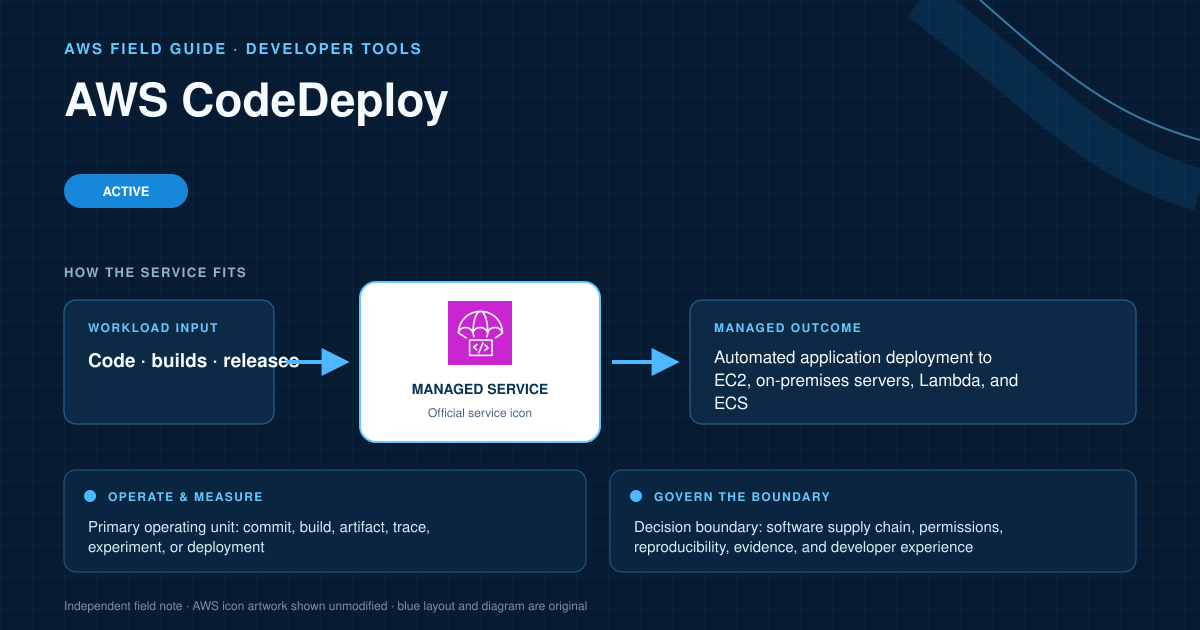
Posted in Developer Tools | Tagged: , , , , | Leave a Comment »

AWS CloudShell Deep Dive: Architecture, Security, Cost & Operations

Posted by Sriram Sanka on August 18, 2026

AWS CloudShell architecture diagram
AWS CloudShell architecture and operating-boundary overview.

AWS CloudShell provides authenticated browser shells with AWS tooling and short-lived environments. This deep dive frames the service as an operating model: the resources it manages, the control and data paths it creates, the responsibilities that remain with customers, and the evidence required before it becomes a production dependency.

Authenticated browser shells with AWS tooling and short-lived environments
Primary operating unit: commit, build, artifact, trace, experiment, or deployment
Decision boundary: software supply chain, permissions, reproducibility, evidence, and developer experience
Field note 01

The short version

AWS CloudShell provides authenticated browser shells with AWS tooling and short-lived environments. This deep dive frames the service as an operating model: the resources it manages, the control and data paths it creates, the responsibilities that remain with customers, and the evidence required before it becomes a production dependency.

Adopt AWS CloudShell when authenticated browser shells with AWS tooling and short-lived environments is an enduring workload requirement and the managed boundary removes work your organization does not need to differentiate. The service decision should be based on measurable behavior and ownership, not catalog breadth. A proof must exercise the hardest integration, the most credible failure, the security boundary, and the dominant unit-cost driver before the design is standardized.

The practical decision is not whether AWS CloudShell is powerful. It is whether its operating model fits the system and the team. It is best suited to workloads that explicitly need authenticated browser shells with AWS tooling and short-lived environments; teams prepared to operate the surrounding identity, network, data, telemetry, delivery, and recovery controls; and platforms that can measure each commit, build, artifact, trace, experiment, or deployment. It is usually a poor fit for systems whose requirement can be met by an external developer platform or a narrower AWS-native workflow; teams without an accountable service owner; or designs that cannot explain software supply chain, permissions, reproducibility, evidence, and developer experience before production traffic arrives. That boundary should be written into the architecture decision so later growth does not turn an intentional choice into accidental lock-in.

Field note 02

Build the right mental model

Think of AWS CloudShell as a managed control plane around each commit, build, artifact, trace, experiment, or deployment. The service accepts desired state, policy, configuration, or workload input, then coordinates AWS-owned infrastructure to deliver authenticated browser shells with AWS tooling and short-lived environments. The exact managed boundary varies by feature and region, but the architectural pattern is stable: management APIs change configuration, resource policies and IAM decide who may act, service endpoints carry production work, telemetry reports selected behavior, and quotas bound how quickly the system can grow. Customer data, application correctness, access choices, downstream dependencies, and business recovery remain customer concerns even when infrastructure replacement is automated.

A production implementation begins with account and region placement, least-privilege administrative and runtime roles, network reachability, encryption ownership, quotas, logging, tags, and configuration expressed as code. For AWS CloudShell, define the authoritative resource model, immutable or versioned deployment unit, and the path from a reviewed change to active service behavior. Identify asynchronous operations, eventual consistency, retry semantics, deletion behavior, and every resource created indirectly. Record which actions are safe to repeat, which require a change window, and which can cause data loss or customer-visible interruption.

Separate the control plane from the data plane in both design and incident response. The control plane creates configuration and desired state; the data plane carries production work. A deployment API succeeding does not prove that traffic, jobs, or events are healthy. Conversely, a transient control-plane problem should not automatically stop already-running work. Document which APIs are needed during steady state, which are needed only for change, and which dependencies sit on the critical request path.

Make ownership boundaries visible. Identity, network reachability, encryption keys, artifacts, telemetry, quotas, and billing dimensions frequently belong to different teams. A service can be technically managed while the surrounding system remains unmanaged. Name an owner for the application, the platform configuration, the data, the recovery procedure, and the cost model. That simple map prevents the most common failure mode in cloud programs: assuming an abstraction transferred a responsibility that it only moved.

Field note 03

Where it earns its keep

The strongest AWS CloudShell architectures begin with a workload whose constraints align with the service. The following patterns are starting points, not product marketing categories. Each still needs an explicit data model, failure model, and ownership model.

Do not choose a cloud service from the deployment demo alone. A demo proves that the happy path exists; an architecture decision must explain day-two change, degraded dependencies, recovery, security evidence, and cost under real load. For AWS CloudShell, those questions reveal whether the service removes undifferentiated work or merely postpones it.

  • Primary production pattern: Use AWS CloudShell where authenticated browser shells with AWS tooling and short-lived environments is on the critical path and the team can own the surrounding controls.
  • Governed shared capability: A platform team can package identity, policy, telemetry, cost allocation, and recovery defaults for multiple consumers.
  • Migration or modernization: Adopt the managed boundary incrementally while preserving data validation, rollback, and an explicit exit path.
Field note 04

Architecture moves that age well

A useful reference architecture is a set of constraints with reasons, not a diagram crowded with service icons. Start with the moves below, assign an owner to each, and encode the ones that can be enforced. Exceptions should include an expiration date and a test that proves why the normal path does not work.

Start capacity work with a workload model rather than a product limit table. Capture arrival rate, concurrency, duration, payload size, state size, latency objective, recovery objective, and acceptable interruption. Measure percentiles and saturation, not just averages. Then test the model with production-like traffic and failure injection. Service quotas are guardrails and ceilings; they are not a substitute for understanding how a dependency behaves as demand approaches its own boundary.

  • Define the authoritative AWS CloudShell resource model and provision it from reviewed, versioned configuration.
  • Measure capacity, latency, failure, and cost per commit, build, artifact, trace, experiment, or deployment under production-shaped load.
  • Separate administrative, deployment, and runtime identities and centralize evidence outside the workload boundary.
  • Test restoration or replacement and document the requirement that would trigger an exit from AWS CloudShell.
Field note 05

Scaling and performance

AWS CloudShell capacity should be planned from the arrival rate and shape of each commit, build, artifact, trace, experiment, or deployment, not from an average utilization graph. Model steady load, bursts, backlog, object or payload size, concurrency, retention, dependency ceilings, and regional quotas. Separate a control-plane request being accepted from capacity becoming usable. Measure provisioning, warm-up, propagation, and recovery time. Where scaling is automatic, set guardrails that protect downstream systems and budgets. Where it is manual, define leading indicators and enough headroom for failure plus deployment overlap.

Start capacity work with a workload model rather than a product limit table. Capture arrival rate, concurrency, duration, payload size, state size, latency objective, recovery objective, and acceptable interruption. Measure percentiles and saturation, not just averages. Then test the model with production-like traffic and failure injection. Service quotas are guardrails and ceilings; they are not a substitute for understanding how a dependency behaves as demand approaches its own boundary.

Performance tuning must preserve correctness. Optimize the slowest meaningful business path, verify the change against a representative distribution, and watch for work displaced into queues, retries, caches, or operators. With AWS CloudShell, a lower service-level latency can still create a worse system if downstream saturation, recovery backlog, or cost per completed transaction rises. Keep load-test artifacts and capacity assumptions versioned beside the architecture.

Field note 06

Security and governance

Secure AWS CloudShell through explicit trust boundaries. Separate human administration, deployment automation, and runtime access; narrow actions and resources; use short-lived credentials; and apply organization guardrails to public exposure, deletion, cross-account sharing, and encryption changes. Protect data in transit and at rest with a documented key model. Send audit and security evidence to a boundary the workload cannot rewrite. Validate untrusted names, payloads, metadata, and configuration even when they arrive through an AWS integration. Treat service-linked roles, resource policies, grants, endpoints, and delegated administration as production code.

Use least privilege as an engineering process, not a one-time IAM document. Begin with separate human, deployment, and runtime identities. Observe required actions, narrow resources and conditions, and add explicit organization guardrails for high-impact operations. Encrypt data in transit and at rest, but also design key ownership, rotation, deletion protection, and break-glass access. Centralize audit records in an account and storage boundary that a compromised workload cannot rewrite.

Threat-model AWS CloudShell across four surfaces: the management API, the workload’s runtime identity, the network and event inputs that reach it, and the software or configuration artifact that is deployed. Add the data stores and observability pipeline as separate trust boundaries. Preventive controls reduce the reachable state space; detective controls shorten time to evidence; recovery controls make destructive events survivable. A mature design has all three and tests them independently.

Governance should make the secure path faster. Provide approved modules, narrowly scoped roles, standard encryption and logging defaults, ownership tags, and automated evidence. Block dangerous configurations at the organization or pipeline boundary when the intent is unambiguous. Leave application teams enough room to tune the workload without letting every team invent identity, ingress, logging, and incident access from scratch.

Field note 07

Reliability and recovery

Reliability for AWS CloudShell is the ability to preserve the intended business outcome when a zone, region, dependency, credential, quota, configuration, or operator action fails. Determine which components are regional or zonal and which state is durable, replicated, restorable, or reproducible. Set recovery-time and recovery-point objectives, then build the smallest mechanism that meets them. Test throttling, unavailable capacity, partial completion, duplicate delivery, stale configuration, corrupted input, telemetry loss, and recovery into an isolated environment. A multi-AZ service does not make a single-region or single-account application automatically recoverable.

Define failure in business terms before selecting a recovery mechanism. Availability, durability, recovery time, and recovery point are different objectives. Multi-zone placement improves some infrastructure failures but does not repair corrupt deployments or deleted data. Backups address some data events but do not guarantee a runnable application. Use layered controls: health-based replacement, redundancy, deployment rollback, data protection, quota monitoring, and a rehearsed regional or organizational recovery path where the business requires one.

Write failure-mode tests for AWS CloudShell before the first serious incident. Include unavailable capacity, throttled control APIs, expired credentials, bad configuration, dependency timeout, partial deployment, telemetry loss, and operator error. Test what happens to in-flight work, how the system detects the condition, who is paged, and how replay or rollback avoids duplicate effects. Recovery time measured in a game day is more credible than recovery time copied from a diagram.

Keep the recovery path simpler than the primary path. If restoration depends on the same identity, network, artifact repository, region, or specialist that the incident removed, it is not independent. Store runbooks where responders can reach them, pre-authorize narrowly scoped emergency actions, and verify backups by restoring into an isolated environment. Record the achieved recovery point and time so business owners can compare evidence with policy.

Field note 08

Cost and capacity economics

Model AWS CloudShell with a unit that finance and engineering both understand: cost per commit, build, artifact, trace, experiment, or deployment. Include baseline resources, request or execution charges, storage and retention, logs, network transfer, cross-zone or cross-region movement, encryption and security services, backups, support, licenses, and operator time. Build expected and stress scenarios, attach owners to long-lived resources, and alarm on abnormal unit cost. Remove waste and rightsize before purchasing commitments. Preserve the capacity and retention margins required by the reliability objective instead of treating every idle byte or spare unit as waste.

Evaluate unit economics at the level customers consume: cost per request, job, simulation, tenant, build, or environment. Tagging helps allocation, but architecture determines most spend. Include idle baseline, burst premium, storage growth, log retention, data transfer, support, licenses, and operator time. Rate discounts should follow rightsizing and workload-shape work. A commitment applied to the wrong baseline converts an optimization opportunity into a contract.

Create a cost model for AWS CloudShell with a low, expected, and stress scenario. Tie every variable to a measurable workload characteristic and identify which team can influence it. Alarm on anomalous unit cost as well as total spend; total spend naturally rises with successful products, while unit cost exposes architectural drift. Review unused capacity and retained artifacts on a schedule, and give every long-lived resource an owner and lifecycle policy.

Optimization should preserve reliability margins. Removing all idle capacity, shortening every retention period, or consolidating every boundary may lower a spreadsheet while increasing incident probability and recovery time. Price the resilience requirement explicitly. Then apply the least risky lever first: eliminate waste, rightsize, improve utilization, reduce unnecessary transfer, select the correct purchasing model, and only then make longer commitments.

Field note 09

Operating it in production

Operate AWS CloudShell as a product with a named owner, versioned modules, approved defaults, dashboards, runbooks, lifecycle reviews, and an exception process. Monitor customer symptoms and service saturation together. Track change success, quota headroom, access exceptions, failed operations, recovery evidence, spend, and AWS lifecycle announcements. Provide developers a paved contract that hides repetitive configuration without hiding state. Review incidents and near misses monthly until routine replacement, rollback, replay, access recertification, and recovery are boring and evidenced.

Treat configuration as versioned product code. Changes should pass static checks, policy checks, integration tests, and an environment that resembles production. Promote the same artifact; do not rebuild it differently at every stage. Prefer gradual exposure, observable health gates, and automated rollback for reversible changes. For irreversible data or identity changes, use expansion-and-contraction patterns and explicit checkpoints. Record who changed what, why, and which measured signal declared the change safe.

Build one operational view that links AWS CloudShell health to customer outcomes. Infrastructure metrics explain resources, application metrics explain behavior, traces explain selected paths, and logs provide detailed evidence. None is sufficient alone. Define symptom-based alerts around availability, latency, backlog, freshness, correctness, and saturation; route them to an accountable team; and attach the first diagnostic action. Remove alerts that never change a decision.

Run a monthly service review until the platform is boring. Examine incidents, near misses, failed changes, quota headroom, runtime or image lifecycle, cost per unit, access exceptions, recovery evidence, and support announcements. Convert repeated manual actions into automation only after the team understands the decision being automated. Good operations reduce surprise without hiding state from the people accountable for it.

Field note 10

Failure patterns to avoid

Most expensive mistakes are reasonable shortcuts that survived beyond their original context. Treat these risks as design-review prompts. Ask which control detects each condition, how quickly the team can recover, and whether the workload can be moved or reshaped before the risk becomes a constraint.

A risk register is useful only when it changes action. Give each item an owner, leading indicator, mitigation, and review date. If a risk is accepted, record the business reason. If it is mitigated, test the mitigation. If it is transferred to a managed service, verify the exact responsibility that moved instead of assuming the service name moved all of it.

  • The team assumes AWS CloudShell transfers application, data, or recovery responsibility that remains with the customer.
  • Automatic scale reaches a quota or overwhelms a downstream dependency before alerts explain the symptom.
  • Manual console changes create drift from the reviewed configuration and weaken incident reconstruction.
  • A lifecycle, pricing, regional, or feature change is discovered only after the architecture depends on it.
Field note 11

Alternatives and the decision

Compare AWS CloudShell with an external developer platform or a narrower AWS-native workflow using the same workload, security assumptions, recovery target, and cost horizon. A managed service can reduce infrastructure labor while increasing product-specific policy, integration, and exit work. Portability of data formats or APIs does not guarantee portability of identity, monitoring, automation, or operating knowledge. The strongest decision states what AWS CloudShell uniquely contributes, what the organization still owns, and which changed requirement would trigger a different platform.

AWS CloudShell is a sound choice when the requirement for authenticated browser shells with AWS tooling and short-lived environments is concrete, the managed boundary is understood, and the team can operate the complete system around it. Start with a production-shaped proof, constrain variation, automate safe defaults, and retain an exit path through portable data, documented configuration, and reproducible artifacts. If the service is marked preview, changing, renamed, or retired, treat availability and lifecycle constraints as first-class architecture inputs rather than documentation footnotes.

Use a short proof of architecture when uncertainty is material. Test the hardest requirement, the most important failure mode, and the expected cost driver—not another hello-world deployment. Compare AWS CloudShell with the strongest alternative using the same workload and evidence. Record the decision, rejected options, assumptions, migration trigger, and date for review. Architecture remains healthy when a future team can understand both why the choice was correct and which changed fact would make it wrong.

Field note 12

A pragmatic 90-day adoption plan

Days 1–15: define the workload and responsibility map. Capture traffic or job shape, data sensitivity, availability and recovery objectives, latency, unit economics, dependencies, regional constraints, and team ownership. Build a thin threat model and request quota changes early. Select one representative path for the proof, not the easiest path. Establish a clean account, identity, network, artifact, encryption, and logging baseline before application convenience creates permanent exceptions.

Days 16–35: implement a production-shaped walking skeleton on AWS CloudShell. Provision it from code, deploy an immutable artifact, integrate one real dependency, emit structured telemetry, and prove that a new team member can reproduce the environment. Exercise duplicate work, bad input, dependency timeout, and lost capacity. Measure cold and warm behavior where relevant, saturation, recovery backlog, and cost per successful business unit.

Days 36–60: harden delivery and recovery. Add policy checks, staged promotion, rollback or replacement, least-privilege runtime identity, secret rotation, data protection, retention, and symptom-based alerts. Restore from backup or recreate from artifacts in an isolated environment. Run a game day that includes an operator mistake and a compromised credential. Convert the findings into platform defaults and owned backlog items rather than a slide deck.

Days 61–90: place controlled production load on the service, review evidence with security, finance, and operations, and compare observed behavior with the original decision. Publish a paved-road module, dashboard, runbook, and exception process. Set capacity and cost review thresholds. Finally, write the exit criteria: the scale, feature, compliance need, economics, or organizational change that would trigger a move away from AWS CloudShell. A reversible decision is easier to make well.

Posted in Developer Tools | Tagged: , , , , , , , , , , , | Leave a Comment »