Not Just Databases

  • Enter your email address to follow this blog and receive notifications of new posts by email.

  • Total Views

    • 732,259 hits
  • $riram $anka

    Unknown's avatar
    The experiences, Test cases, views, and opinions etc expressed in this website are my own and does not reflect the views or opinions of my employer. This site is independent of and does not represent Oracle Corporation in any way. Oracle does not officially sponsor, approve, or endorse this site or its content.Product and company names mentioned in this website may be the trademarks of their respective owners.

Archive for the ‘Uncategorized’ Category

Script To Generate Alter Statements to Kill Locked Sessions in RDS

Posted by Sriram Sanka on May 28, 2021


Script to generate Kill Locked Sessions in Oracle :

In case of RDS ,

SELECT 'exec rdsadmin.rdsadmin_util.kill('||s.sid ||','|| s.serial# ||' );'
FROM v$session s ,
v$process p ,
v$lock l ,
dba_objects o
WHERE
s.paddr = p.addr
AND l.sid = s.sid
AND l.id1 = o.object_id
AND s.username = 'XXAPPS' --- Change as needed.
AND object_name like ('XXSC%'); --- Change as needed.

Posted in Uncategorized | Leave a Comment »

FRM-10102: Cannot attach PL/SQL library

Posted by Sriram Sanka on May 27, 2021


When you try to Open R12 Form template fmb files in Oracle forms, you may receive FRM-10102: Cannot attach PL/SQL library APPCORE .

Unable to open Template.fmb. Getting following error

FRM-10102: Cannot attach PL/SQL library APPCORE. This library attachment will be lost if the module is saved.
FRM-10102: Cannot attach PL/SQL library APPDAYPK. This library attachment will be lost if the module is saved.
FRM-10102: Cannot attach PL/SQL library GLOBE. This library attachment will be lost if the module is saved.
FRM-10102: Cannot attach PL/SQL library FNDSQF. This library attachment will be lost if the module is saved.
FRM-10102: Cannot attach PL/SQL library JA. This library attachment will be lost if the module is saved.
FRM-10102: Cannot attach PL/SQL library JE. This library attachment will be lost if the module is saved.
FRM-10102: Cannot attach PL/SQL library JL. This library attachment will be lost if the module is saved.
FRM-10102: Cannot attach PL/SQL library VERT. This library attachment will be lost if the module is saved.
FRM-10102: Cannot attach PL/SQL library GHR. This library attachment will be lost if the module is saved.
FRM-10102: Cannot attach PL/SQL library PQH_GEN. This library attachment will be lost if the module is saved.
FRM-10102: Cannot attach PL/SQL library PSAC. This library attachment will be lost if the module is saved.

Solution : Set the Path for FORMS_PATH with the location of all core libraries(pll files).

Posted in Uncategorized | Leave a Comment »

Apache – No space left on device / Failed to create proxy Mutex

Posted by Sriram Sanka on August 10, 2018


A Big Thanks to “https://help.directadmin.com/item.php?id=110

Restarting  Apache in one of the Servers failed with “No Space left on the Device ” Error and we have enough space in all available partitions.

This is something to deal with Server Kernel semaphores.

“On Linux, A semaphore is a System V IPC object that is used to control utilization of a particular process. Refer https://www.tldp.org/LDP/tlk/ipc/ipc.html

Semaphores are a shareable resource that take on a non-negative integer value. They are manipulated by the P (wait) and V (signal) functions, which decrement and increment the semaphore, respectively. When a process needs a resource, a “wait” is issued and the semaphore is decremented. When the semaphore contains a value of zero, the resources are not available and the calling process spins or blocks (as appropriate) until resources are available. When a process releases a resource controlled by a semaphore, it increments the semaphore and the waiting processes are notified.”

The system does n`t have actual resource available to serve the request, so either we need to configure the Kernel Semaphores or clear the Old entries to get it back.

kernel.sem = SEMMSL SEMMNS SEMOPM SEMMNI

SEMMSL      maximum number of semaphores per array
SEMMNS     maximum semaphores system-wide
SEMOPM     maximum operations per semop call
SEMMNI      maximum arrays

[root@r12 ~]# cat /etc/sysctl.conf |grep kernel.sem
kernel.sem = 256 32000 100 142
[root@r12 ~]#

[root@r12 ~]# cat /proc/sys/kernel/sem
256 32000 100 142
[root@r12 ~]#

[root@r12 ~]# ipcs -l | awk ‘FNR>=7 && FNR<=15’

—— Semaphore Limits ——–
max number of arrays = 142
max semaphores per array = 256
max semaphores system wide = 32000
max ops per semop call = 100
semaphore max value = 32767

—— Messages: Limits ——–
[root@r12 ~]#

[root@r12 ~]# ipcs -ls

—— Semaphore Limits ——–
max number of arrays = 142
max semaphores per array = 256
max semaphores system wide = 32000
max ops per semop call = 100
semaphore max value = 32767

To Clear ,  we can execute the following

ipcs | grep apache | awk ‘{print $2}’ > sem.txt
for i in `cat sem.txt`; do { ipcrm -s $i; }; done;

For Automating the removal of apache semaphores with ipcs/ipcrm, Please refer https://help.directadmin.com/item.php?id=572

Posted in Uncategorized | Tagged: , , | Leave a Comment »

Applying WLS patch using BSU -java.lang.OutOfMemoryError: GC overhead limit exceeded

Posted by Sriram Sanka on July 8, 2018


If you are trying to Apply any Big Patch, while Checking for conflicts…., “BSU”  might end-up with Java Heap  Errors.


To Avoid,  Try to Increase the size in $FMW_Home/utils/bsu . Edit bsu.sh using any editor as below. 

Change the Value MEM_ARGS=”-Xms256m -Xmx512m” to MEM_ARGS=”-Xms1024m -Xmx1024m” or even bigger  and save. 

This will resolve the above issue and re-try applying the patch .


For more Details Ref Oracle MOS Doc:  Weblogic 10.3.6 Patching Error Using BSU – “java.lang.OutOfMemoryError: GC overhead limit exceeded” (Doc ID 2007492.1) and 

Enhancement for WLS BSU (Smart Update): Resolves Very Long Time to Apply Patches – Especially When Checking for Patch Conflicts (Doc ID 2271366.1)


Posted in Web Logic Server | Leave a Comment »

Oracle Internals – Memory structures (arrays) – Part 1

Posted by Sriram Sanka on January 19, 2018


Dynamic Performance Views

Oracle contains a set of underlying views that are maintained by the database server and accessible to the database administrator user SYS. These views are called dynamic performance views because they are continuously updated while a database is open and in use, and their contents relate primarily to performance.

Although these views appear to be regular database tables, they are not. These views provide data on internal disk structures and memory structures. You can select from these views, but you can never update or alter them.

Screen Shot 2018-01-19 at 10.50.09 AM

https://docs.oracle.com/cd/B28359_01/server.111/b28320/dynviews_1001.htm#i1398692

There are two types of views,  

  • V$ Views
  • GV$ Views

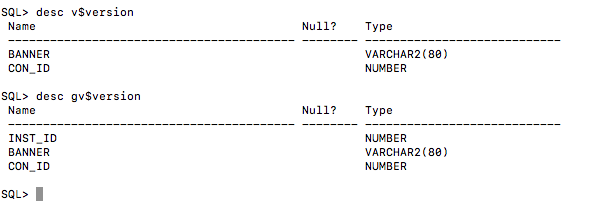
Almost For Every V$ View there is a GV$View which will hold the instance specific Information in a Multi Instance Environment like RAC.
Screen Shot 2018-01-19 at 10.33.49 AM

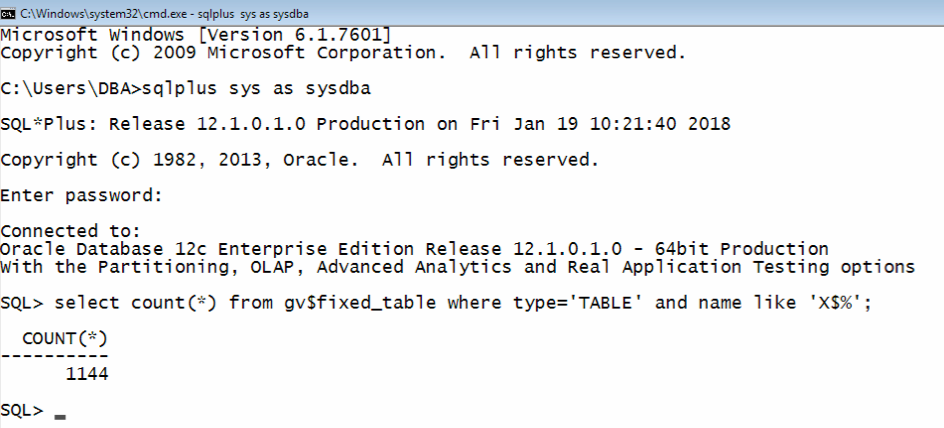
These Dynamic Views are owned by Sys User and These views are constructed based on the Oracle Internal Memory Structures (X$ Tables/Views). We cannot alter or Update on these views. These X$ structure Get Created when the Instance started and Will get destroyed when you shutdown the DB.  

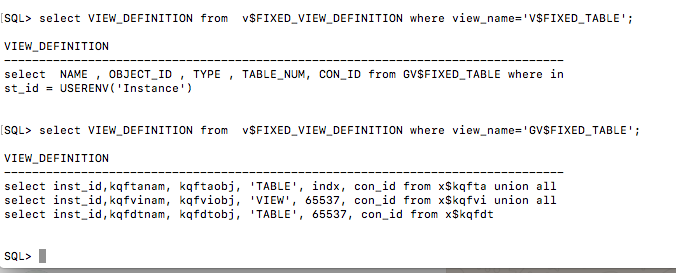
V$FIXED_VIEW

V$FIXED_TABLE displays all dynamic performance tables, views, and derived tables in the database.

V$FIXED_VIEW_DEFINITION

This  View contains the definitions of all the fixed views (views beginning with V$). Use this table with caution. Oracle tries to keep the behavior of fixed views the same from release to release, but the definitions of the fixed views can change without notice.

As described in the Above Example, Dynamic Performance views are based on Internal Memory Structures X$.

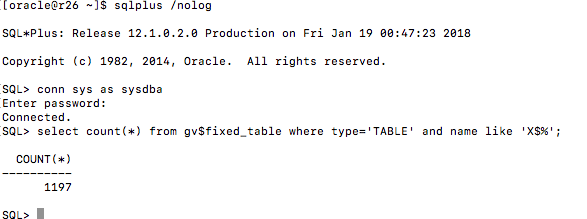
The X$ tables/views  are platform-specific & the No of tables are keep on increasing By Oracle Version.The Oracle kernel consists of layers. The X$ table names contain an abbreviation for the particular kernel layer.

The No#  Of Views are dependent on Oracle version and the OS Specific.
Screen Shot 2018-01-19 at 11.18.14 AM

Screen Shot 2018-01-19 at 10.24.17 AM

These Views Get populated only when the Instance Started. These Views Contains information about all the parameters,performance etc info. As We all know Oracle has documented some of Dynamic Views (V$_ objects) which are in handy to get the info from your instance these Dynamic Views are Based on GV$_ VIEWS which includes the data for Multiple Instances.  GV$ are Designed from these Fixed Views. View Columns might be similar from version to version where as Underlying Fixed X$ objects might different.
Screen Shot 2018-01-19 at 10.56.14 AM

Why do we call them “Fixed”?

As mentioned, All these Objects are owned by SYS and DDL or DML Operations are not permitted/supported on these. Even if we try to perform, Operation will end up with error ORA-02030: can only select from fixed tables/views.

Screen Shot 2018-01-19 at 10.50.09 AM

These objects contain information about the current configuration of the instance, information about the sessions connected to the instance, and a goldmine of performance information.  

Using Views like (g) v$fixed_view_definition  one can get the Actual Creation script of these Fixed views which are harmful in case of replacing the Existing or Create New views, which will end up with Errors or incorrect data as These Views are for Oracle not for Others. DBA/Developers should not create Objects using actual “V$_ “, they need to use v$ Objects instead of v$_ or X$, as The Definition of the base view may change in OS/DB software versions.   

The X$ views are completely undocumented, and Oracle does not provide any assistance for deriving the meaning of the contents of the X$ structures. since V$ views are dynamic and consistency is not guaranteed, Oracle does not support joins or sorts of dynamic views.  

The X$ views are an Oracle internal interface not exposed for customer use; customers should not be using it unless directed to do so by the support.Customer use without support guidance is unsupported.

Posted in Uncategorized | Leave a Comment »

oracle-e-business-suite-1227-now-available

Posted by Sriram Sanka on September 12, 2017


https://blogs.oracle.com/stevenchan/oracle-e-business-suite-1227-now-available

Posted in Uncategorized | Leave a Comment »

Error While invoking Discoverer Plus or Viewer 11g in a Single-node EBS Server

Posted by Sriram Sanka on August 10, 2017


Screen Shot 2017-08-10 at 6.15.32 PM
When you have Discoverer and EBS running on the same machine, this kind of conflicts may happen.

To resolve,
Start another session, clear All Environment Variables, restart the Web-logic Server Again. 

This will resolve the issue. For More Info, Refer

Unable to Access Discoverer Plus/Viewer 11g Installed On Server Having EBS 11i / R12 (Doc ID 1338244.1)


Posted in Uncategorized | Leave a Comment »

Error Opening 12.2.6 EBS URL

Posted by Sriram Sanka on May 22, 2017


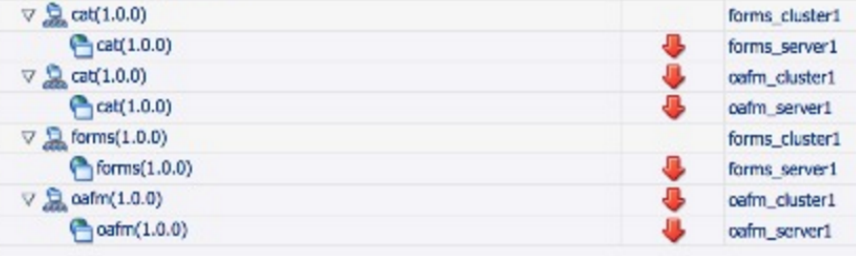
There was an error while Re-Starting Our Newly Configured Oracle R12.2.6 Application Instance after a Hard reboot. I was unable to start some of the Server Components like oacore, oafm and forms.   When I tried to start them Manually, There was No error and everything seems to be started Successfully, But I was unable to access the URL with Below Error.


” Error 404–Not Found From RFC 2068 Hypertext Transfer Protocol — HTTP/1.1: 10.4.5 404 Not Found The server has not found anything matching the Request-URI. No indication is given of whether the condition is temporary or permanent. If the server does not wish to make this information available to the client, the status code 403 (Forbidden) can be used instead. The 410 (Gone) status code SHOULD be used if the server knows, through some internally configurable mechanism, that an old resource is permanently unavailable and has no forwarding address. ”

This  is due to the failure of  oafm_server,Forms_server and oacore_server using EBS Startup scripts .Starting Using Web Logic Server Deployments as  below endup with Java Null Pointer Issues with state as”ADMIN”

“<Server ‘forms_server1’ in cluster ‘forms_cluster1′ is being brought up in administration state due to failed deployments.>

“(self-tuning)’> <<WLS Kernel>> <> <> <1417622780708> <BEA-149205> <Failed to initialize the application ‘oafm [Version=1.0.0]’ due to error java.lang.NullPointerException.
java.lang.NullPointerException
at java.io.File.<init>(File.java:251)
at oracle.apps.ad.util.AppStartupPropertyListener.preStart(AppStartupPropertyListener.java:89)
at weblogic.application.internal.flow.BaseLifecycleFlow$PreStartAction.run(BaseLifecycleFlow.java:290) ”


This is Due to the recent Change in Hosts file. My Database Lister Started with an Alias Name defined in the Host file and these Server Components were unable to start/connect to the Actual Host Defined.   Changing the Host Entry and restart of these Components  resolved the issue.

For More info Refer Below Oracle Metalink Document

After Cloning Unable To Start The Managed Servers In 12.2.4 (Doc ID 1952853.1)

Posted in Uncategorized | 3 Comments »

ORA-600:[kpdbModAdminPasswdInRoot: Not CDB] Oracle v 12.1.0.1

Posted by Sriram Sanka on April 22, 2016


While Attempting to use the SQLPLUS PASSWORD command to change password of an Oracle-supplied user in a non-CDB can result ORA-600 as below.

ora-600

There is a patch available for Linux Platform. Oracle Meta link Doc ID 1583225.1 has more info on the Patch.


Posted in Uncategorized | Tagged: | 2 Comments »

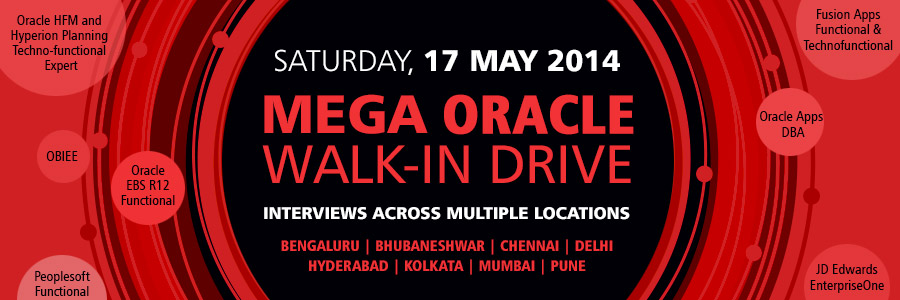
Mega Oracle Walk-In Drive on 17th May

Posted by Sriram Sanka on May 9, 2014


http://www.careers.tcs.com/CareersDesign/Jsps/OracleDrive/AboutTCS.html


OracleDrive17May2014-WalkinMicrositeBanner

Posted in Uncategorized | Leave a Comment »

 
Tales From A Lazy Fat DBA

Its all about Databases, their performance, troubleshooting & much more .... ¯\_(ツ)_/¯

Thinking Out Loud

Michael T. Dinh, Oracle DBA

Notes On Oracle

by Mehmet Eser

Oracle Diagnostician

Performance troubleshooting as exact science

deveshdba

get sum oracle stuffs

Data Warehousing with Oracle

Dani Schnider's Blog

ORASteps

Oracle DBA's Daily Work

DBAspaceblog.com

Welcome everyone!! The idea of this blog is to help the DBA in their daily tasks. Enjoy.

Anand's Data Stories

Learn. Share. Repeat.

Tanel Poder's blog: Core IT for geeks and pros

Oracle Performance Tuning, Troubleshooting, Internals

Yet Another OCM

Journey as an Oracle Certified Master

Neil Chandler's DB Blog

A resource for Database Professionals

DBA Kevlar

Tips, tricks, (and maybe a few rants) so more DBA's become bulletproof!

OraExpert Academy

Consulting and Training